Quranic Answer
In the comprehensive and balanced framework of Islam, particularly from the perspective of the Holy Quran, the concept of 'effect' and 'outcome' is dependent on various factors, of which prayer (Dua) and action (Amal) are two fundamental pillars. The answer to whether prayer without action has an effect requires a deep elucidation of the relationship between these two components. The Quran clearly emphasizes the importance of both, but not as separate or unrelated entities; rather, they are seen as two wings for achieving goals and success in this world and the Hereafter. In other words, Islam is a religion that values both the spiritual and heartfelt connection with God and stresses human effort, endeavor, and responsibility. Therefore, expecting miracles without any effort is not consistent with Quranic teachings. First, let's address the exalted status of prayer in the Quran. Prayer is not merely a verbal utterance or a passive request; it is a profound and sincere connection with the Creator of the universe. In the Holy Quran, Allah invites His servants to pray and promises to respond. In Surah Al-Baqarah, verse 186, He states: "And when My servants ask you, [O Muhammad], concerning Me - indeed I am near. I respond to the invocation of the supplicant when he calls upon Me. So let them respond to Me [by obedience] and believe in Me that they may be [rightly] guided." This verse shows that Allah responds to prayers, and prayer itself is an act of worship that leads to guidance. Furthermore, in Surah Ghafir, verse 60, Allah says: "And your Lord says, 'Call upon Me; I will respond to you.' Indeed, those who disdain My worship will enter Hell [rendered] contemptible." These verses clearly indicate the importance of prayer and Allah's promise to respond, demonstrating that prayer is one of the believer's most powerful tools for establishing a connection with God, seeking help, forgiveness, and guidance. Prayer can bring about spiritual tranquility, strengthen hope, and direct thoughts and intentions. However, alongside this emphasis on prayer, the Quran simultaneously insists on the necessity of 'righteous action' (Amal Salih) and human effort. This is where the concept of the 'effect' of prayer without action finds its true meaning. The Holy Quran strongly discourages idleness, laziness, and lack of effort, viewing success as a result of human endeavor and hard work. In Surah Ar-Ra'd, verse 11, we read: "Indeed, Allah will not change the condition of a people until they change what is in themselves." This verse explicitly states that change and improvement in circumstances depend on the human being's own change and effort. Expecting a change in circumstances from Allah without any effort from the servant contradicts this Quranic principle. This principle applies not only to internal and spiritual changes but also to external and practical ones. Furthermore, in Surah An-Najm, verses 39-41, Allah Almighty says: "And that there is not for man except that for which he strives. And that his striving will be seen. Then he will be recompensed for it with the fullest recompense." These verses clearly state that humans only possess the achievements and results of their own efforts, and every effort, whether small or large, will be observed and fully rewarded by Allah. This principle forms the basis of human responsibility and emphasizes the central role of 'action' in achieving outcomes. Therefore, from the Quranic perspective, prayer and action are not only compatible but are complementary. Prayer is a driving force that gives hope and motivation, illuminates the path, and warms the heart with divine grace and assistance. However, this motivation must be accompanied by practical movement and effort. For example, if a person is sick, their prayer for healing without consulting a doctor and taking medication, or at least making an effort to improve their physical condition, will rarely lead to the desired outcome. Or if someone prays for success in an exam, without studying and academic effort, their prayer alone will not suffice. These examples show that sincere prayer combined with intelligent effort can lead to the best results. The concept of 'Tawakkul' (reliance on Allah) in Islam also expresses this balance. Tawakkul means entrusting the outcome to Allah after exerting all efforts and capabilities, not abandoning work and waiting idly. The Prophet Muhammad (PBUH) said: "Tie your camel and then rely on Allah." This hadith clearly indicates that before relying on Allah, all necessary means and causes must be provided. Prayer also follows this rule; a prayer offered with sincere intention and alongside action has astonishing effects. These effects can include opening up difficult paths, granting insight for correct decision-making, increasing blessings in efforts, and strengthening patience and resilience in the face of difficulties. In conclusion, it can be said that prayer without action, although it may have spiritual effects such as peace and heartfelt connection, is not sufficient alone for achieving tangible worldly results and concrete changes. The full and desired effect of prayer is realized when it is accompanied by effort, endeavor, and the utilization of natural means and causes. The Holy Quran calls Muslims to an active and dynamic movement in which faith and action, prayer and effort, and reliance and striving find meaning together. This balance is the secret to individual and societal success within the Islamic value system and shows that Allah Almighty never wastes the reward of those who do good and strive.
Related Verses
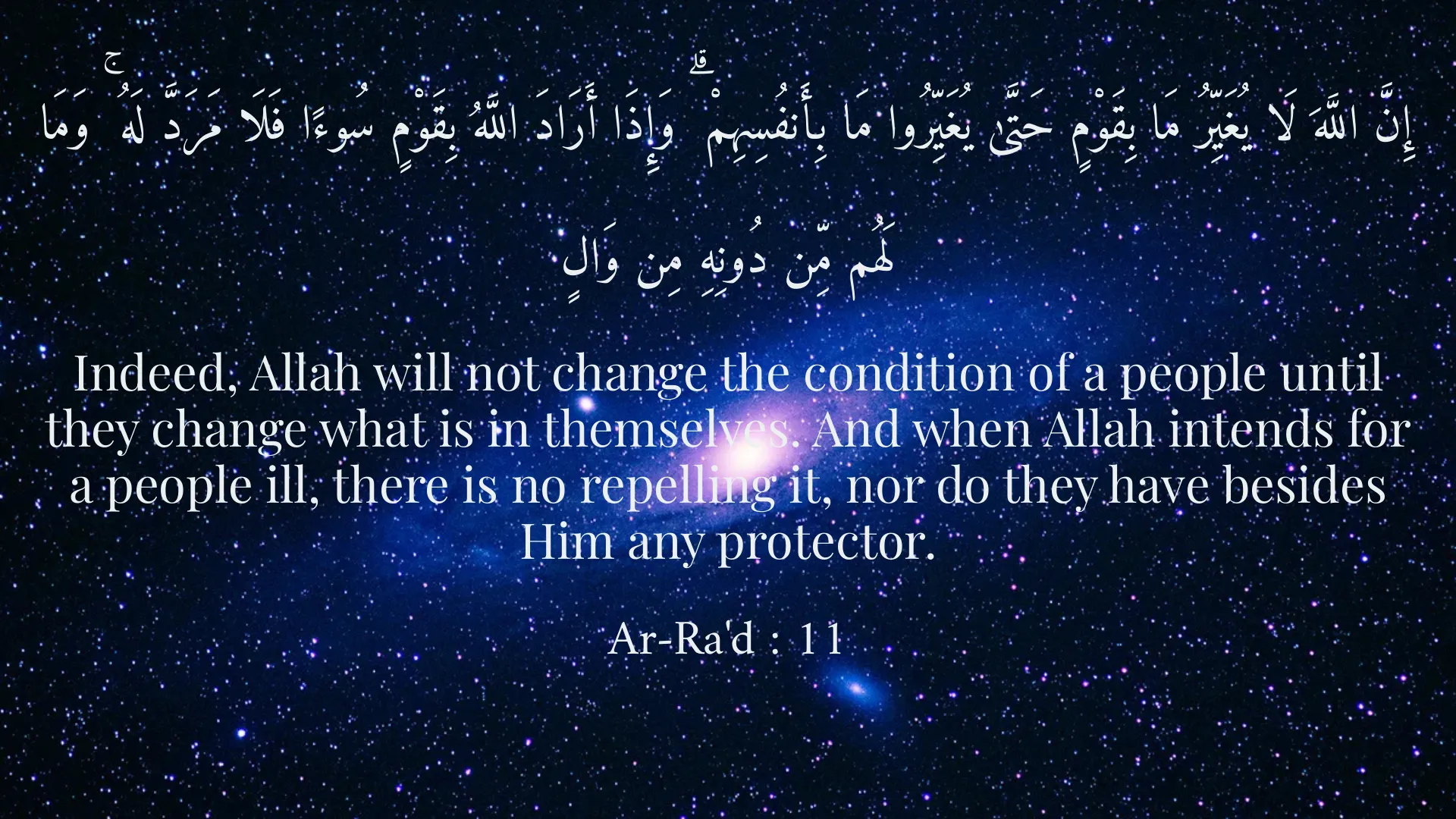
إِنَّ اللَّهَ لَا يُغَيِّرُ مَا بِقَوْمٍ حَتَّىٰ يُغَيِّرُوا مَا بِأَنفُسِهِمْ ۗ وَإِذَا أَرَادَ اللَّهُ بِقَوْمٍ سُوءًا فَلَا مَرَدَّ لَهُ ۚ وَمَا لَهُم مِّن دُونِهِ مِن وَالٍ
Indeed, Allah will not change the condition of a people until they change what is in themselves. And when Allah intends for a people ill, there is no repelling it, nor do they have besides Him any protector.
Ar-Ra'd : 11
وَأَن لَّيْسَ لِلْإِنسَانِ إِلَّا مَا سَعَىٰ
And that there is not for man except that for which he strives
An-Najm : 39
وَأَنَّ سَعْيَهُ سَوْفَ يُرَىٰ
And that his striving will be seen
An-Najm : 40
وَإِذَا سَأَلَكَ عِبَادِي عَنِّي فَإِنِّي قَرِيبٌ ۖ أُجِيبُ دَعْوَةَ الدَّاعِ إِذَا دَعَانِ ۖ فَلْيَسْتَجِيبُوا لِي وَلْيُؤْمِنُوا بِي لَعَلَّهُمْ يَرْشُدُونَ
And when My servants ask you, [O Muhammad], concerning Me - indeed I am near. I respond to the invocation of the supplicant when he calls upon Me. So let them respond to Me [by obedience] and believe in Me that they may be [rightly] guided.
Al-Baqarah : 186
Short Story
One day, a pious man was sitting in a corner, with his hands raised in prayer, asking God to provide for him from the unseen. He believed that prayer alone was sufficient and that he should not strive for worldly sustenance. A wise man passed by and saw him in that state. The wise man asked, "O dervish, why are you sitting idle and making no effort?" The man replied, "I have placed my trust in God, and I know He is the Sustainer, and whoever fears God, He will provide for them from where they do not expect." The wise man smiled gently and said, "You spoke well, but does an apple tree bear fruit if you don't plant a seed and water it? Does a bird find its sustenance without flying and searching? Trust in God does not mean ignoring means and causes; rather, it means that after exerting all your efforts, you entrust your heart to divine help. Know that God has placed a cause for every matter. When you exert effort and pray, God will answer your prayer and make the means available." So, the man took heed of the wise man's words, rose, and engaged in work, and he saw that both his prayer had an effect and his effort yielded results, and divine blessings came upon him.