Quranic Answer
Does prayer without heartfelt devotion have any benefit? This question delves into profound concepts of faith and the human relationship with the Creator, and its answer can be thoroughly explored in the light of the sublime teachings of the Holy Quran. The Quran, as a book of guidance for humanity, not only emphasizes the importance of supplication and prayer but is also very sensitive to the quality and spirit governing it. To understand the benefit of prayer without heartfelt devotion, we must address the essence of prayer and its primary purpose from a Quranic perspective. The Holy Quran, in numerous verses, emphasizes the necessity of heartfelt attention and pure intention (ikhlas) in acts of worship and supplications. Prayer is not merely a verbal utterance or a repetition of words; rather, its essence is a deep and intimate connection between the servant and the Creator. In Surah Al-A'raf, verse 55, Allah states: "Call upon your Lord humbly and privately; indeed, He does not like transgressors." The terms "tadarru'an" (humbly, with humility and earnestness) and "khufyatan" (privately, without showing off or hypocrisy) clearly point to the internal and heartfelt state of the supplicant. Tadarru' signifies expressing true helplessness and need from the depths of one's soul, and khufyah means avoiding ostentation and hypocrisy. These are states that cannot be achieved without heartfelt devotion and presence of mind. A prayer lacking these elements, though seemingly a string of words uttered, is spiritually and effectively deficient. This deficiency does not mean that no benefit whatsoever is gained, but rather that it misses the majority of the deep and primary benefits of prayer. Another key Quranic concept closely related to heartfelt devotion in prayer is "khushu'." Khushu' is a state of complete humility and submission of the heart before the majesty of God. Although khushu' is mostly discussed in the context of ritual prayer (Salat), such as in Surah Al-Mu'minun, verse 2: "Those who are in their prayers humbly submissive," this spirit of khushu' permeates all acts of worship, including supplication (Dua). A prayer performed with a humble heart and a mind attentive to God is a prayer that has spirit and ascends to the Divine Presence. Conversely, a prayer performed out of habit, inattentiveness, or merely as a duty will lack this spirit of khushu' and cannot be expected to have the same effectiveness and benefit as a sincere prayer from the depths of one's being. The Quran teaches us that Allah is near and responds to the supplicant's call, as stated in Surah Al-Baqarah, verse 186: "And when My servants ask you, [O Muhammad], concerning Me - indeed I am near. I respond to the invocation of the supplicant when he calls upon Me. So let them respond to Me [by obedience] and believe in Me that they may be [rightly] guided." The phrase "idha da'an" (when he calls upon Me) implies a true calling, stemming from need and longing, not merely the recitation of words. This phrase ties Allah's response to the quality of the calling and the heart's attention, meaning that divine acceptance, which is the highest benefit of prayer, is linked to the degree of sincerity and heartfelt focus. The primary benefit of prayer, beyond the fulfillment of a material need, includes spiritual and moral growth, strengthening of faith, inner peace, and a feeling of closeness to Allah. Prayer without heartfelt devotion might not be entirely devoid of benefit, particularly as a remembrance of Allah and a repetition of His name, for any divine remembrance, even if not with full presence of heart, still carries a light of divine mercy and at least prevents complete heedlessness. However, this benefit is incomparable to the benefit of a sincere prayer from the depths of one's soul. A prayer accompanied by heartfelt devotion builds a strong bridge between the servant and God; it purifies the soul, cleanses the heart from impurities, and brings a person closer to their divine nature. In this state, prayer is not merely a means of asking for something but is itself a goal and an ascension for the human soul. Indeed, the ultimate goal of prayer is to reach the station of servitude and utter dependence on Allah, meaning that one realizes their utmost need in the face of Allah's absolute self-sufficiency. This recognition and acknowledgment are impossible without heartfelt devotion and presence of heart. Allah states in Surah Az-Zumar, verse 3: "Unquestionably, for Allah is the pure religion." This purity permeates all aspects of religiosity, including prayer. A prayer without heartfelt devotion is like a body without a soul; although it has a form, it lacks true life and movement. Allah, in His grace and generosity, might respond to some prayers even if they lack complete presence of heart, but this would be out of divine favor, not due to the prayer's inherent perfection or deservedness. The main benefits of prayer, including increased faith, submission, contentment, patience in difficulties, and inner peace, are only realized through heartfelt devotion and sincerity. These benefits, which nourish the human heart and soul, require a deep and real connection that is only possible with the full presence of the heart. A prayer uttered merely out of habit or fear of punishment, without any heartfelt attention, although it might save an individual from being categorized as someone who abandons prayer, cannot bring about the spiritual transformation and divine proximity that is the main goal of worship. The Holy Quran teaches us that righteous deeds must be done for the "Wajh Allah," meaning for the sake of Allah and with complete sincerity, to be accepted. This sincerity is vital in our prayers and guarantees their effectiveness and profound benefit. In conclusion, it can be said that prayer without heartfelt devotion might not be entirely without benefit, but the benefit gained from it is far more limited and superficial than the benefit of a prayer from the depths of one's soul and with presence of heart. True prayer is the manifestation of the servant's poverty and need before the Creator's infinite richness, and this manifestation is not possible without heartfelt devotion and complete attention. Therefore, the Quran calls us to a prayer where not only words flow from the tongue but also the heart, with its entire being, accompanies the tongue, flying towards its Creator. It is in this flight that the pinnacle of benefit and blessing is achieved. The more devotion there is, the deeper the impact and the closer one becomes to Allah. This means not only that the likelihood of acceptance increases, but the prayer process itself transforms into a profound spiritual experience that internally changes the person and grants them a deeper understanding of Tawhid (Oneness of God) and His infinite power. Thus, the recommendation of the Quran and the practice of prophets and saints has always emphasized the necessity of the heart accompanying the tongue in all acts of worship, especially prayer, so that humanity may reach the highest levels of perfection and attain divine grace, being quenched from the endless ocean of divine mercy.
Related Verses
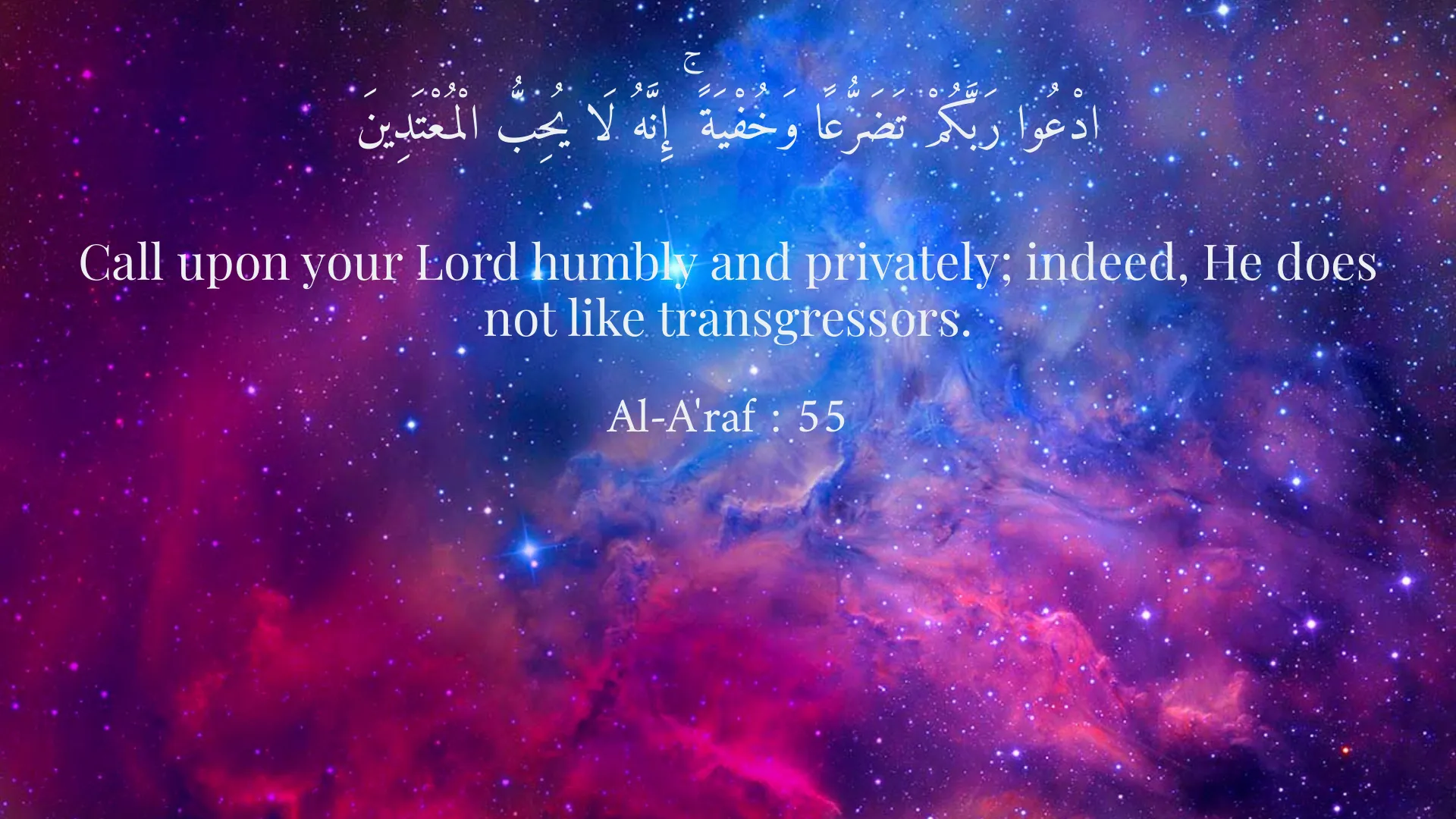
ادْعُوا رَبَّكُمْ تَضَرُّعًا وَخُفْيَةً ۚ إِنَّهُ لَا يُحِبُّ الْمُعْتَدِينَ
Call upon your Lord humbly and privately; indeed, He does not like transgressors.
Al-A'raf : 55
وَإِذَا سَأَلَكَ عِبَادِي عَنِّي فَإِنِّي قَرِيبٌ ۖ أُجِيبُ دَعْوَةَ الدَّاعِ إِذَا دَعَانِ ۖ فَلْيَسْتَجِيبُوا لِي وَلْيُؤْمِنُوا بِي لَعَلَّهُمْ يَرْشُدُونَ
And when My servants ask you, [O Muhammad], concerning Me - indeed I am near. I respond to the invocation of the supplicant when he calls upon Me. So let them respond to Me [by obedience] and believe in Me that they may be [rightly] guided.
Al-Baqarah : 186
الَّذِينَ هُمْ فِي صَلَاتِهِمْ خَاشِعُونَ
Who are in their prayers humbly submissive.
Al-Mu'minun : 2
أَلَا لِلَّهِ الدِّينُ الْخَالِصُ
Unquestionably, for Allah is the pure religion.
Az-Zumar : 3
Short Story
Once there was a king renowned for his piety, always presenting himself as devout and prayerful among the people. In public, he would perform prayers with great humility and recite long supplications, earning him much praise. However, in private, his heart was far from the essence of worship, and his actions were mostly for show and maintaining appearances. Saadi, the eloquent poet, beautifully states in his Gulistan: "Many there are who outwardly display piety, but in private they commit sins. The truly good person is one whose outer and inner selves are one." Eventually, the tides of time turned, and the king, who lacked sincerity, faced troubles, and his superficial prayers remained ineffective because they lacked heartfelt devotion and inner truth. This story teaches us that outward acts, without presence of heart and pure intention, hold no true value, for God looks into our hearts. The king realized that only with a present heart and devotion do prayers reach the Divine Presence and become effective. He understood that even if he uttered the words correctly, without a heartfelt connection, these words were merely empty sounds that would not ascend to the heavens.