Quranic Answer
In the rich and profound teachings of the Holy Quran, one of the most fundamental and central concepts is the principle of 'change from within'. This idea is not merely a moral recommendation but a divine and social law that forms the basis of any lasting and meaningful transformation, whether on an individual or collective level. The Quran explicitly states that any real and fundamental change must first begin from the depths of a person's being—from their heart, intention, thoughts, beliefs, and will. Without this internal metamorphosis, any external change will remain superficial, unstable, and ultimately fruitless. The core of this concept is encapsulated in Surah Ar-Ra'd, verse 11, which states: "Indeed, Allah will not change the condition of a people until they change what is in themselves." This noble verse articulates a foundational principle: Allah does not arbitrarily alter the destiny or state of any nation unless they initiate the change within themselves. This is a powerful message about human responsibility and free will. God does not whimsically change their condition from good to bad or bad to good without their own proactive efforts. Rather, it is human beings themselves who, by transforming their inner selves, lay the groundwork for external and divine changes. This change encompasses the transformation of corrupt beliefs, undesirable morals, wicked intentions, and harmful habits. Until these internal elements are rectified, superficial and externally imposed changes will not endure. Internal change in the Quran has various dimensions. One of the most significant is "Tazkiyat al-Nafs," or the purification and growth of the soul and self. Surah Ash-Shams, in verses 9 and 10, declares: "He has succeeded who purifies it, And he has failed who corrupts it." These verses clearly show that ultimate success and salvation are contingent upon the purification and growth of the self (the inner being of a person). Tazkiyat al-Nafs is a process through which an individual consciously strives to cleanse their heart of undesirable traits such as envy, arrogance, backbiting, lying, greed, and stinginess, and to adorn it with virtuous qualities like humility, patience, gratitude, trustworthiness, truthfulness, contentment, generosity, kindness, and love for God and His creation. This process is only possible through accurate self-awareness, honesty with oneself, sincere repentance (Tawbah Nasuhah), and continuous effort. Furthermore, the Quran frequently emphasizes the importance of "Niyyah" (intention). Intention is the underlying purpose and motivation behind every action. In Islam, the value and acceptance of deeds depend not only on the action itself but also on the intention behind it. If the intention is pure and solely for the pleasure of Allah, even small actions will yield immense reward, whereas if the intention is impure, even seemingly good deeds will become worthless. This illustrates that purifying one's inner self, particularly intentions, is a prerequisite for reforming outward actions. This emphasis on intention compels individuals to constantly look deep within themselves and examine the true motives of their deeds. The process of internal change is a lifelong spiritual and ethical journey. This journey requires "Muhasabat al-Nafs" (continuous self-assessment), "Muraqabah" (vigilant self-monitoring of thoughts and actions), and "Mujahadah" (struggle and striving against one's base desires). The greater jihad (Jihad al-Akbar) in Islam is not warfare against an external enemy but the struggle against the commanding self (Nafs al-Ammarah) and overcoming satanic whispers within oneself. Only those who triumph in this internal struggle can achieve success and tranquility in the external aspects of their lives. The impact of internal change extends beyond the individual to society as a whole. A society whose individuals are internally corrupt and spiritually ailing can never achieve lasting justice, peace, and progress. Administrative corruption, social injustice, dishonesty, betrayal, and oppression all have roots in the spiritual and moral diseases of individuals within that society. Therefore, every social reform movement and every fundamental societal transformation must first begin with the change of hearts and souls. The Holy Quran repeatedly emphasizes the importance of reconciling disputes (Islah Dhat al-Bayn) and preserving brotherhood and solidarity, all of which necessitate a sound heart and a pure soul. In conclusion, the Holy Quran teaches us that real, deep, and lasting change originates only from within. This transformation encompasses the purification of the heart, the rectification of intentions, the cleansing of the self, and the discipline of the will. This path is challenging yet profoundly blessed, leading not only to individual salvation but also laying the groundwork for building just, peaceful, and evolved societies. Allah Almighty extends His help only to those who actively embark on the path of self-reform and internal change. This is a firm promise that keeps hope alive in the heart of every seeker of perfection, guiding them towards self-actualization and transcendence.
Related Verses
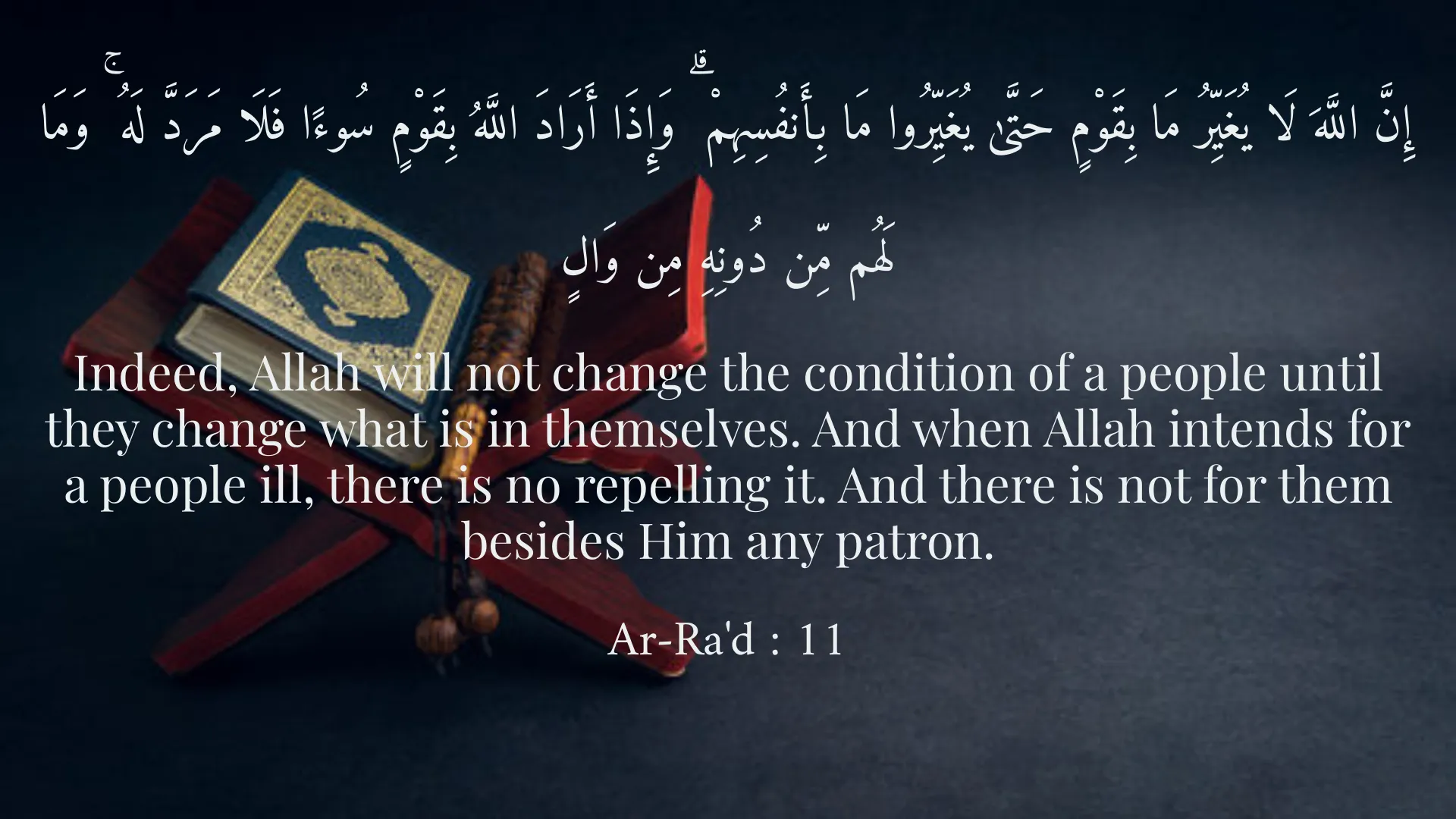
إِنَّ اللَّهَ لَا يُغَيِّرُ مَا بِقَوْمٍ حَتَّىٰ يُغَيِّرُوا مَا بِأَنفُسِهِمْ ۗ وَإِذَا أَرَادَ اللَّهُ بِقَوْمٍ سُوءًا فَلَا مَرَدَّ لَهُ ۚ وَمَا لَهُم مِّن دُونِهِ مِن وَالٍ
Indeed, Allah will not change the condition of a people until they change what is in themselves. And when Allah intends for a people ill, there is no repelling it. And there is not for them besides Him any patron.
Ar-Ra'd : 11
قَدْ أَفْلَحَ مَن زَكَّاهَا
He has succeeded who purifies it,
Ash-Shams : 9
وَقَدْ خَابَ مَن دَسَّاهَا
And he has failed who corrupts it.
Ash-Shams : 10
يَوْمَ لَا يَنفَعُ مَالٌ وَلَا بَنُونَ
The Day when neither wealth nor children will be of any benefit,
Ash-Shu'ara : 88
إِلَّا مَنْ أَتَى اللَّهَ بِقَلْبٍ سَلِيمٍ
Except for he who comes to Allah with a sound heart.
Ash-Shu'ara : 89
Short Story
One day, a powerful but troubled king awoke from his bed, finding no peace within himself. He pondered why, despite all his wealth and authority, he was constantly anxious. He summoned his ministers and physicians, but none knew the remedy for his ailment. Finally, he was told of an ascetic dervish living in a corner of the city, who might have the cure. The king went to the dervish and recounted his heart's distress. The dervish smiled and said: 'O King, if you wish your outer world to flourish, you must first cultivate your inner self. Cleanse your heart of greed and envy, and turn towards contentment and generosity. For the true treasure lies within your chest, not in your treasury.' The king took these words to heart. From then on, instead of accumulating more wealth, he focused on purifying his soul, showed kindness to his people, and found contentment in what he possessed. Not long after, a tranquility settled within him that he had never experienced before. He realized that real change begins from within, and the treasure of the heart is more precious than any other.