Quranic Answer
The concept of death is a profound and often sensitive subject, yet within the framework of many religions, and most notably in the Holy Quran, it is treated as an essential reality that affects the very essence of human life. The remembrance of death serves not only as a reminder of the inevitable end but also as a catalyst for spiritual and moral awakening within individuals. This article endeavors to delve deeper into the Islamic perspective on the remembrance of death and its implications for personal growth and character refinement. In Surah Al-Imran, verse 185, Allah states: 'Every soul will taste death, and surely those who strive in Our cause will be rewarded greatly.' This divine pronouncement underscores the universal inevitability of death, a reality that no person can escape. Understanding this truth encourages individuals to reflect on their actions and choices throughout their lives. The acknowledgment of death acts as a wake-up call, prompting believers to engage in righteous conduct and good deeds that align with the will of Allah. The exhortation to strive in His cause reveals that the recognition of mortality is not merely about fearing the end, but instead, it is about seeking purpose through mission-driven living. Furthermore, the awareness of death serves as a grounding influence against the excesses of arrogance and pride that often accompany material success and worldly achievements. In a society that may emphasize wealth, status, and power, the consciousness of mortality serves to remind individuals of their humble beginnings and inevitable endings. Engaging with the reality of death encourages humility, compassion, and a sense of social responsibility, which leads to a more fulfilling and meaningful existence. Moreover, the Quranic verses in Surah Al-Fajr, verses 27-30, provide a beautiful and comforting perspective on what comes after life: 'O tranquil soul! Return to your Lord, well pleased and pleasing.' Here, Allah speaks to the soul that has led a life of righteousness and has prepared for the afterlife. The phrase 'well pleased and pleasing' illustrates a profound relationship that the individual has with their Creator, one that is rooted in love, satisfaction, and mutual approval. The teachings of these verses reveal that the remembrance of death should not be a motive for despair, but rather an invitation to live life with intent and purpose. When one internalizes the inevitable nature of death, it becomes an impetus to optimize every moment of life, to engage in enriching experiences, and to cultivate relationships that matter. In essence, the awareness of death shapes individuals’ priorities, steering them towards actions that resonate with ethical and spiritual values, as opposed to empty pursuits. In many ways, the remembrance of death can serve as a motivational source for personal development. It pushes individuals to pursue higher spiritual objectives, inspiring a transformative journey towards self-betterment. When one reflects on the transient nature of worldly life, it often leads to a desire to contribute positively to society and to engage in acts of charity, kindness, and understanding. This pursuit creates an environment where individual growth aligns seamlessly with communal well-being. Additionally, the remembrance of death provides a framework through which individuals can focus on their ultimate purpose in life and the legacy they wish to leave behind. By considering how they wish to be remembered, individuals are guided towards making choices that reflect their values and beliefs. This perspective reflects a deeper understanding that life is not merely a series of events to be consumed but rather a sacred journey towards unity with the divine. The significance of death in Islamic teachings is multifaceted, pointing not only towards an end but also towards a new beginning in the hereafter. It offers believers a chance to reflect on their lives, consider their impact on those around them, and prepare their hearts and minds for eternity. In this light, the remembrance of death becomes a spiritual practice, a meditation that encourages mindfulness and intentional living. Through this lens, the act of remembering death blossoms into a celebration of life itself—a call to live fully, to remain grounded, and to give back to the community. Moreover, in Islamic traditions, one is encouraged to engage in Dhikr (remembrance of God) and to perform good deeds in remembrance of those who have passed away. Such practices create a bridge to the concept of death, encouraging a living connection to the memories we hold while simultaneously nurturing a spiritual discipline that calms the soul and affirms faith in the teachings of Islam. In conclusion, the remembrance of death, as highlighted in the Holy Quran, is not merely a call to reflect on the end of life, but rather an invitation to embrace it as an essential aspect of existence. It serves to elevate personal behaviors, guiding individuals toward spiritual and moral growth, and instilling in them an appreciation of life that transcends the material. By recognizing the transient nature of life and preparing for what lies beyond, individuals can lead a more profound and enriching existence, one that is connected to the divine and that strives for righteousness. Thus, the remembrance of death is fundamentally intertwined with the quest for spiritual ascent and moral integrity, reinforcing the idea that every action, every thought, and every intention count in the grand tapestry of life.
Related Verses
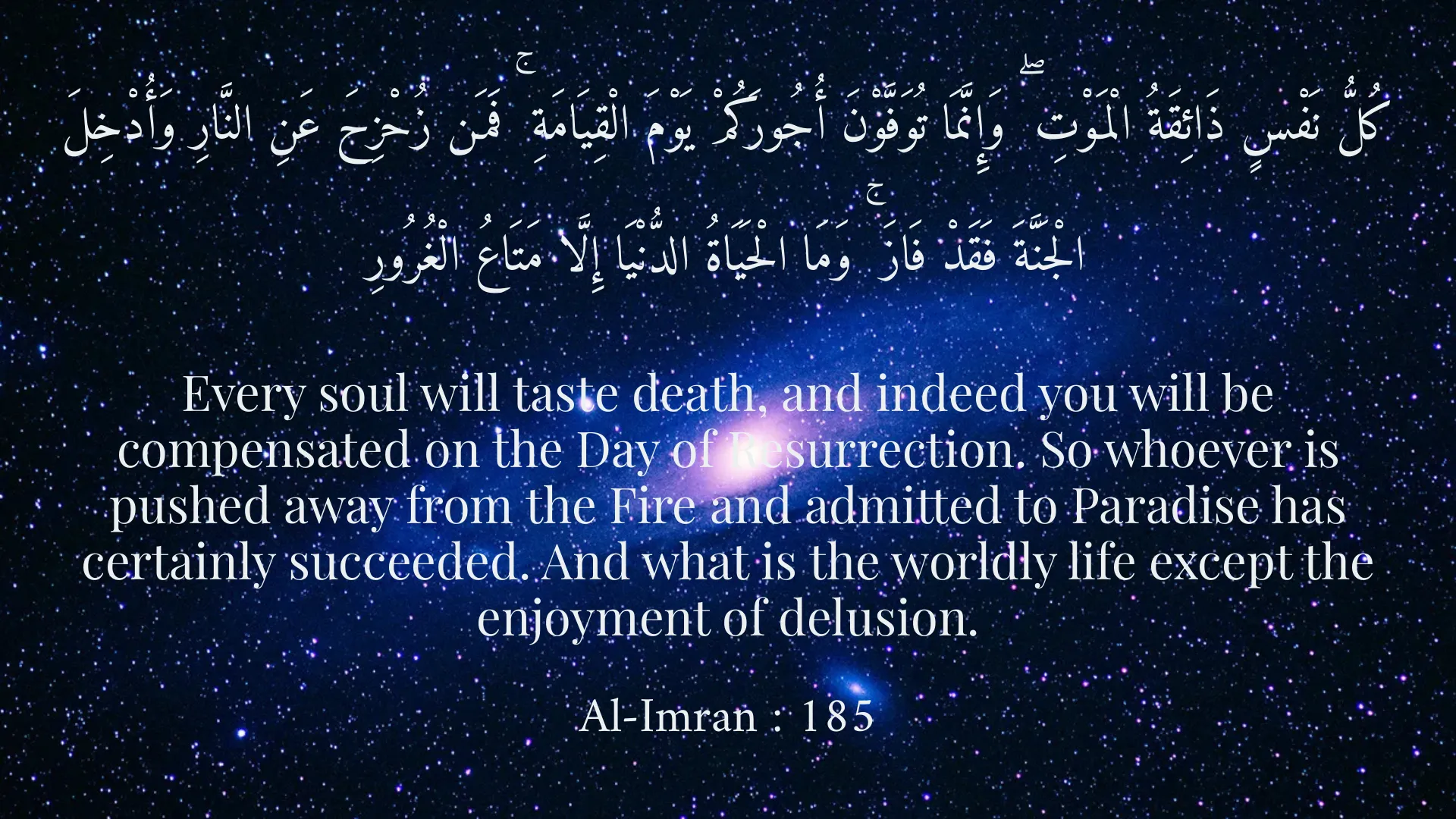
كُلُّ نَفْسٍ ذَائِقَةُ الْمَوْتِ ۖ وَإِنَّمَا تُوَفَّوْنَ أُجُورَكُمْ يَوْمَ الْقِيَامَةِ ۚ فَمَن زُحْزِحَ عَنِ النَّارِ وَأُدْخِلَ الْجَنَّةَ فَقَدْ فَازَ ۚ وَمَا الْحَيَاةُ الدُّنْيَا إِلَّا مَتَاعُ الْغُرُورِ
Every soul will taste death, and indeed you will be compensated on the Day of Resurrection. So whoever is pushed away from the Fire and admitted to Paradise has certainly succeeded. And what is the worldly life except the enjoyment of delusion.
Al-Imran : 185
يَا أَيَّتُهَا النَّفْسُ الْمُطْمَئِنَّةُ
O tranquil soul!
Al-Fajr : 27
فَادْخُلِي في عِبَادِي وَادْخُلِي جَنَّتِي
And enter among My righteous servants and enter My Paradise.
Al-Fajr : 30
Short Story
A friend was sitting by the sea, looking at the water. He remembered death and the blessings of life. He recalled the verses of the Quran and decided to keep God in mind more in his life. He understood that through a deeper understanding of life and death, he could become a better person. From that day on, he tried to be kinder to others in his life.