Quranic Answer
The question of whether seeking material success contradicts asceticism (Zuhd) is a topic that has been debated among Muslims for centuries, with various interpretations offered. To answer this question from the perspective of the Holy Quran, it is first necessary to provide a clear and precise definition of both 'material success' and 'Zuhd' within the framework of Islamic teachings. Material success refers to the acquisition of wealth, comforts, social status, and advancement in worldly affairs, achieved through lawful effort and work. On the other hand, Zuhd, which is not a direct Quranic word but a deeply rooted concept in the prophetic tradition and Islamic teachings, is often understood as a complete withdrawal from the world and its pleasures. However, this interpretation can be incomplete or even incorrect. True Zuhd in Islam means non-attachment of the heart to the world and its allurements, not necessarily abandoning worldly blessings. In other words, an ascetic (zaahid) is not someone who possesses no wealth, but rather someone whom wealth does not govern, whose heart is not enslaved by the world; instead, they use it as a means to achieve divine and eternal goals. With this understanding, it becomes clear that seeking material success, as long as it is pursued lawfully, with good intentions, and without forgetting the Hereafter and one's divine duties, not only does not contradict Zuhd but can even complement it. The Holy Quran explicitly encourages earning a lawful livelihood and striving for sustenance. In numerous verses, Allah calls upon humanity to work hard and benefit from His blessings. For instance, in Surah Al-Jumu'ah, verse 10, it states: “And when the prayer has been concluded, disperse within the land and seek from the bounty of Allah, and remember Allah often that you may succeed.” This verse clearly indicates that after performing prayers, believers should engage in activity to earn their livelihood. Furthermore, in Surah Al-Mulk, verse 15, we read: “It is He who made the earth subservient to you, so walk upon its regions and eat from His provision; and to Him is the resurrection.” These verses and similar ones not only permit the pursuit of material success but also present it as part of the divine plan for cultivating the earth and benefiting from its resources. Many prophets and great figures in Islamic history, including Prophet David (peace be upon him) who was a wealthy king and ate from the labor of his own hands, and Prophet Muhammad (peace be upon him) who engaged in trade, are clear examples of individuals who pursued worldly affairs while simultaneously being at the peak of asceticism and piety. Wealth and material success, if utilized in the path of Allah and for the service of humanity, can be a means to attain divine proximity and earn the pleasure of the Lord. Helping the needy, building mosques and charitable centers, supporting knowledge and education, and providing for family needs are all examples of the proper use of wealth, which are highly emphasized in Islam. On the other hand, true Zuhd means disinterest in worldly materialism and excessive love for worldly possessions, not disinterest in the world in its absolute sense. An ascetic is not someone who has nothing, but rather someone who, even if they possess wealth, their heart is not attached to it, and they are always ready to spend what they have in the way of Allah. Numerous Quranic verses condemn worldliness and excessive attachment to worldly manifestations. For example, in Surah Al-Hadid, verse 20, Allah says: “Know that the life of this world is only play and amusement, an adornment and boasting among yourselves, and competition in [accumulating] wealth and children – like the example of a rain whose [resulting] plant growth pleases the tillers; then it dries and you see it turned yellow; then it becomes [scattered] debris. And in the Hereafter is severe punishment and forgiveness from Allah and approval. And what is the worldly life except the enjoyment of delusion.” The purpose of this verse and similar ones is not to condemn the mere possession of wealth and children, but rather to warn against excessive attachment to these matters and forgetting the primary purpose of creation and the afterlife. A true ascetic knows that the world is fleeting and transient, while the Hereafter is eternal and everlasting. Therefore, they ascribe true value to the Hereafter and consider the world merely a tool to reach it. The point of intersection and balance between these two concepts is beautifully articulated in Surah Al-Qasas, verse 77: “But seek, through that which Allah has given you, the home of the Hereafter; and [yet], do not forget your share of the world. And do good as Allah has done good to you. And desire not corruption in the land. Indeed, Allah does not like corrupters.” This verse is the key to understanding the relationship between Zuhd and material success. Allah explicitly states that one should strive for the Hereafter while also not forgetting one’s share of this world. This means that material success, as long as it does not lead to corruption and does not detract from the noble status of the Hereafter, is not only permissible but also desirable. Zuhd does not mean having nothing; rather, it means 'not being attached.' That is, if you acquire wealth, do not let your heart be enslaved by it, and make it a means to achieve perfection and divine pleasure. Therefore, a believing individual can be successful in worldly affairs and benefit from divine blessings, while simultaneously having a heart free from worldly attachments and always keeping the Hereafter as their ultimate goal. This balance is the 'straight path' and the way of moderation that Islam recommends, allowing Muslims to excel in both their worldly and otherworldly lives and attain salvation. Wealth itself is neither good nor bad; it is the intention and the way it is used that gives it spiritual value. In conclusion, seeking material success does not contradict Zuhd, provided that this pursuit: 1) is through lawful and legitimate means; 2) is accompanied by pure and divine intentions (e.g., to support family, help others, or strengthen the Islamic community); 3) does not lead to forgetting divine and otherworldly duties; 4) does not lead to arrogance or heedlessness of Allah; and 5) always fulfills the rights of others (such as zakat and charity) from it. True Zuhd lies in self-control and proper management of possessions, not in poverty or withdrawal from society. A zaahid individual can be wealthy, but their wealth never distracts them from the remembrance of Allah and the Hereafter. They view wealth as a means to attain divine pleasure, not as an ultimate end. Therefore, what is important is a person's 'heart' and their 'orientation,' not the extent of their possessions.
Related Verses
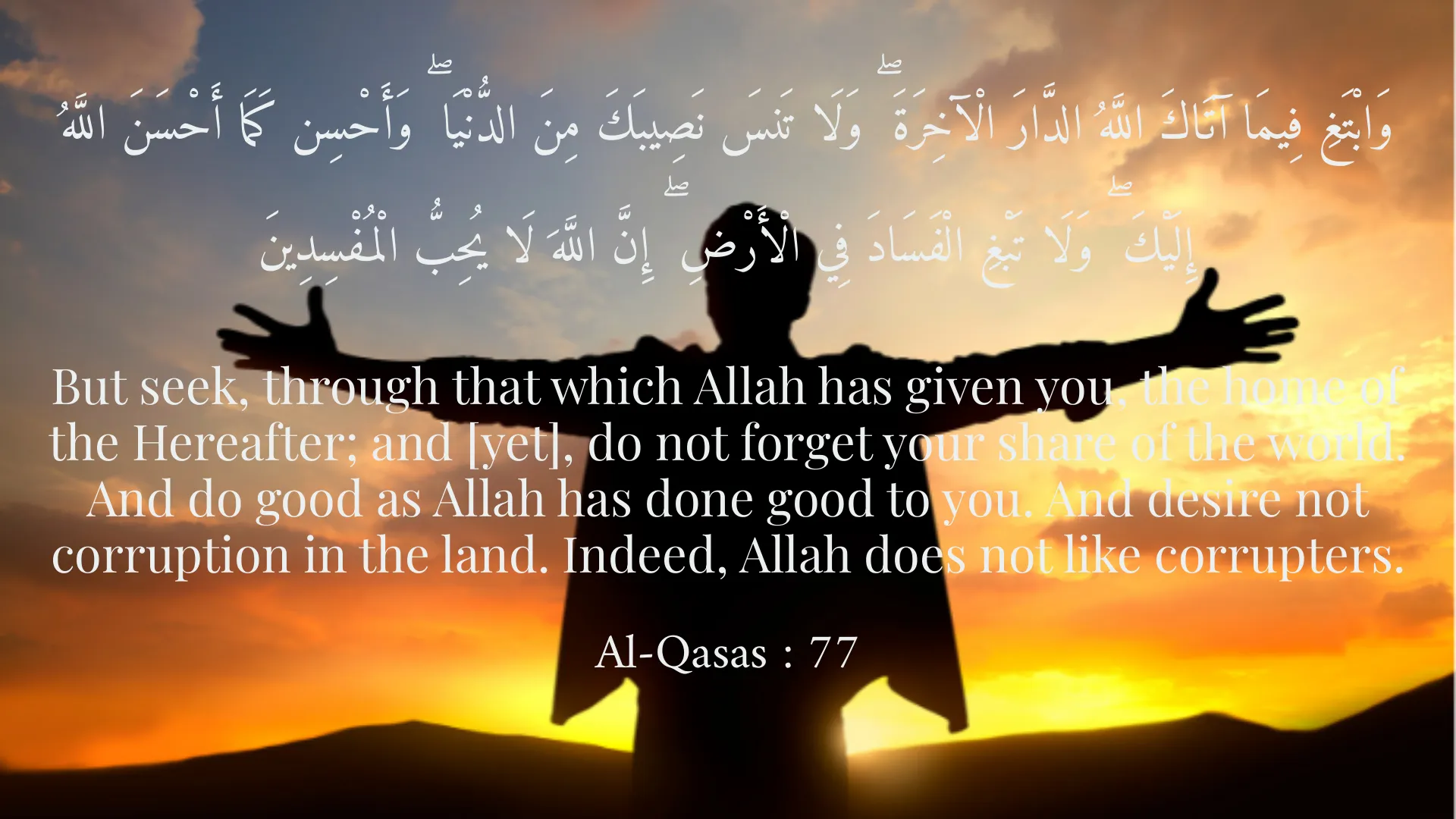
وَابْتَغِ فِيمَا آتَاكَ اللَّهُ الدَّارَ الْآخِرَةَ ۖ وَلَا تَنسَ نَصِيبَكَ مِنَ الدُّنْيَا ۖ وَأَحْسِن كَمَا أَحْسَنَ اللَّهُ إِلَيْكَ ۖ وَلَا تَبْغِ الْفَسَادَ فِي الْأَرْضِ ۖ إِنَّ اللَّهَ لَا يُحِبُّ الْمُفْسِدِينَ
But seek, through that which Allah has given you, the home of the Hereafter; and [yet], do not forget your share of the world. And do good as Allah has done good to you. And desire not corruption in the land. Indeed, Allah does not like corrupters.
Al-Qasas : 77
فَإِذَا قُضِيَتِ الصَّلَاةُ فَانتَشِرُوا فِي الْأَرْضِ وَابْتَغُوا مِن فَضْلِ اللَّهِ وَاذْكُرُوا اللَّهَ كَثِيرًا لَّعَلَّكُمْ تُفْلِحُونَ
And when the prayer has been concluded, disperse within the land and seek from the bounty of Allah, and remember Allah often that you may succeed.
Al-Jumu'ah : 10
اعْلَمُوا أَنَّمَا الْحَيَاةُ الدُّنْيَا لَعِبٌ وَلَهْوٌ وَزِينَةٌ وَتَفَاخُرٌ بَيْنَكُمْ وَتَكَاثُرٌ فِي الْأَمْوَالِ وَالْأَوْلَادِ ۖ كَمَثَلِ غَيْثٍ أَعْجَبَ الْكُفَّارَ نَبَاتُهُ ثُمَّ يَهِيجُ فَتَرَاهُ مُصْفَرًّا ثُمَّ يَكُونُ حُطَامًا ۖ وَفِي الْآخِرَةِ عَذَابٌ شَدِيدٌ وَمَغْفِرَةٌ مِّنَ اللَّهِ وَرِضْوَانٌ ۚ وَمَا الْحَيَاةُ الدُّنْيَا إِلَّا مَتَاعُ الْغُرُورِ
Know that the life of this world is only play and amusement, an adornment and boasting among yourselves, and competition in [accumulating] wealth and children – like the example of a rain whose [resulting] plant growth pleases the tillers; then it dries and you see it turned yellow; then it becomes [scattered] debris. And in the Hereafter is severe punishment and forgiveness from Allah and approval. And what is the worldly life except the enjoyment of delusion.
Al-Hadid : 20
Short Story
It is narrated that one day, a wealthy and self-satisfied man, adorned in luxurious garments and surrounded by many servants, passed by a dervish who was sitting contentedly in a corner, unattached to worldly affairs. The rich man arrogantly asked the dervish, “Why do you not work to accumulate wealth and escape this poverty?” The dervish replied with a gentle smile, “I consider myself wealthier than you. You are constantly striving to increase your wealth, and the fear of thieves and the greed of others have stolen sleep from your eyes. But I am content with what I have and possess a free and fearless heart. You are a slave to your possessions, while I am my own master.” This story reminds us that true asceticism lies in the heart's independence, not in the hand's emptiness; and true wealth is in contentment, not in the abundance of possessions.