Quranic Answer
Yes, absolutely! The Holy Quran comprehensively and profoundly addresses the issue of individual responsibility concerning social and economic inequalities, deeming it one of the pillars of faith and piety. Islam not only acknowledges the existence of natural and test-based inequalities but also provides clear mechanisms and practical guidelines to reduce unjust disparities and combat their negative consequences. These teachings place a significant burden on every believer, extending beyond mere ritualistic observances to encompass broad social and economic commitments aimed at achieving justice and solidarity in society. From the Quranic perspective, existence and everything within it, including wealth and possessions, are a trust from God. Humans are not the true owners of anything but are merely stewards (Khalifa) tasked with managing this trust correctly and in a way that pleases God. This perspective forms the foundation of individual responsibility regarding wealth and inequalities. When an individual becomes wealthy, the Quran reminds them that this wealth is not due to their inherent superiority but by divine will and as a test for them. Therefore, a portion of this wealth is the right of the needy and deprived, which must be fulfilled. This is where key concepts such as 'Zakat,' 'Sadaqa,' and 'Infaq fi Sabilillah' (spending in the way of God) come into play. Zakat, as a mandatory financial obligation, is the most systematic form of contributing to the reduction of inequalities. It is not merely a voluntary act of charity but a right that the poor have over the wealthy, and its fulfillment purifies one's wealth and soul. The Quran explicitly states that wealth should not circulate exclusively among the rich (Al-Hashr: 7), which itself indicates the necessity of fair wealth distribution and the responsibility of the wealthy in this regard. Beyond Zakat, the broader concept of 'Infaq,' or spending in the way of God, includes any financial and non-financial aid to meet the needs of society, and there are numerous encouragements for it in the Quran. This spending must be done not for show or hypocrisy, but with pure intention and for the sake of Allah's pleasure to have true effectiveness. Individual responsibility in the Quran is not limited to financial aspects. Every individual has a duty not to remain silent in the face of oppression and injustice observed in society. The concept of 'Amr bil Ma'ruf wa Nahi anil Munkar' (enjoining good and forbidding evil) includes combating the roots of inequality and promoting justice and fairness in all aspects of life. This means that a Muslim individual is responsible not only for acting justly themselves but also for combating any exploitation, corruption, hoarding, and usury (Riba) that exacerbate inequalities. This responsibility can be exercised through advice, peaceful protest, or even practical action when possible and under appropriate circumstances. For example, the Quran has strictly forbidden usury (interest), viewing it as a primary cause of economic inequality, exploitation, and injustice. A Muslim individual is responsible for avoiding such transactions and warning others against them. Furthermore, the Quran places great emphasis on 'work and effort' and earning a lawful living, condemning idleness and laziness. However, alongside this, individual responsibility towards those who are unable to work, or who cannot support themselves due to illness, old age, or disability, is also highlighted. This responsibility does not fall solely on the Islamic government; rather, every individual, within their sphere of connections and capabilities, has a duty to help and support their needy fellow human beings. This help can include skill training, providing employment opportunities, or direct financial support. The Quran's insistence on 'brotherhood' and 'equality' among people, regardless of race or social class, strengthens the foundation of this responsibility, reminding individuals that all are members of one body, and the pain of one member affects the others. Ultimately, individual responsibility towards inequalities in the Quran has deep roots in a monotheistic worldview. A believer understands that all possessions are from God, and He is the ultimate Provider. This belief deters them from excessive attachment to wealth and its accumulation, leading them towards generosity and altruism. Being responsible for inequalities is not just a philanthropic act but an inseparable part of faith and a means of salvation in this world and the hereafter. It is an invitation to active participation in building a more just and compassionate society, where no one is oppressed due to poverty and deprivation, and human dignity is preserved. This approach goes beyond a mere moral duty; it is presented as a divine obligation that guarantees the well-being of the individual and society and reduces the roots of corruption and decay. By fulfilling this responsibility, each individual not only helps themselves but also moves closer to the lofty ideals of the Quran for a virtuous and just society.
Related Verses
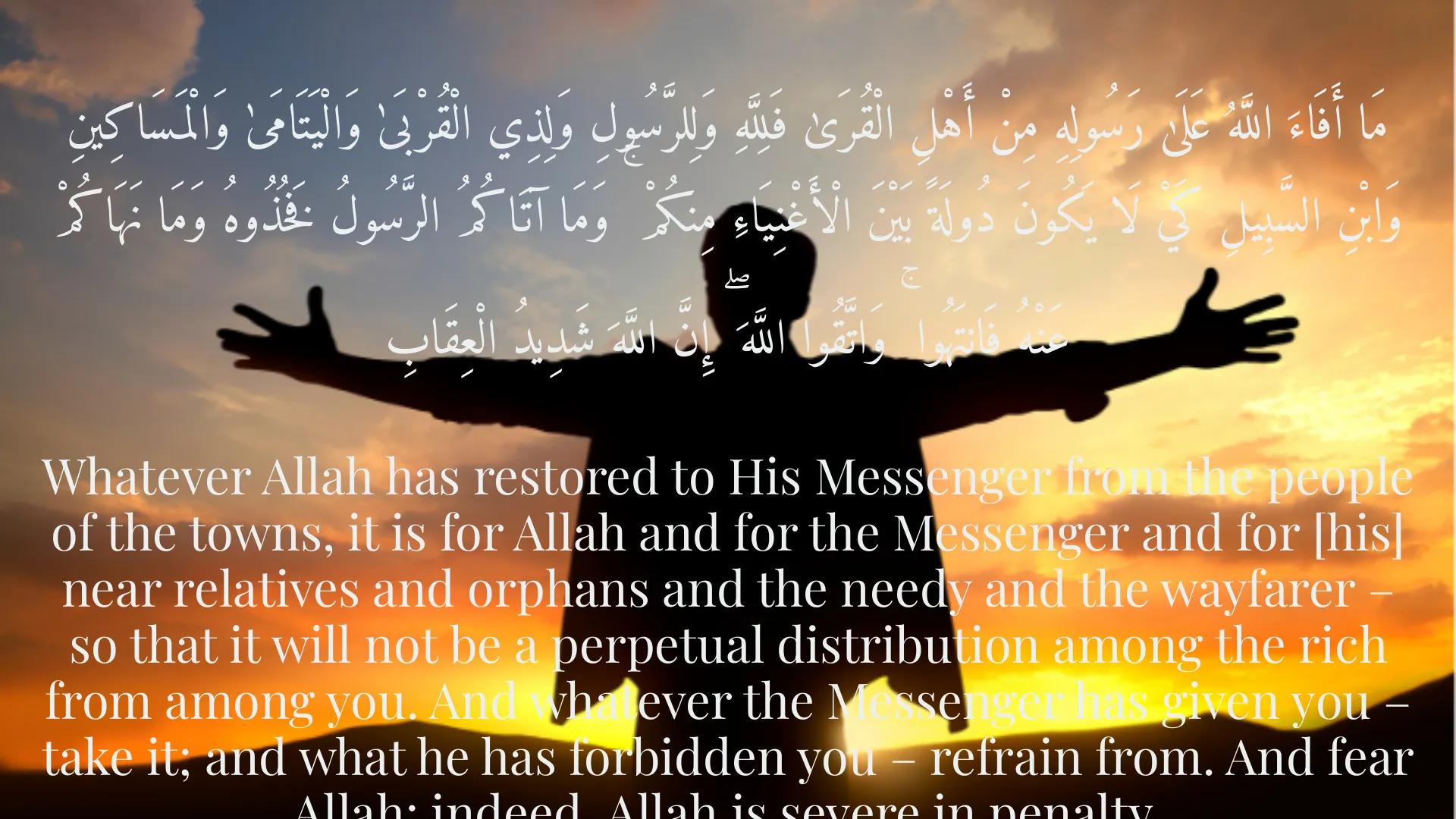
مَا أَفَاءَ اللَّهُ عَلَىٰ رَسُولِهِ مِنْ أَهْلِ الْقُرَىٰ فَلِلَّهِ وَلِلرَّسُولِ وَلِذِي الْقُرْبَىٰ وَالْيَتَامَىٰ وَالْمَسَاكِينِ وَابْنِ السَّبِيلِ كَيْ لَا يَكُونَ دُولَةً بَيْنَ الْأَغْنِيَاءِ مِنكُمْ ۚ وَمَا آتَاكُمُ الرَّسُولُ فَخُذُوهُ وَمَا نَهَاكُمْ عَنْهُ فَانتَهُوا ۚ وَاتَّقُوا اللَّهَ ۖ إِنَّ اللَّهَ شَدِيدُ الْعِقَابِ
Whatever Allah has restored to His Messenger from the people of the towns, it is for Allah and for the Messenger and for [his] near relatives and orphans and the needy and the wayfarer – so that it will not be a perpetual distribution among the rich from among you. And whatever the Messenger has given you – take it; and what he has forbidden you – refrain from. And fear Allah; indeed, Allah is severe in penalty.
Al-Hashr : 7
وَفِي أَمْوَالِهِمْ حَقٌّ لِّلسَّائِلِ وَالْمَحْرُومِ
And in their wealth was a recognized right for the petitioner and the deprived.
Adh-Dhariyat : 19
يَا أَيُّهَا الَّذِينَ آمَنُوا كُونُوا قَوَّامِينَ بِالْقِسْطِ شُهَدَاءَ لِلَّهِ وَلَوْ عَلَىٰ أَنفُسِكُمْ أَوِ الْوَالِدَيْنِ وَالْأَقْرَبِينَ ۚ إِن يَكُنْ غَنِيًّا أَوْ فَقِيرًا فَاللَّهُ أَوْلَىٰ بِهِمَا ۖ فَلَا تَتَّبِعُوا الْهَوَىٰ أَن تَعْدِلُوا ۚ وَإِن تَلْوُوا أَوْ تُعْرِضُوا فَإِنَّ اللَّهَ كَانَ بِمَا تَعْمَلُونَ خَبِيرًا
O you who have believed, be persistently firm in justice, witnesses for Allah, even if it be against yourselves or parents and relatives. Whether one is rich or poor, Allah is more worthy of both. So follow not [personal] inclination, lest you deviate. And if you distort [your testimony] or turn away, then indeed Allah is ever, with what you do, Acquainted.
An-Nisa : 135
Short Story
It is narrated that in ancient times, there was a just king who always thought of the poor. One day, while walking in his garden, he saw a dervish who, despite his poverty, was cheerful and smiling. The king, surprised, asked: "How is it that with all my wealth and power, I am sometimes anxious, and you, in your humble state, are so calm and content?" The dervish replied: "O King! You think this wealth will be with you forever, and that is what keeps you anxious. But I know that this world is transient, and what I possess is merely a trust that I must share with others. This generosity and detachment from worldly possessions have kept my heart free and at peace." The king took heed of these words and became even more aware of his responsibility towards his people, and his generosity and justice increased.