Quranic Answer
Justice in speech is one of the foundational values in Islam and the Holy Quran. Throughout history, various cultures and religions have emphasized the significance of justice, but perhaps none so explicitly as Islam. Central to its teachings is the concept of fairness and accuracy in expression, especially when it comes to important societal issues. Given its profound implications, justice in speech is not merely a principle but an essential component of the Islamic moral framework. This article delves deeper into the significance of justice in speech as prescribed in the Quran, its implications on interpersonal relationships, societal harmony, and its role in fostering an equitable world. First and foremost, the Quran commands believers to uphold justice in their speech and to always advocate for truth and fairness. In Surah Al-Ma'idah, verse 8, Allah states: "O you who have believed, be persistently standing firm in justice, witnesses in justice, and do not let the hatred of a people prevent you from being just." This crucial verse underscores the unwavering commitment required from Muslims towards justice. The emphasis on being 'persistently standing firm' denotes that justice should not be a temporary or situational act; it should be a constant principle guiding every individual's actions and statements. The importance of this principle is further illustrated as it recognizes the inherent human tendency to let emotions—such as hatred, bias, or personal relationships—cloud judgment. In recognizing this potential for bias, believers are urged to rise above their feelings in order to uphold justice. Here, the act of speaking with justice becomes an act of moral courage, necessitating individuals to confront their own biases in favor of an objective truth. This context highlights that the pursuit of truth often requires personal sacrifice and a willingness to acknowledge uncomfortable realities. Continuing in the same vein, Surah An-Nisa, verse 135 eloquently reinforces the call for justice in all matters, including bearing witness. The verse articulates: "O you who have believed, be persistently standing firm in justice, witnesses in justice for the sake of Allah, even if it be against yourselves or parents and relatives." This powerful exhortation mandates believers to prioritize justice over personal ties and allegiances, elevating the significance of truth above all else. It calls for an unwavering commitment to fairness even when it involves difficult truths that may go against familial or friendly relationships. Justice in speech is thus intrinsically linked to personal integrity. Speaking the truth becomes a mechanism for individuals to honor their moral obligations, as it aligns with divine expectations. The call for justice also acts as a reminder that every individual bears responsibility not only to themselves but to the community as a whole. In articulating transparent truths, individuals help foster a culture of accountability, trust, and fairness—qualities that are paramount in building strong communal bonds. Moreover, justice in communication contributes to building a more just and transparent society. In contexts where misinformation, falsehood, and deceit are prevalent, the need for justice in speech becomes even more pronounced. By adhering to the principles laid out in the Quran, individuals are better equipped to challenge injustices and misrepresentations in their environments. As communities strive for equity, the dissemination of truthful information becomes an instrument for societal progress. Additionally, the ramifications of justice in speech extend into various life aspects—jurisprudence, governance, and social justice, among others. For instance, in legal contexts, the obligation to speak justly has monumental implications. Witnesses and judges are urged to uphold these values when testifying or delivering judgments. When individuals speak with justice, they lend credence to the legal processes, ensuring that justice can be rightly served. Conversely, dishonesty and corruption in speech can derail legal proceedings and lead to societal injustices. Furthermore, the ethical implications of just speech can enhance interpersonal relationships. When individuals embrace the tenets of justice in their communication with others, relationships become fortified by trust and respect. People are more likely to engage in open dialogues when they know their words will be respected and valued. An environment that advocates for justice in speech creates a safe space for discussions on contentious issues and promotes understanding in larger societal discourses. This is particularly relevant in diverse societies, where people from various backgrounds and beliefs converge, allowing for collaborative problem-solving and peace-building. It is evident that the concept of justice in speech is intricately woven into the fabric of Islamic teachings. The Quran places a significant emphasis on fair communication, advocating for truths that respect human dignity and justice. The values outlined in Surah Al-Ma'idah and Surah An-Nisa reflect a profound understanding of the complexities of human relationships and the necessity of accountability. In conclusion, justice in speech is not only a moral imperative for Muslims but also a universal principle that transcends cultural and religious boundaries. Upholding justice through truthful communication fosters respect, accountability, and integrity. The powerful teachings presented in the Quran remind believers that they hold a precious responsibility to advocate for truth and fairness in every aspect of their lives. The principles of justice in speech can play a pivotal role in shaping individuals and societies—urging collective growth towards a fairer and more equitable world. Thus, it becomes essential for all individuals, irrespective of their background, to reflect on the implications of their speech and strive to speak with justice as a testament to their commitment to truth and fairness.
Related Verses
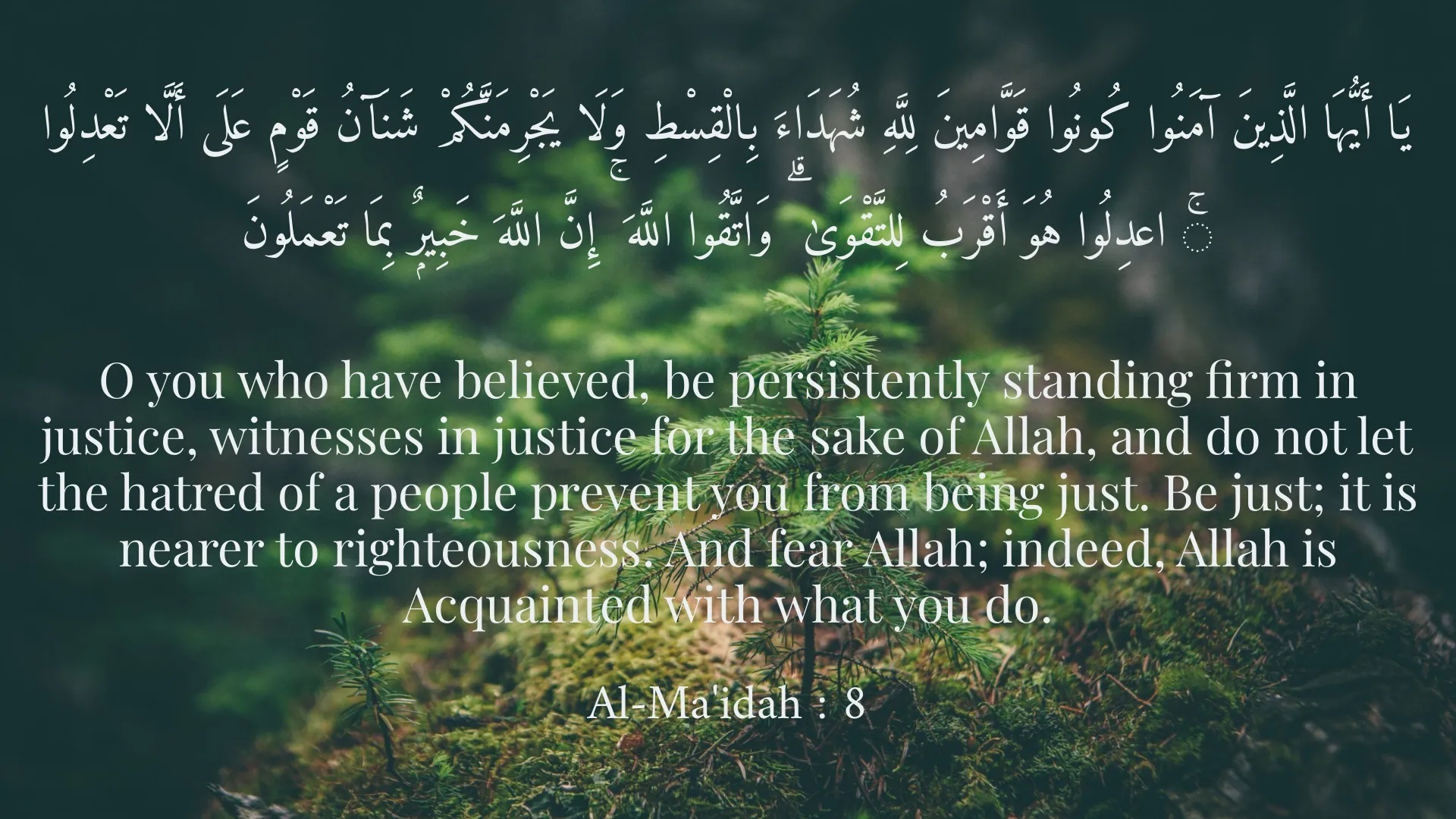
يَا أَيُّهَا الَّذِينَ آمَنُوا كُونُوا قَوَّامِينَ لِلَّهِ شُهَدَاءَ بِالْقِسْطِ وَلَا يَجْرِمَنَّكُمْ شَنَآنُ قَوْمٍ عَلَى أَلَّا تَعْدِلُوا ۚ اعدِلُوا هُوَ أَقْرَبُ لِلتَّقْوَىٰ ۗ وَاتَّقُوا اللَّهَ ۚ إِنَّ اللَّهَ خَبِيرٌۭ بِمَا تَعْمَلُونَ
O you who have believed, be persistently standing firm in justice, witnesses in justice for the sake of Allah, and do not let the hatred of a people prevent you from being just. Be just; it is nearer to righteousness. And fear Allah; indeed, Allah is Acquainted with what you do.
Al-Ma'idah : 8
يَا أَيُّهَا الَّذِينَ آمَنُوا كُونُوا قَوَّامِينَ لِلَّهِ شُهَدَاءَ بِالْقِسْطِ وَإِن كَانَ عَلَى أَنفُسِكُمْ أَوِ الْوَالِدَيْنِ أَوِ الْأَقْرَبِينَ ۖ إِن يَكُنْ غَنِيًّۭا أَوْ فَقِيرًۭا فَاللَّهُ أَعْلَمُ بِهِمَا ۖ فَلَا تَتَّبِعُوا الْهَوَىٰ أَن تَعْدِلُوا ۚ وَإِن تَلْوُوا أَوْ تُعْرِضُوا فَإِنَّ اللَّهَ كَانَ بِمَا تَعْمَلُونَ خَبِيرًا
O you who have believed, be persistently standing firm in justice, witnesses in justice for the sake of Allah, even if it be against yourselves or parents and relatives. Whether one is rich or poor, Allah is more worthy of both. So follow not [personal] inclination, lest you not be just. And if you distort [your testimony] or refuse [to give it], indeed Allah is Ever, with what you do, Acquainted.
An-Nisa : 135
Short Story
One day, a man named Hasan went to the market and noticed that the seller was not treating other customers fairly. Hasan recalled the verses of the Quran that emphasize justice. He kindly told the seller, 'Justice in speech and trade attracts God's mercy and increases your sustenance.' The seller was impacted and decided to pay closer attention to the promises of the Quran. From that day, people returned home happier than ever after their purchases.