Quranic Answer
You have asked a very profound and crucial question, one that goes to the heart of the Quran's teachings and the ultimate purpose of prophetic missions. The unequivocal answer is: Yes, the Holy Quran not only commands societal reform but also presents it as one of the most fundamental objectives of the prophets' dispatch and the message of Islam. Islam is not merely an individualistic religion concerned solely with a person's relationship with God; rather, it is a comprehensive divine system that views the well-being of the individual and society as interconnected and inseparable. Societal reform is a vast concept encompassing moral, economic, political, cultural, and social improvements, and the Quran addresses it in various dimensions. One of the most significant and explicit directives in the Quran regarding societal reform is the principle of "Amr bil Ma'ruf wa Nahi anil Munkar" (enjoining good and forbidding evil). This principle represents a universal and continuous duty for every Muslim, and particularly for social institutions and the Islamic government. In Surah Al-Imran, verse 104, Allah states: "And let there be [arising] from you a nation inviting to [all that is] good, enjoining what is right and forbidding what is wrong, and those will be the successful." This verse indicates that the existence of a group or community responsible for guidance and social oversight is a sign of societal prosperity. Enjoining good and forbidding evil goes beyond a simple moral recommendation; it is a vital mechanism for preserving the health and dynamism of society. This duty starts with guidance and admonition and extends to combating oppression and corruption at broader societal levels. The Quran repeatedly emphasizes the importance of establishing justice (Adl) and equity (Qist) in society. Justice is the foundation of governance and societal well-being; without it, no society can achieve peace and progress. In Surah An-Nisa, verse 135, it is stated: "O you who have believed, be persistently Qawwameen bil-Qist (maintainers of justice), witnesses for Allah, even if it be against yourselves or parents and relatives. Whether one is rich or poor, Allah is more worthy of both. So follow not [personal] inclination, lest you deviate. And if you distort [your testimony] or refuse [to give it], then indeed Allah is ever, with what you do, Acquainted." This verse demonstrates that justice must be upheld even against oneself, parents, or relatives, and no one, whether rich or poor, should be exempt from the circle of justice. This justice encompasses judicial, economic, social, and even individual relationships. Furthermore, the Quran pays special attention to economic and social issues for societal reform. Directives such as Zakat, Sadaqat (charity), infaq (spending in Allah's cause), prohibition of usury (riba), combating hoarding, and extravagance are all introduced with the aim of creating a balanced, just society free from extreme poverty and class disparities. The goal is the circulation of wealth among all segments of society so that it does not remain concentrated only among the wealthy (Surah Al-Hashr, verse 7). The Quran also places great emphasis on the rights of orphans, the poor, the needy, and the destitute, considering their care to be an important duty of believers (Surah Al-Baqarah, verse 177). Another aspect of social reform in the Quran is the call for unity and brotherhood. Islam combats all forms of division, racism, tribalism, and ignorant prejudices, considering all humans as brothers and equals due to their shared humanity and faith. In Surah Al-Hujurat, verse 10, we read: "The believers are but a brotherhood, so make reconciliation between your brothers and fear Allah that you may receive mercy." This verse explicitly refers to the duty of Muslims to resolve disputes among themselves and establish peace and tranquility in society. This social unity and solidarity are the fundamental pillars of a strong society resilient against corruption and decay. The Quran also emphasizes the necessity of educating righteous individuals who are committed to social responsibilities. Societal reform begins with individual reform; an individual who is committed to divine ethics can also be effective in reforming their surroundings. Divine prophets first invited individuals to faith and self-purification, and then, with the cooperation of these individuals, proceeded to reform social structures. Finally, the Quran pays special attention to the responsibility of rulers and leaders, considering their duty to establish religion, justice, and protect the rights of the people. The failure of rulers in this regard leads to corruption and decay in society. Therefore, the Quran provides a complete and comprehensive roadmap for building an ideal society based on justice, ethics, brotherhood, and servitude to God, considering societal reform a continuous and vital duty for every Muslim and the entire Islamic Ummah.
Related Verses
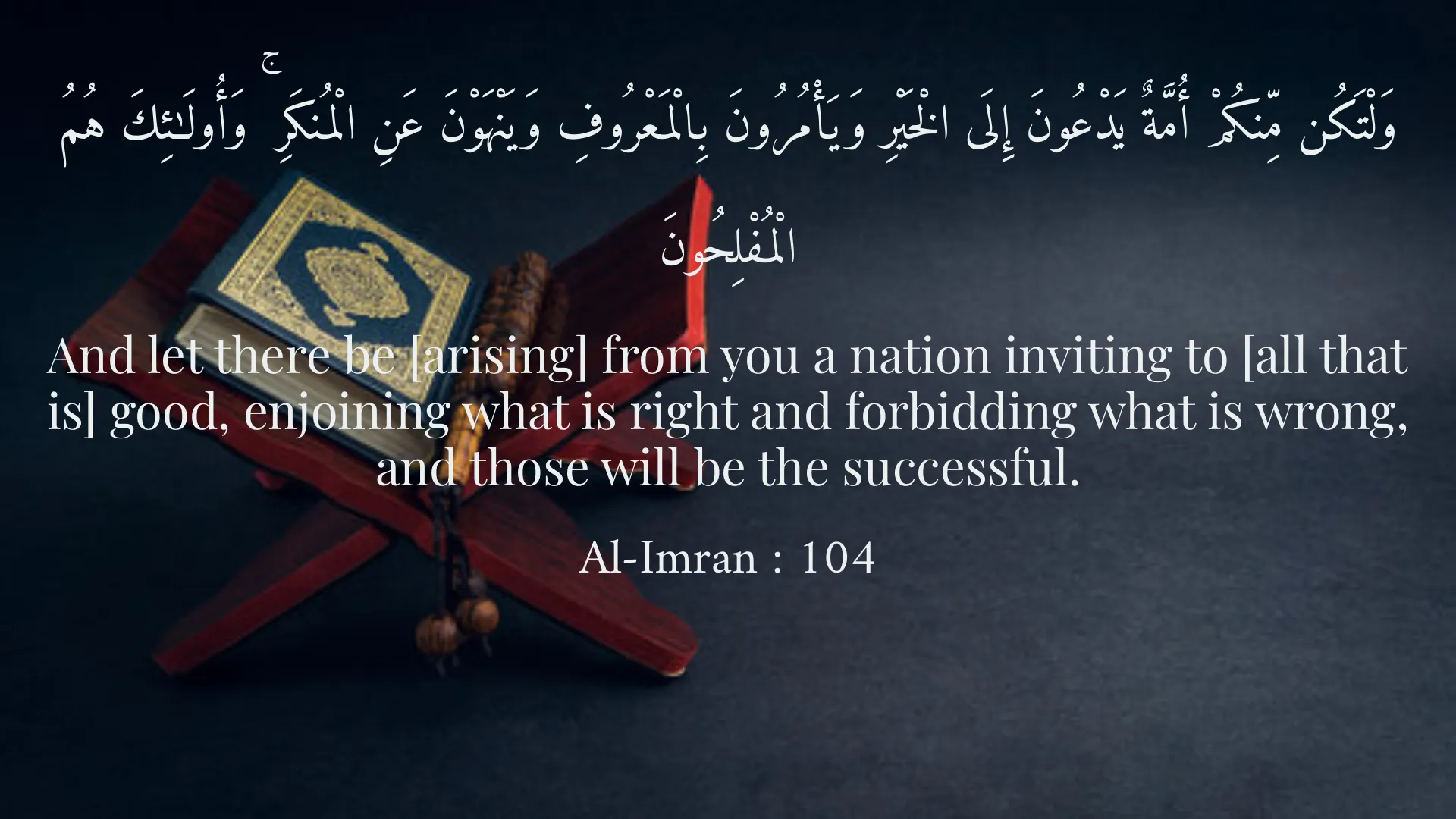
وَلْتَكُن مِّنكُمْ أُمَّةٌ يَدْعُونَ إِلَى الْخَيْرِ وَيَأْمُرُونَ بِالْمَعْرُوفِ وَيَنْهَوْنَ عَنِ الْمُنكَرِ ۚ وَأُولَٰئِكَ هُمُ الْمُفْلِحُونَ
And let there be [arising] from you a nation inviting to [all that is] good, enjoining what is right and forbidding what is wrong, and those will be the successful.
Al-Imran : 104
يَا أَيُّهَا الَّذِينَ آمَنُوا كُونُوا قَوَّامِينَ بِالْقِسْطِ شُهَدَاءَ لِلَّهِ وَلَوْ عَلَىٰ أَنْفُسِكُمْ أَوِ الْوَالِدَيْنِ وَالْأَقْرَبِينَ ۚ إِنْ يَكُنْ غَنِيًّا أَوْ فَقِيرًا فَاللَّهُ أَوْلَىٰ بِهِمَا ۖ فَلَا تَتَّبِعُوا الْهَوَىٰ أَنْ تَعْدِلُوا ۚ وَإِنْ تَلْوُوا أَوْ تُعْرِضُوا فَإِنَّ اللَّهَ كَانَ بِمَا تَعْمَلُونَ خَبِيرًا
O you who have believed, be persistently maintainers of justice, witnesses for Allah, even if it be against yourselves or parents and relatives. Whether one is rich or poor, Allah is more worthy of both. So follow not [personal] inclination, lest you deviate. And if you distort [your testimony] or refuse [to give it], then indeed Allah is ever, with what you do, Acquainted.
An-Nisa : 135
إِنَّمَا الْمُؤْمِنُونَ إِخْوَةٌ فَأَصْلِحُوا بَيْنَ أَخَوَيْكُمْ ۚ وَاتَّقُوا اللَّهَ لَعَلَّكُمْ تُرْحَمُونَ
The believers are but a brotherhood, so make reconciliation between your brothers and fear Allah that you may receive mercy.
Al-Hujurat : 10
Short Story
It is narrated that one day, Saadi Shirazi was sitting in a rose garden (Golestan) and conversing with a group of companions. Someone asked: 'O Sheikh, how can a society be built where everyone achieves happiness?' Saadi smiled and said: 'The story goes that there was a king in a city who was oppressive and tyrannical, having turned away from justice and fairness. The people were weary of his injustice, and the city's decay grew day by day. In that city, there lived a learned and wise man who was saddened by the people's plight. One day, he saw the king enjoying himself in his garden, oblivious to the state of his subjects. The wise man approached respectfully and said: 'O King, I have heard that you intend to build a new edifice. Do you know that the foundation of any structure must be firm and strong to endure?' The king replied: 'Of course, I will use the best materials.' The wise man said: 'The foundation of your rule and kingship is no exception to this rule. Its foundation is justice and equity. If justice prevails among the people and everyone receives their due rights, then the hearts of the subjects will be with you, and your reign will endure. But if the foundation is built on oppression, no matter how magnificent its appearance, it will not be long before it collapses.' The king pondered over these words and gradually began to reform his affairs and those of his subjects. The city began to flourish, and the people found peace and tranquility under the shadow of justice. Saadi then added: 'So know that societal reform begins with the reform of the ruler's heart and the observance of justice and fairness, and it is everyone's duty to enjoin good and forbid evil, so that a virtuous society may be built.'