Quranic Answer
The Holy Quran, regarded as the literal word of God by Muslims, holds a central role in Islamic teachings and principles. Among the numerous themes embedded within its verses, one of the most poignant is the emphasis on kindness, compassion, and respect for all living beings, including animals. The divine scriptures serve as a guiding light not only for human interactions but also for how we should treat the natural world and its inhabitants. This article delves into the significance of kindness towards creatures, with a particular focus on animals, as highlighted in the Quran and the Hadith (sayings of Prophet Muhammad, PBUH). One of the key verses illustrating the concept of inclusiveness in creation is found in Surah Al-An'am (verse 38). This verse states: 'And there is no creature on earth, nor a bird that flies with its wings, but they are communities like you. We have not neglected in the Book a thing.' This powerful verse emphasizes the interconnectedness and equality of all living beings. Just as humans live in communities governed by rules and ethics, so too do all creatures that share the earth. This suggests that God holds an awareness and concern for every living being, no matter how small or seemingly insignificant. The message is clear: every creature has a right to existence and should be treated with dignity and respect. Within the framework of Islamic ethics, the idea of harming another being is profoundly taken into consideration. Surah Al-Ma'idah (verse 32) further enunciates this principle by asserting: 'Whoever kills a soul unless for a soul or for corruption [done] in the land - it is as if he had slain mankind entirely.' This verse is profound in its implication, signaling that acts of violence and injustice against any being, including animals, are not only wrong but are considered a severe transgression against the sanctity of life. Therefore, the Quran explicitly links the treatment of animals to broader ethical standards that govern human behavior, reinforcing the idea that causing harm to any being is a grave offense. The teachings of the Prophet Muhammad (PBUH) further amplify the Quranic encouraging stances on kindness to animals. One of the well-known stories exemplifying this moral standard is of a woman who faced punishment in Hell for her cruel treatment of a cat. The cat, which she had trapped and starved, became a critical cautionary tale illustrating that neglect and cruelty towards even the smallest of creatures can have serious consequences in the afterlife. This story serves as a powerful reminder for Muslims to remain attentive to the needs of animals and encourages a disposition of compassion and nurturing towards living beings in our everyday lives. Moreover, various Hadiths elaborate on the virtuous treatment of animals. The Prophet Muhammad (PBUH) instructed his followers to treat animals well, honoring their needs and welfare. One narration states that a man, who quenched the thirst of a thirsty dog, was rewarded with entrance into Paradise. Such affirmations demonstrate that compassion towards animals is not merely a nicety but can serve as a moral compass guiding one's actions towards righteousness and fulfillment of divine approval. In a broader sense, the teachings of the Quran and the Hadith encapsulate a philosophy that extends beyond the act of kindness itself. It promotes a deep respect for all forms of life, thereby urging followers to create a balance between their existence and that of all living beings. This interconnectedness espouses the idea of stewardship, where humans are seen as caretakers of the earth, responsible for the health and well-being of the environment and its inhabitants. Modern society has gradually become more aware of and sensitive to animal rights. Various movements seek to advocate on behalf of animals that are often subjected to cruelty and neglect, making the teachings of the Quran and Prophet Muhammad (PBUH) incredibly relevant and pressing in today's context. The principles of compassion and kindness towards animals resonate deeply with the values of equality and justice that many contemporary activists strive to uphold. Furthermore, in our interactions with domesticated animals, an understanding grounded in ethical treatment is essential. Many household pets serve not just as companions but also play a crucial role in families’ emotional well-being. As such, the teachings of kindness are not just confined to wild animals or those in the environment but are equally applicable to our pets, reinforcing that every being deserves respect and care. Lastly, the modern implications of these teachings have begun to shape various laws and regulations concerning animal welfare around the world. Nations with significant Muslim populations are engaging in discussions to implement stronger protections for animal rights, drawing inspiration from the Quranic exhortations and the Prophet’s examples. In conclusion, the Holy Quran and the Sunnah of Prophet Muhammad (PBUH) present a comprehensive message emphasizing the importance of kindness towards all creatures, especially animals. The verses and teachings not only reflect a moral responsibility but also a spiritual obligation, urging Muslims to act with compassion in their daily lives. As societies evolve, these age-old teachings serve as valuable guidance, ensuring that we maintain a sense of humanity, dignity, and respect for the rights of all living beings. The reflections from the Islamic tradition remind us of the interconnectedness of life and compel us to approach our existence with love and care for every creature that shares this world with us.
Related Verses
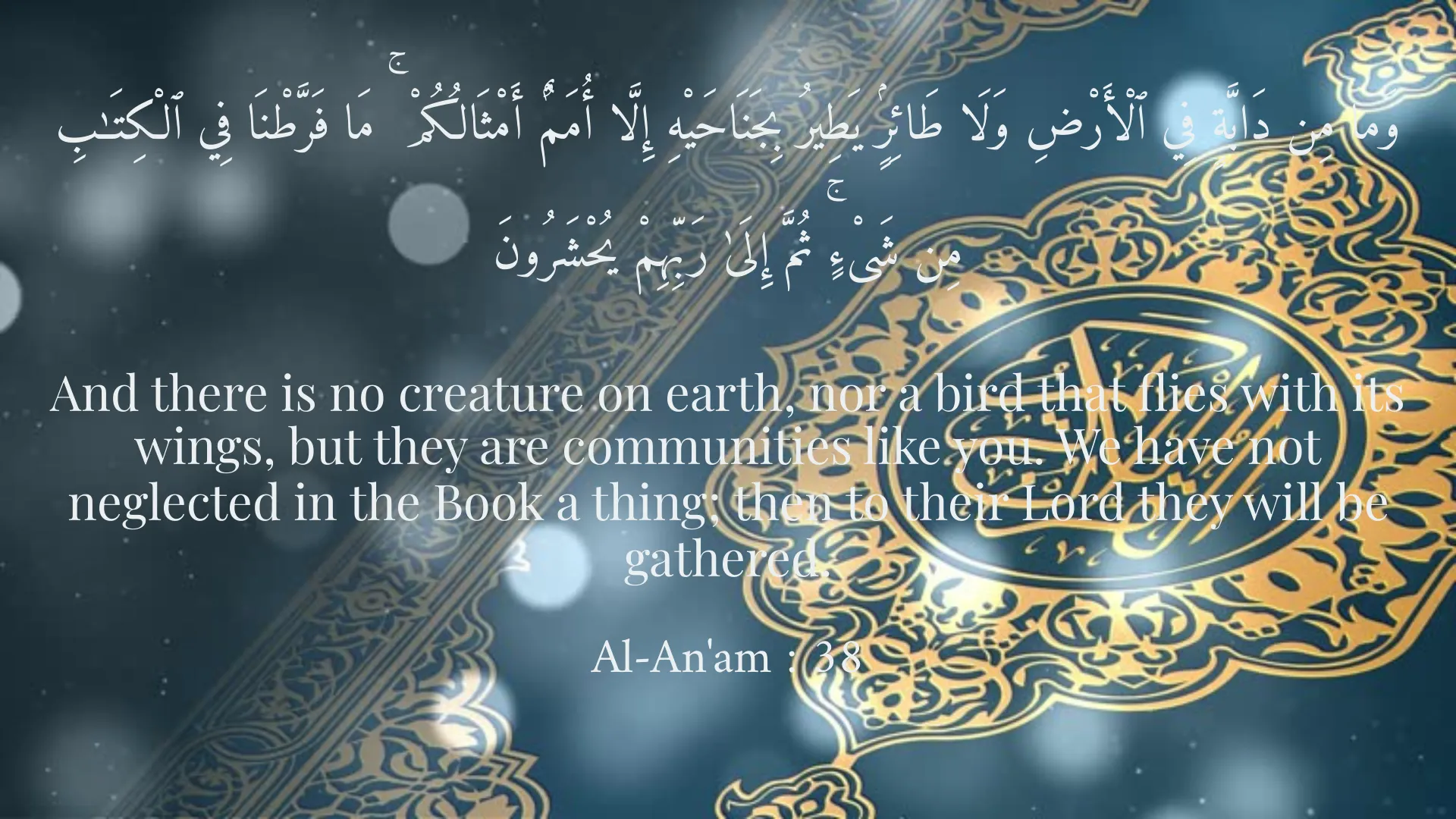
وَما مِن دَابَّةٍ فِي ٱلْأَرْضِ وَلَا طَائِرٍۢ يَطِيرُ بِجَنَاحَيْهِ إِلَّا أُمَمٌۢ أَمْثَالُكُمْ ۚ مَا فَرَّطْنَا فِي ٱلْكِتَـٰبِ مِن شَىْءٍۚ ثُمَّ إِلَىٰ رَبِّهِمْ يُحْشَرُونَ
And there is no creature on earth, nor a bird that flies with its wings, but they are communities like you. We have not neglected in the Book a thing; then to their Lord they will be gathered.
Al-An'am : 38
مَن قَتَلَ نَفْسًۭا بِغَيْرِ نَفْسٍۢ أَوْ فَسَادٍۢ فِي ٱلْأَرْضِ فَكَأَنَّمَا قَتَلَ النَّاسَ جَمِيعًۭا
Whoever kills a soul unless for a soul or for corruption [done] in the land - it is as if he had slain mankind entirely.
Al-Ma'idah : 32
Short Story
One day, a man named Ali, who loved animals, decided to spend time at a park where many animals lived. Every day, he would feed them and play with them. One day, he noticed a small dog sitting alone and hungry in a corner. He immediately approached the dog and gave it some food. Ali's act of kindness was not just out of goodwill; he understood that God is watching over all His creatures and that we must respect them too. From that day on, Ali decided to visit the park every week to help stray animals.