Quranic Answer
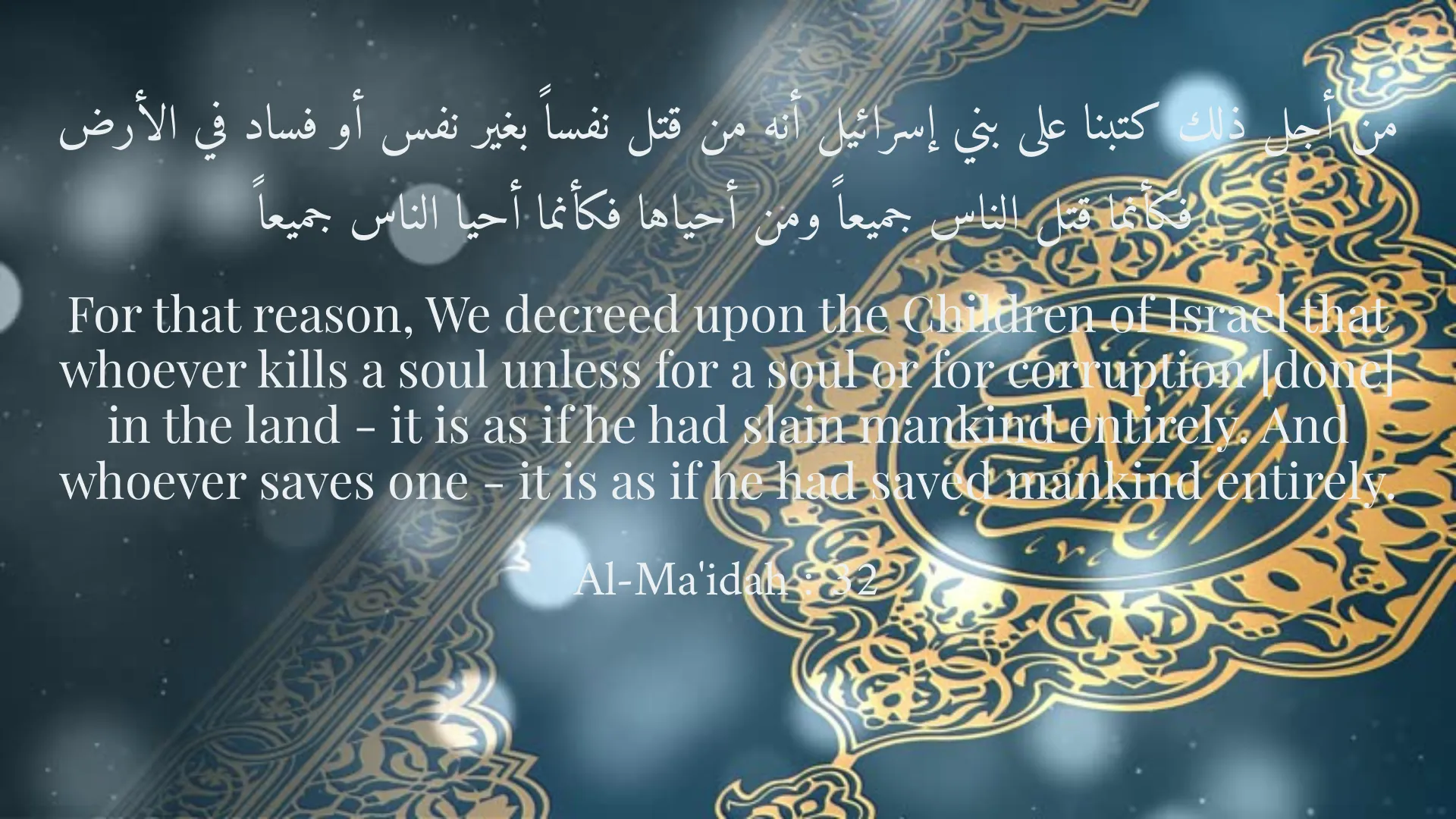
The Quran, regarded as the holy scripture of Islam, serves as a foundational text that guides millions of believers around the world. Beyond its religious significance, the Quran carries timeless messages underlying the core values of humanity, primarily focusing on themes of peace, friendship, tolerance, and respect. In a world often marked by conflicts and divisions, these fundamental tenets of the Quran remind us of the importance of nurturing a compassionate society, irrespective of one’s background or beliefs. One of the most poignant aspects of the Quran is its insistence on the sanctity of human life. This principle is captured elegantly in Surah Al-Ma'idah, verse 32, where it states: "For that reason, killing one person is like killing all of humanity, and saving one soul is like saving all of humanity." This verse not only underscores the immense value of every single life but also serves as a powerful condemnation of acts of violence and homicide. The implication of this verse is profound—taking a life is not merely a crime against an individual but an assault on humanity itself. The Quran positions the act of killing as something that disrupts the very fabric of human coexistence, thus framing murder as an act that contravenes the divine intention for peace and collective flourishing. Despite the emphasis on peace, the Quran does acknowledge human realities where violence may seem inevitable. In certain contexts, it refers to self-defense, particularly in situations where Muslims or oppressed individuals face aggression. However, this acknowledgment of violent situations does not equate to a blanket endorsement of violence or warfare. Rather, it is a nuanced portrayal of human struggles that demands ethical considerations even in the face of conflict. The Quranic verses address the complexity of human interactions and relationships, urging believers to act justly, even under duress. For example, in Surah Al-Baqarah, verse 190, it states: "Fight in the way of Allah those who fight you, but do not transgress. Indeed, Allah does not like transgressors." This verse illustrates the Quranic principle that, even amidst conflict, certain moral boundaries must be maintained. The directive to "not transgress" serves as a reminder that while self-defense may be permitted, unnecessary harm or violence against innocents is categorically rejected. Furthermore, this principle extends to fostering peace and reconciliation, which are seen as values paramount to the Quranic ethos. The notion of reconciliation surfaces frequently within the Quran. For instance, Surah Al-Hujurat, verse 10, emphasizes the importance of communal harmony: "The believers are but brothers, so make settlement between your brothers. And fear Allah that you may receive mercy." This verse advocates for proactive measures toward resolving disputes and emphasizes the belief that nurturing relationships and fostering unity yields divine favor. Here, the Quran positions itself as a mediator of peace, steering individuals away from division and enmity toward a peaceful coexistence. Moreover, the translation of these principles into actionable behaviors manifests in the teachings surrounding empathy and kindness. Verses throughout the Quran encourage believers to practice compassion towards all beings, irrespective of their faith or alignment. In Surah Al-Anfal, verse 61, it mentions: "And if they incline to peace, then incline to it as well and put your trust in Allah. Indeed, He is the Hearing, the Knowing." This potential for dialogue and peace is reinforced by the concept of ‘musalahah’—the act of reconciliation—a significant theme that permeates various Quranic narratives and encourages Muslims to foster relationships based on understanding and mutual respect. Furthermore, the Quran promotes the concept of justice, which extends beyond personal interactions and encompasses societal obligations. Islamic teachings derived from the Quran underline that justice must prevail in all dealings, whether they involve personal relationships or matters affecting entire communities. For instance, Surah An-Nisa, verse 135 insists: "O you who have believed, be persistently standing firm in justice, witnesses in justice, even if it be against yourselves or parents and relatives." Such verses not only illustrate a commitment to justice but also highlight the bonds of humanity and the interconnectedness that exists among individuals. In summary, the Quran stands as a testimony to the enduring values of peace, reconciliation, and the sanctity of human life. While acknowledging the complexities of human nature and the potential for conflict, it ardently calls for ethical conduct, emphasizing non-violence, kindness, and justice. The overarching message of the Quran is fundamentally one of harmony and mutual respect among mankind. In a world yearning for understanding and acceptance, the Quran's teachings provide a beacon of hope, suggesting that despite our differences, we can choose to embrace peace and create a more harmonious existence. Conducting ourselves with compassion, addressing grievances with dialogue, and patiently working towards resolutions are essential steps toward realizing the peaceful society envisioned by the Quran. As humanity continues to grapple with conflicts, crises, and ethical dilemmas, the messages embedded within the Quran serve as a reminder of the still-relevant principles that can guide us toward a better future.
Related Verses
من أجل ذلك كتبنا على بني إسرائيل أنه من قتل نفساً بغير نفس أو فساد في الأرض فكأنما قتل الناس جميعاً ومن أحياها فكأنما أحيا الناس جميعاً
For that reason, We decreed upon the Children of Israel that whoever kills a soul unless for a soul or for corruption [done] in the land - it is as if he had slain mankind entirely. And whoever saves one - it is as if he had saved mankind entirely.
Al-Ma'idah : 32
وَقَاتِلُوا فِي سَبِيلِ اللَّهِ الَّذِينَ يُقَاتِلُونَكُمْ وَلَا تَعْتَدُوا ۚ إِنَّ اللَّهَ لَا يُحِبُّ الْمُعْتَدِينَ
And fight in the way of Allah those who fight you, but do not transgress. Indeed, Allah does not like the transgressors.
Al-Baqarah : 190
Short Story
Once upon a time, there was a man who was always in search of understanding his faith. He would go to the mosque and attend religious gatherings to ask scholars and clerics about the existence of violence in the Quran. One day, a learned person told him: 'The Quran is a book that invites man to peace and kindness. If you reflect upon the meanings of the verses, you will understand that violence is never desirable and is only permissible in specific situations and with ethical considerations.' Upon hearing these words, he felt a specific tranquility in his heart and devoted the rest of his life to spreading the culture of peace and friendship, opposing violence.