Quranic Answer
The concept of destiny and divine decree is one of the most profound and engaging themes within Islamic theology. Central to this discourse is the Holy Quran, which unequivocally asserts that everything that transpires in life is predetermined by Allah's divine will. This belief forms an essential aspect of a Muslim's understanding of their existence and life's trials. The Quran is replete with verses that elucidate this notion, inviting believers to grapple with and reflect upon their life's events through the lens of faith and trust in Allah's grand design. One particularly striking verse is found in Surah Al-Hadid, verse 22, which states: "No disaster strikes upon the earth or among yourselves except that it is in a register before We bring it into being." This verse serves as an eye-opener about the omnipotence and foreknowledge of Allah. It conveys a powerful message that nothing—be it a calamity or a blessing—occurs without it being already engraved in the "Preserved Tablet" (Al-Lawh al-Mahfuz), which is an eternal record of what will transpire in the universe. The implication of this verse encourages believers to understand that life's hardships are not arbitrary; rather, they are part of a divine script that has been written with infinite wisdom. In juxtaposition, Surah Al-An'am, verse 59 further enhances this understanding: "And with Him are the keys of the unseen; none knows them except Him." Here, the Quran emphasizes that human understanding is inherently limited. Although we may experience confusion, frustration, or despair in the face of unexplainable events, it is critical to recognize that Allah, in His infinite knowledge, sees the comprehensive picture that we cannot perceive. This verse instills a sense of humility in believers, reminding them that faith requires surrendering to the divine wisdom of Allah, recognizing that He alone holds the keys to all mysteries of existence. The Islamic principles of Qadar (divine destiny) and Qadha (divine decree) act as foundational beliefs within the faith. To believe in Qadar is to acknowledge that everything occurring in the universe, both good and bad, is preordained by Allah. This recognition plays a crucial role in how Muslims navigate their lives, especially when faced with adversity. Life, as described in Islamic teachings, is a series of tests—challenges meant to enhance one's character, cultivate resilience, and deepen faith. Therefore, understanding one's destiny as being under Allah's control invites a sense of peace and acceptance, enabling believers to rely on His wisdom in all situations. Moreover, the Quran accentuates the importance of patience (Sabr) during trials and tribulations. Adversity, although often painful and disheartening, is portrayed as a significant part of the human experience. Surah Al-Baqarah, verse 155 reminds the believer: "And We will surely test you with something of fear and hunger and a loss of wealth and lives and fruits, but give good tidings to the patient." This reassurance recognizes that while struggles are inevitable, they are also opportunities for spiritual growth and improvement. The trials of life serve a divine purpose—purifying the soul, fostering gratitude, and reinforcing one's reliance on Allah. Furthermore, the notion of Qadar and Qadha enriches the understanding of human effort. While everything is ultimately decreed by Allah, this does not negate the significance of striving and working towards goals. Islamic teachings inspire individuals to make efforts towards bettering their situations, as every endeavor holds its own value within Allah's decree. The balance of placing trust in Allah’s plan while actively engaging in one's responsibilities is a subtle harmony presented in Islamic teachings. Nevertheless, this intricate balance leads to an essential question: how does one reconcile the tension between divine predestination and human free will? Scholars of Islamic theology have grappled with these concepts for centuries, resulting in diverse interpretations and understandings within different communities. Generally, Muslim scholars maintain that while Allah has complete foreknowledge and control over destiny, humans are also endowed with free will, allowing them to make choices that affect their lives. This introduction of free will—without detracting from Allah's omniscience—highlights the divine justice embedded within the framework of Qadar. In doing so, Muslims are called to take accountability for their actions, understanding that their choices have consequences. The concept of destiny urges believers to remain aware that while they may plan and pursue their goals, the ultimate outcome lies within Allah's domain. Embracing this duality can cultivate a sense of inner tranquility; believers can strive towards their ambitions while relinquishing the attachment to outcomes, trusting in Allah's wise and benevolent plan. Ultimately, a deeply rooted belief in destiny and divine decree can lead to a profound transformation in one’s mindset. The trials that accompany life become vehicles of understanding and spiritual refinement. Those who learn to accept the divine decree as both a source of comfort and a reminder of Allah's omnipotence often display a greater sense of resilience, patience, and fulfillment in their lives. In conclusion, the Quran paints a comprehensive picture of destiny and divine decree, presenting it as a tool for understanding life's struggles and victories. Believers are encouraged to embrace their challenges, recognizing that, through faith, patience, and trust in Allah, every trial can be a stepping stone towards personal growth and spiritual enlightenment. As the Holy Quran reminds us, it is through these trials that we are often led to paths of unexpected blessings, urging us to maintain hope and faith amid our earthly sojourn.
Related Verses
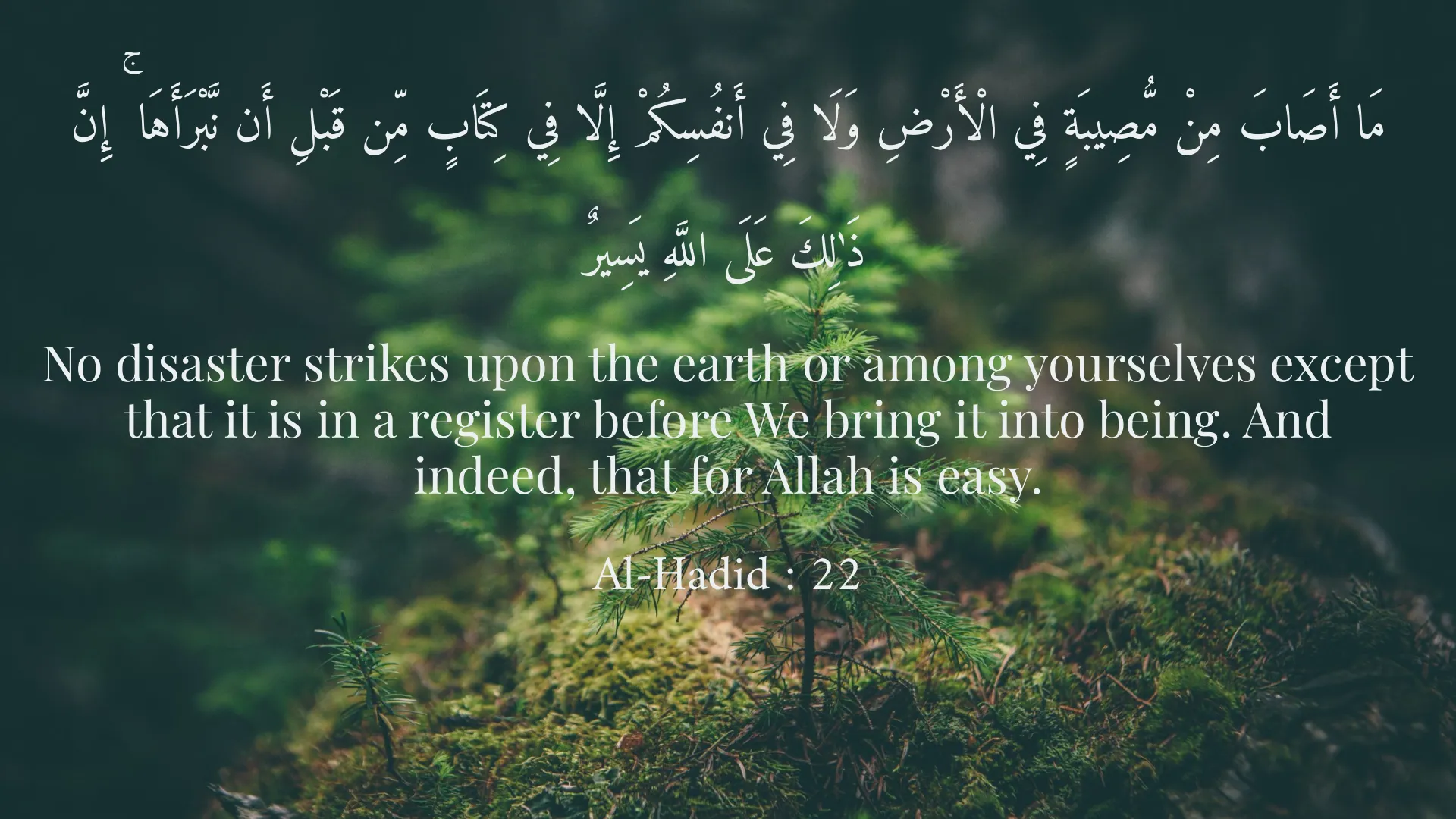
مَا أَصَابَ مِنْ مُّصِيبَةٍ فِي الْأَرْضِ وَلَا فِي أَنفُسِكُمْ إِلَّا فِي كِتَابٍ مِّن قَبْلِ أَن نَّبْرَأَهَا ۚ إِنَّ ذَٰلِكَ عَلَى اللَّهِ يَسِيرٌ
No disaster strikes upon the earth or among yourselves except that it is in a register before We bring it into being. And indeed, that for Allah is easy.
Al-Hadid : 22
وَعِندَهُ مَفَاتِيحُ الْغَيْبِ لَا يَعْلَمُهَا إِلَّا هُوَ ۖ وَمَا تَكُونُ مِن مُّصِيبَةٍ فِي الْأَرْضِ وَلَا فِي أَنفُسِكُمْ إِلَّا فِي كِتَابٍ قَبْلَ أَن نَّبْرَأَهَا ۚ إِنَّ ذَٰلِكَ عَلَى اللَّهِ يَسِيرٌ
And with Him are the keys of the unseen; none knows them except Him. And no disaster strikes upon the earth or among yourselves except that it is in a register before We bring it into being.
Al-An'am : 59
Short Story
One day, a man named Hossein was deeply saddened by his financial struggles. He complained to Allah and asked Him to relieve his troubles. Soon, he realized that what he was experiencing was part of his destiny, and he had to accept Allah's decree. He began to practice patience and prayer, and after some time he noticed positive changes in his life. By placing his faith in Allah's destiny, he found more peace and hope.