Quranic Answer
The Holy Quran stands as a monumental text, not just for its spiritual guidance but also for its profound assertion of human rights, particularly those of women. The verses within this sacred scripture highlight a comprehensive understanding of equality, dignity, and respect for women, challenging the pre-Islamic norms that relegated them to subordinate roles in society. This article aims to delve deep into the Quranic verses that underscore women's rights, exploring the transformative implications of these teachings both in historical contexts and in contemporary society. In Surah An-Nisa, verse 32, Allah articulates a clear message: 'And do not wish for that by which Allah has made some of you exceed others.' This verse encapsulates the essence of equality between men and women, directly countering the prevalent notions of male superiority that defined the patriarchal structure of the pre-Islamic Arab society. Women were often seen merely as property or tools for reproduction, stripped of agency and autonomy. Yet, the Quran emerges as a revolutionary force, asserting that all human beings, regardless of gender, hold intrinsic value and worth. The significance of this equality is profound. The Quran urges a shift in perspective, calling upon individuals to acknowledge and respect one another’s rights and capabilities. It advocates for a society where women are not merely extensions of men but are recognized as independent entities with their unique rights and voices. This perspective serves as a cornerstone for the evolving status of women in Islamic cultures, challenging age-old traditions that placed them in inferior positions. Transitioning to Surah An-Nur, verse 30, the Quran further entrenches women's rights within the social fabric by instructing men to 'lower their gaze' and to act with respect towards women. This teaching not only promotes modesty but also empowers women by encouraging a societal shift in how they are perceived and treated. By emphasizing respect and dignified behavior, the Quran sets a standard that elevates the social standing of women, allowing them to engage more fully in public life while retaining their honor and dignity. The directive for men to avert their gaze signifies a critical change in societal norms, advocating for women's autonomy in how they present themselves and interact with the world around them. In another pivotal verse, Surah Al-Ahzab, verse 35, the Quran explicitly mentions women in various aspects of life, such as social, political, and economic spheres. This acknowledgment signifies that women, like men, are entitled to dignity and security, empowering them to actively participate in all facets of society. By recognizing women's contributions and rights in these domains, the Quran lays the groundwork for progressive changes that have historically been absent in many cultures. The empowerment of women within Islamic teachings is not just an act of social reform; it is a divine mandate that pushes back against injustices and inequalities. Historically, these principles have resonated in various Islamic societies where women have played significant roles in governance, education, and the economy. The stories of influential women throughout history, such as Khadijah, the wife of Prophet Muhammad, and Aisha, one of his companions, highlight the active and impactful roles women were able to assume within Islamic contexts. They served as businesswomen, scholars, and leaders, reshaping the narrative about women’s capabilities and influence during their times. Furthermore, the Quranic notions of women’s rights and empowerment can be observed in contemporary discussions surrounding gender equality in Islamic societies. The teachings of the Quran continue to serve as a foundation for advocating reforms aimed at enhancing women's status in various regions. Women’s rights movements within Islamic frameworks often draw upon Quranic verses to argue for equality, education, and participation in all aspects of life. This ongoing dialogue illustrates the dynamic relationship between scripture and social progress, emphasizing that the essence of the Quran transcends time, continuing to inspire new generations seeking justice and equity. However, it is crucial to acknowledge the cultural interpretations and practices that have sometimes contradicted these Quranic teachings. In various regions, patriarchal norms have persisted, often in stark contrast to the Quran’s ethos. This dichotomy calls for a careful examination and reformation of societal attitudes towards women based on the sacred texts and principles of Islam. Islamic scholars and activists are increasingly working to reinterpret these teachings in ways that resonate with modern sensibilities, ensuring that the rights and dignity of women remain at the forefront of discourse. The Quran’s teachings on women’s rights also challenge the notion that religion is inherently oppressive to women. Instead, they reveal a faith deeply rooted in compassion, justice, and equality. Engaging with the Quran is not just about adhering to religious guidelines; it is about understanding and embodying the spirit of justice that it promotes. Hence, the empowerment of women within Islam must be a harmonious collaboration between spiritual adherents and social advocates, fostering an inclusive environment where all individuals can thrive. In conclusion, the Holy Quran presents a transformative perspective on women’s rights that challenges historical norms and invites progressive change. Through verses that advocate for equality, respect, and dignity, the Quran lays the foundation for women's empowerment across various spheres of life. The teachings within this sacred text continue to inspire movements for gender justice, illustrating the Quran's relevance and its potential to foster a more equitable society. As we navigate contemporary issues surrounding women’s rights, returning to the Quran’s core teachings emerges as an essential step toward fulfilling the promise of dignity and respect for all women.
Related Verses
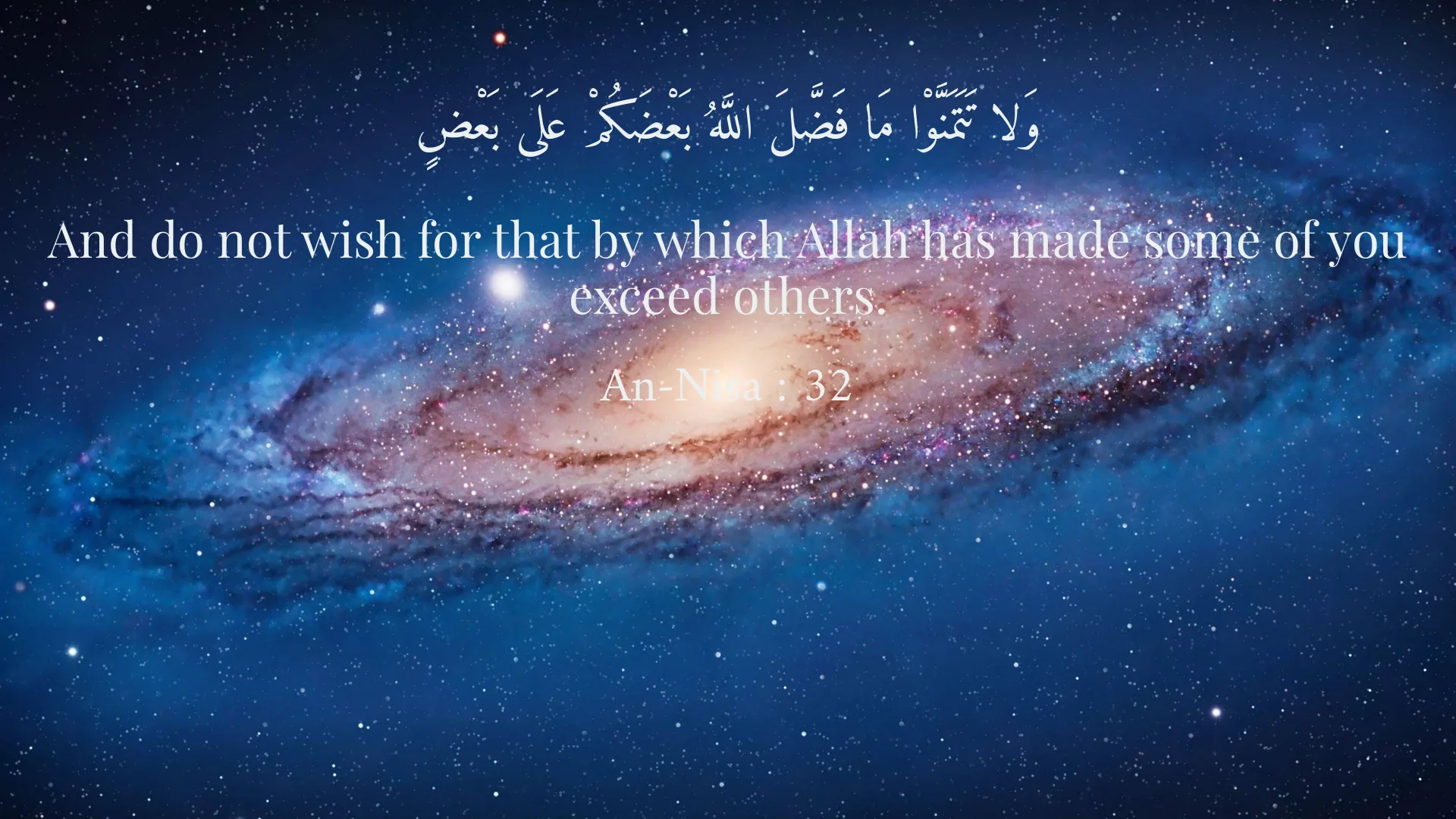
وَلا تَتَمَنَّوْا مَا فَضَّلَ اللَّهُ بَعْضَكُمْ عَلَى بَعْضٍ
And do not wish for that by which Allah has made some of you exceed others.
An-Nisa : 32
قُلْ لِلْمُؤْمِنِينَ يَغُضُّوا مِنْ أَبْصَارِهِمْ وَيَحْفَظُوا فُرُوجَهُمْ ذَٰلِكَ أَزْكَىٰ لَهُمْ ۗ إِنَّ اللَّهَ خَبِيرٌۭ بِمَا يَصْنَعُونَ
Tell the believing men to reduce (some) of their vision and guard their private parts. That is purer for them. Indeed, Allah is Acquainted with what they do.
An-Nur : 30
إِنَّ الْمُسْلِمِينَ وَالْمُسْلِمَاتِ وَالْمُؤْمِنِينَ وَالْمُؤْمِنَاتِ وَالْقَانِتِينَ وَالْقَانِتَاتِ وَالصَّادِقِينَ وَالصَّادِقَاتِ وَالصَّابِرِينَ وَالصَّابِرَاتِ وَالْخَاشِعِينَ وَالْخَاشِعَاتِ وَالْمُتَصَدِّقِينَ وَالْمُتَصَدِّقَاتِ وَالصَّائِمِينَ وَالصَّائِمَاتِ وَالْحَافِظِينَ فُرُوجَهُمْ وَالْحَافِظَاتِ وَالذَّاكِرِينَ اللَّهَ كَثِيرًا وَالذَّاكِرَاتِ أَعَدَّ اللَّهُ لَهُمْ مَغْفِرَةً وَأَجْرًا عَظِيمًا
Indeed, the مسلم men and مسلم women, the believing men and believing women, the devout men and devout women, the truthful men and truthful women, the patient men and patient women, the humble men and humble women, the charitable men and charitable women, the fasting men and fasting women, and those who guard their private parts, and men who remember Allah often and women who remember Allah often - Allah has prepared for them forgiveness and a great reward.
Al-Ahzab : 35
Short Story
One day, a man named Hamed went to the market and saw many women shopping together. He recalled the Quranic verses that present women as independent individuals with dignity. Hamed decided to treat women with more respect in his conversations and pay special attention to their rights. A few days later, one of his friends told him that he noticed positive changes in Hamed's behavior and that his relationships with women had improved.