Quranic Answer
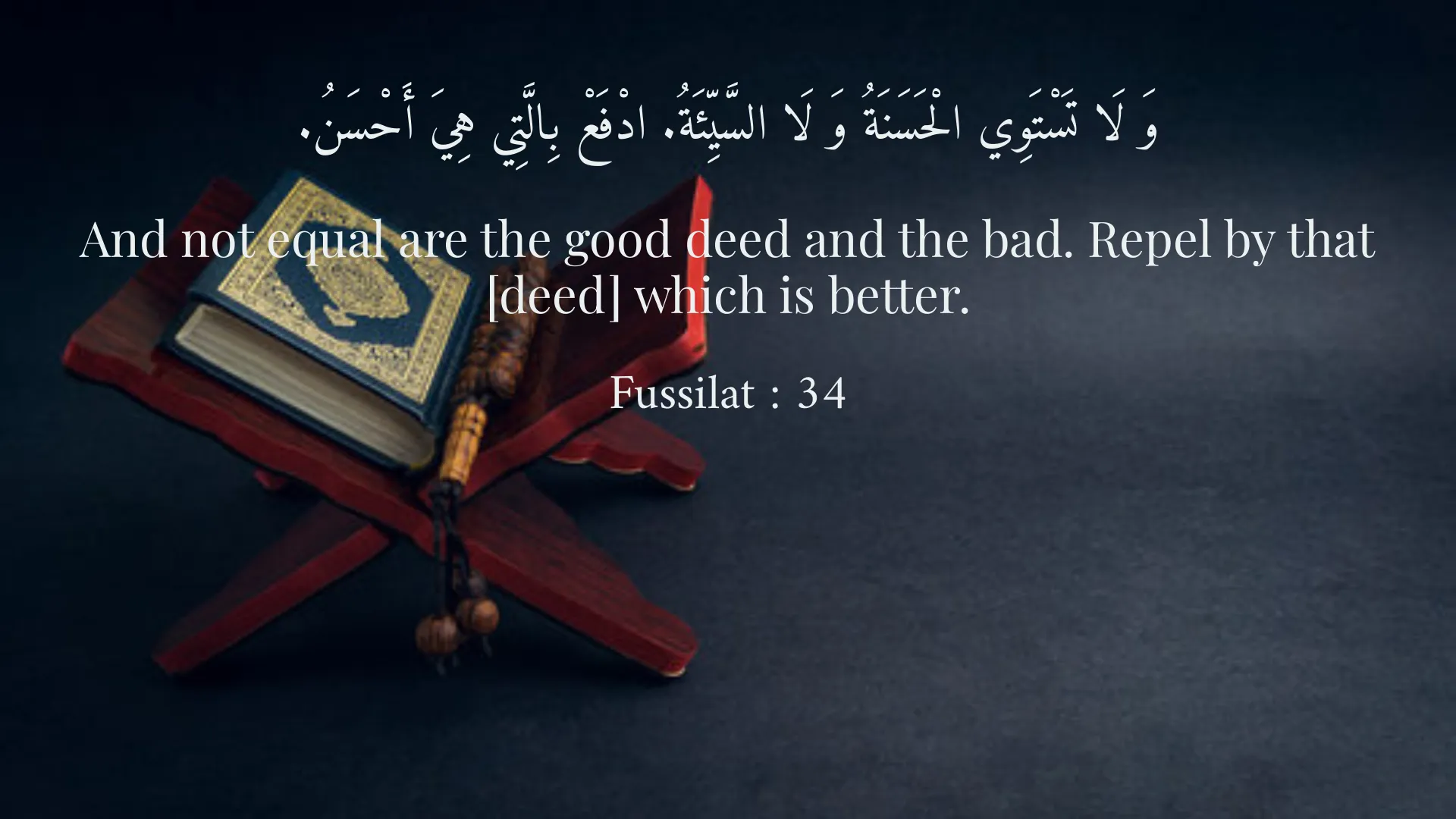
The Holy Quran, revered as the final words of God to humanity, consistently underscores the significance of performing virtuous actions and exercising mindfulness against malevolence. Within its verses, the Quran provides guidance on navigating the complexities of life, especially in dealing with conflict and adversity. One such verse that encapsulates this principle is found in Surah Fussilat, verse 34, which states, 'And not equal are the good deed and the bad. Repel by that [deed] which is better.' This profound directive encourages individuals to respond to malevolence with benevolence and to counteract misdeeds with good behavior, highlighting the transformative power of goodness in the face of evil. This teaching is not merely a religious edict; rather, it serves as a powerful, universal principle that can be applied in various aspects of our daily lives. In essence, the Quran invites us to elevate our responses to wrongdoing, advocating for a cycle of positivity that can break the chain of negativity. For instance, in situations where one might feel wronged or hurt by another’s actions, the Quran encourages us to forgive and respond with kindness. The act of forgiveness is not only liberating for the one who forgives but also more beneficial than seeking retribution. Developing a mindset focused on grace and understanding can foster healthier relationships and community ties, a message that resonates in many cultures and philosophies, further illustrating the Quran's timeless relevance. In another powerful verse, Surah Al-Imran, verse 133, Allah instructs, 'And hasten to forgiveness from your Lord and a garden as wide as the heavens and the earth, prepared for the righteous.' This verse signifies the importance of seeking forgiveness not only from others but importantly from God, presenting a vivid metaphor of paradise as a reward for those who embody righteousness through acts of kindness and forgiveness. The Quran emphasizes that moving toward a state of goodness grants one mercy, reinforcing the value of spiritual growth through virtuous actions. Furthermore, Surah Al-Baqarah, verse 177 brings forth another valuable lesson on righteousness. The verse states, 'Righteousness is not in turning your faces toward the east or the west, but rather includes doing good deeds in daily life.' Here, the Quran shifts the focus from mere rituals and outward appearances to the very essence of what it means to be righteous. It dismantles any superficial understanding of piety that relies solely on physical acts of worship or the direction of prayer. Instead, this verse encapsulates a holistic view of righteousness—one that is defined by our actions, compassion, and responsiveness to the needs of others. At its core, the messages relayed through these verses emphasize that goodness should be our default reaction when confronted with evil. This principle provides a framework for dealing with conflicts in our personal lives, within neighborhoods, or even on a larger societal scale. The Quran challenges us to move away from retaliation and instead embrace love, compassion, and empathy, proving that these attributes are far more potent than anger or bitterness. In practice, implementing this principle of responding to evil with good can be challenging. It requires a conscious effort to foster inner peace, patience, and understanding. Acknowledging our imperfections and the nature of humanity can aid in this process; we must recognize that everyone is prone to error and that responding with vengeance often perpetuates a cycle of hostility. Educating ourselves about conflict resolution and communication skills can also empower us to implement these teachings more effectively. Moreover, as we delve deeper into the community dynamics, the impact of promoting goodness becomes even more vital. The Quranic teachings encourage not only personal development but also collective growth, as acts of kindness can create a ripple effect, inspiring others to adopt similar behaviors. By nurturing an environment of compassion, we contribute to a culture that values peace and understanding, directly counteracting the impulsivity that can arise in conflict situations. Additionally, it is essential to acknowledge that responding to evil with good does not suggest passivity in the face of injustice. Rather, it teaches us to address wrongs calmly and thoughtfully, advocating for justice while simultaneously maintaining one’s dignity and integrity. Acts of goodness can take various forms, from simple gestures of kindness towards others to advocating for social justice issues that affect marginalized communities—each contributing to a greater good. In conclusion, the Quran’s repeated emphasis on the importance of doing good and reacting thoughtfully in the face of evil serves as a timeless reminder of our moral responsibilities. The teachings presented in Surah Fussilat, Surah Al-Imran, and Surah Al-Baqarah inspire individuals to respond to negativity with positivity, forgiveness, and acts of righteousness. This approach not only facilitates individual growth but also fosters cohesive community relationships, ultimately leading humanity toward a more peaceful coexistence. As we navigate through the complexities of our modern world, these principles remain as relevant as ever, inviting us to embody the goodness we wish to see in our lives and the world around us.
Related Verses
وَ لَا تَسْتَوِي الْحَسَنَةُ وَ لَا السَّيِّئَةُ. ادْفَعْ بِالَّتِي هِيَ أَحْسَنُ.
And not equal are the good deed and the bad. Repel by that [deed] which is better.
Fussilat : 34
وَ سَابِقُوا إِلَى مَغْفِرَةٍ مِّن رَّبِّكُمْ وَجَنَّةٍ عَرْضُهَا السَّمَاوَاتُ وَالْأَرْضُ أُعِدَّتْ لِلْمُتَّقِينَ
And hasten to forgiveness from your Lord and a garden as wide as the heavens and the earth, prepared for the righteous.
Al-Imran : 133
لَيْسَ الْبِرَّ أَن تُوَلُّوا وَجُوهَكُمْ قِبَلَ المَشْرِقِ وَالمَغْرِبِ وَلَكِنَّ الْبِرَّ مَنْ آمَنَ بِاللَّهِ وَالْيَوْمِ الآخِرِ وَالْمَلَائِكَةِ وَالْكِتَابِ وَالنَّبِيِّينَ.
Righteousness is not in turning your faces toward the east or the west, but [true] righteousness is in one who believes in Allah, the Last Day, the Angels, the Book, and the Prophets.
Al-Baqarah : 177
Short Story
One day, a man named Amir was walking through the city when someone insulted him. Amir initially felt very upset, but he remembered the verses of the Quran and decided to respond with kindness instead of retaliation. He smiled and said to the person, 'I hope you have a good day.' Surprisingly, the way the insulting person reacted changed, and he apologized. Amir learned that doing good in the face of bad is always effective.