Quranic Answer
The Holy Quran stands as a cornerstone of guidance for Muslims and is revered for its profound spiritual, ethical, and moral teachings. Among its many themes, the promotion of peace, coexistence, and harmonious living emerges as a pivotal aspect that resonates throughout various verses. Islamic teachings not only seek to establish a personal connection with the divine but also encourage a broader societal vision rooted in understanding and compassion. One of the central doctrines regarding peace in the Quran is encapsulated in the concept of ‘Salaam’, which translates to both peace and surrender to Allah’s will. This idea reflects the Quran's comprehensive approach to peace that encompasses individual tranquility, social harmony, and global coexistence. A key verse that underlines this theme can be found in Surah Al-Ma'idah, verse 32, which states: "For this reason, We decreed upon the Children of Israel that whoever kills a soul unless for a soul or for corruption [done] in the land—it is as if he had slain mankind entirely." This profound statement signifies the sanctity of human life and conveys the powerful message that taking a life unjustly equates to violating the existence of humanity as a whole. This verse emphasizes a crucial aspect of moral responsibility that transcends religious boundaries, advocating for the protection of human life as a universal principle. This sanctity is foundational to Islamic belief, where each soul is regarded as a sacred creation deserving of respect and dignity. The emphasis on life preservation invites believers to engage in actions that promote welfare and prevent harm, embodying the essence of peaceful living. Moreover, the Quran calls for peaceful interactions and engagement with others, including nations and communities outside of Islam. In Surah Al-Baqarah, verse 193, it conveys the guidance: "And fight them until there is no fitnah and [until] the religion is for Allah." This directive has often been the subject of various interpretations; however, a fundamental understanding highlights that warfare and conflict are permissible only as a last resort, primarily aimed towards establishing justice and truth. The overarching aim is not the pursuit of conflict for conflict's sake, but rather the restoration of balance and order in the face of oppression or transgression. The requirement to strive towards peace shines even brighter in Surah Al-Anfal, verse 61: "But if they incline to peace, you also incline to it." This specific directive encourages Muslims to respond positively to gestures of peace, fostering an environment of mutual understanding and cooperation. The implication is clear: Muslims are compelled to prioritize peace, creating pathways for dialogue and reconciliation rather than escalation and discord. The emphasis on responding favorably to peace even amidst adversity signals a profound commitment to conflict resolution through non-violent means. In addition to these verses, the Quran addresses broader themes of justice, compassion, and mercy. The ethos of justice underscores that a society founded on equity and fairness is essential to achieve and sustain lasting peace. Additionally, compassion is integral to the Quran’s teachings, as it encourages individuals to practice empathy and kindness towards others. The well-known verse in Surah Al-Anfal, which articulates the qualities of the faithful, underscores that true believers are those who possess feelings of compassion for their fellow beings, reinforcing the interconnectedness of humanity. Furthermore, the Quran intricately weaves the essence of forgiveness and tolerance into its teachings, highlighting their monumental importance in maintaining social cohesion. Surah Al-A'raf, verse 199, states: "Take what is given freely, enjoin what is good, and turn away from the ignorant." This encourages Muslims to embrace the principles of tolerance, seeking to uplift those who are disoriented without inducing further conflict. The idea of turning away from ignorance by promoting understanding over animosity serves as a practical approach for fostering peace in diverse settings, reflecting the necessity for patience and forbearance in human interactions. Moreover, contemporary scholars and community leaders draw from these Quranic principles to promote interfaith dialogue and understanding with individuals of varying beliefs and backgrounds. The conscientious application of Quranic teachings has proven beneficial in forging harmonious relations in multicultural societies, thus exemplifying how foundational spiritual texts can provide the framework for peaceful coexistence. In essence, the Quran's teachings on peace encourage not only the avoidance of strife but emphasize proactivity in building arenas of understanding and goodwill. To reiterate, the verse from Surah Al-Ma'idah underpins the vital understanding that the preservation of life is a shared human responsibility. Verses that promote peaceful interaction and encourage reconciliation underscore the spirituality each believer can cultivate, leading to a harmonious existence with others, regardless of their faith or cultural background. In conclusion, the Holy Quran offers important insights for promoting peace, tolerance, and coexistence in a world often marked by divisions and conflict. From the sanctity of life to the necessity of justice and compassion, the Quran encourages humanity to strive for a society marked by mutual respect and understanding. As modern issues continue to challenge these ideals, revisiting the Quranic prescriptions can guide both individual behavior and collective action, fostering a world where peace reigns supreme. It is this call for harmony and coexistence that echoes through the ages, remaining as relevant today as it ever was, providing a timeless framework that upholds the dignity and worth of every human being.
Related Verses
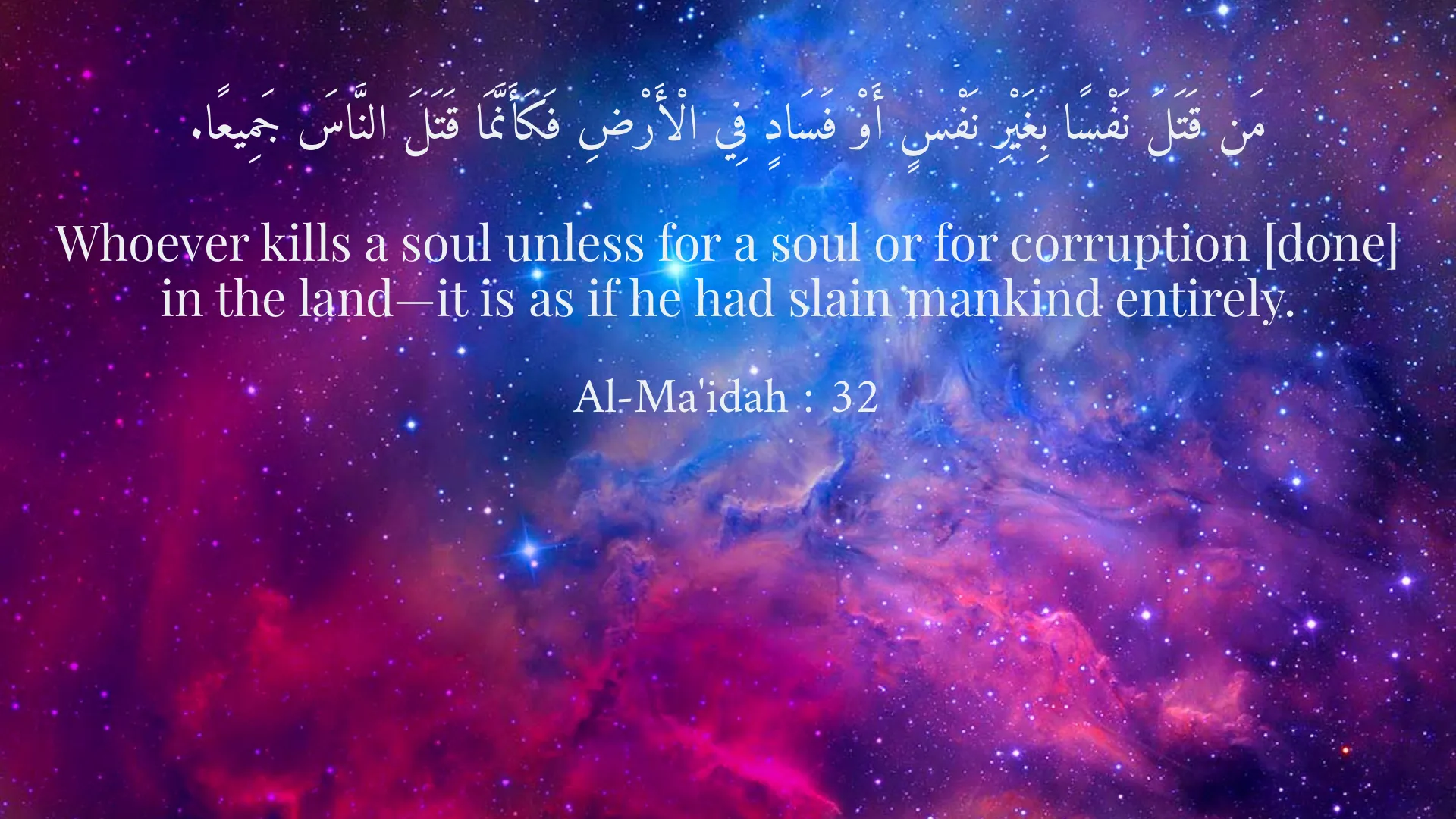
مَن قَتَلَ نَفْسًا بِغَيْرِ نَفْسٍ أَوْ فَسَادٍ فِي الْأَرْضِ فَكَأَنَّمَا قَتَلَ النَّاسَ جَمِيعًا.
Whoever kills a soul unless for a soul or for corruption [done] in the land—it is as if he had slain mankind entirely.
Al-Ma'idah : 32
وَقَاتِلُوهُمْ حَتَّى لَا تَكُونَ فِتْنَةٌ وَيَكُونَ الدِّينُ لِلَّهِ.
And fight them until there is no fitnah and [until] the religion is for Allah.
Al-Baqarah : 193
وَإِن جَنَحُوا لِلسَّلْمِ فَاجْنَحْ لَهَا.
But if they incline to peace, you also incline to it.
Al-Anfal : 61
Short Story
Once upon a time, in a small town, there lived a man named Hamid. He always taught others that they should live in peace and avoid conflict. One day, while walking in the market, he saw two people fighting. Hamid quickly intervened and invited both sides to peace. He reminded them of a verse from the Quran and explained how valuable a life in peace and love is. After his words, both parties came to an agreement and returned home hand in hand.