Quranic Answer
You’ve raised a profoundly important and vital question, as the preservation of privacy is one of the core pillars of individual tranquility and social cohesion in any society. While the modern term "privacy" itself is not directly used in the Holy Quran, numerous verses and teachings within it emphatically, both explicitly and implicitly, stress the necessity of respecting individuals' personal boundaries and prohibiting any transgression against them. This Quranic emphasis underscores Islam's deep and comprehensive view of human dignity, considering the observance of personal limits and boundaries as an integral part of ethical faith. One of the most prominent examples of respecting privacy in the Quran is found in the verses addressing the etiquette of entering homes. In Surah An-Noor, verses 27 and 28, Allah explicitly instructs believers not to enter houses other than their own without seeking permission and greeting their occupants first. This divine command is far more than a mere social etiquette; it reveals the profound Islamic perspective on the "psychological security" and "sense of ease" that individuals should experience in their private spaces. Imagine the chaos and widespread insecurity that would ensue if anyone could enter another's home without permission. To prevent such a scenario, the Quran has established this golden rule: "O you who have believed, do not enter houses other than your own houses until you ask permission and greet their people. That is better for you, that you may be reminded. And if you find no one within, then do not enter them until permission is given you. And if it is said to you, 'Go back,' then go back; it is purer for you. And Allah is Knowing of what you do." These verses explicitly affirm an individual's right to their personal space and prohibit any unauthorized entry. Even if permission is not granted or you are asked to leave, complying with this command, from the Quran's perspective, is purer for your soul and social conduct. This detailed instruction highlights Islam's foresight in establishing social norms that safeguard personal peace and prevent intrusive behaviors, laying a foundational principle for communal harmony. Furthermore, the Holy Quran explicitly prohibits spying and prying into others' hidden affairs. In Surah Al-Hujurat, verse 12, Allah the Almighty declares: "O you who have believed, avoid much [negative] assumption. Indeed, some assumption is sin. And do not spy or backbite each other. Would one of you like to eat the flesh of his brother when dead? You would abhor it. And fear Allah; indeed, Allah is Accepting of repentance and Merciful." This noble verse addresses three crucial aspects of privacy protection: Firstly, it advises avoiding excessive suspicion and negative assumptions, which often serve as the basis for intrusive behavior. Secondly, it directly forbids "tajassus," meaning to search for or investigate the hidden faults and secrets of others. This prohibition encompasses any attempt to discover what people intend to keep private, whether through eavesdropping, peeping, or any other means. Thirdly, it prohibits "gheebah" (backbiting), which is itself an infringement on an individual's privacy once their faults are exposed. Comparing backbiting to eating the flesh of one's dead brother profoundly illustrates the abhorrence of this act in Islam, emphasizing the importance of preserving people's honor even in their absence. These three injunctions collectively and comprehensively protect individuals' personal boundaries from undue curiosity and the disclosure of secrets, fostering an environment where individuals can feel secure in their personal lives without fear of intrusion or defamation. Moreover, the concept of "ghadd al-basar" or lowering the gaze, as found in Surah An-Noor, verse 30, also contributes to a form of visual privacy. When the Quran instructs believing men to lower their gaze and guard their private parts, it not only contributes to individual chastity and modesty but also implies refraining from intruding or meddling in what concerns others. Not looking at what one should not see is itself a way of respecting others' privacy and preventing visual intrusion. These commands teach Muslims not to be overly curious about what belongs to others and not to cross ethical boundaries. This extends beyond merely physical modesty; it encompasses respect for the sanctity of others' private moments and spaces, preventing unwanted gazes and intrusive observations, thereby building a society based on mutual respect. Beyond these specific prohibitions, Islam also emphasizes the preservation of "satr," or covering private parts, which is another form of physical privacy. These directives allow individuals to protect their bodies from prying eyes and maintain their personal boundaries against unwanted views. Protecting marital secrets, safeguarding the secrets of friends and family, and not exposing others' faults are all instances of privacy protection in Quranic teachings and the Prophetic tradition (Sunnah). Islam expects individuals not only to refrain from revealing their own faults but also to conceal the faults of others and prevent the spread of indecency and sin in society. These commands collectively foster an environment of trust, mutual respect, and security, where every individual can live with peace and dignity without fearing intrusion into their personal life. Therefore, it can be affirmed that the Holy Quran, through various means and from multiple dimensions, guarantees rights related to privacy and makes their observance an essential ethical and spiritual requirement for believers, providing a complete roadmap for harmonious social living.
Related Verses
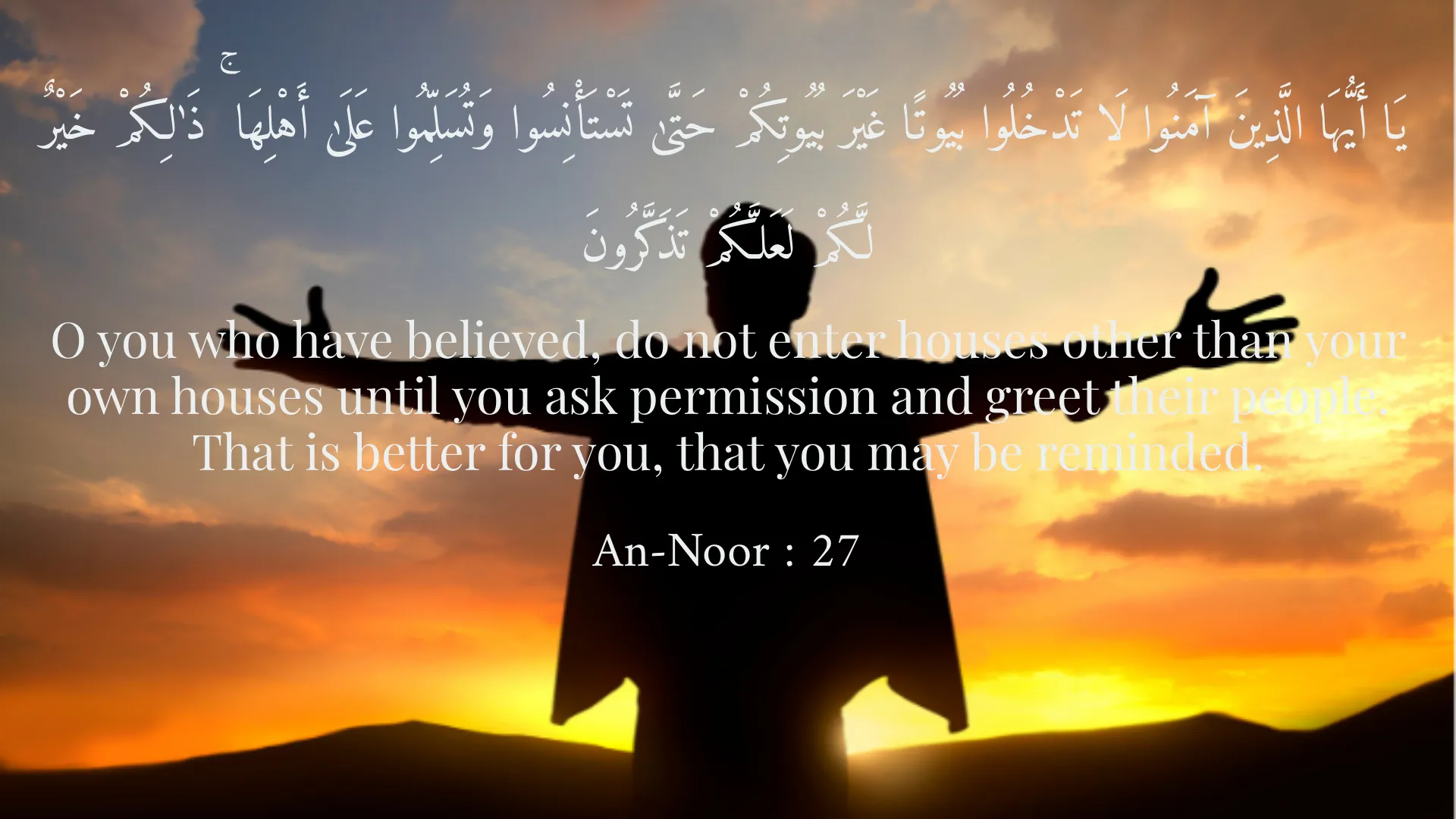
يَا أَيُّهَا الَّذِينَ آمَنُوا لَا تَدْخُلُوا بُيُوتًا غَيْرَ بُيُوتِكُمْ حَتَّىٰ تَسْتَأْنِسُوا وَتُسَلِّمُوا عَلَىٰ أَهْلِهَا ۚ ذَٰلِكُمْ خَيْرٌ لَّكُمْ لَعَلَّكُمْ تَذَكَّرُونَ
O you who have believed, do not enter houses other than your own houses until you ask permission and greet their people. That is better for you, that you may be reminded.
An-Noor : 27
فَإِن لَّمْ تَجِدُوا فِيهَا أَحَدًا فَلَا تَدْخُلُوهَا حَتَّىٰ يُؤْذَنَ لَكُمْ ۖ وَإِن قِيلَ لَكُمُ ارْجِعُوا فَارْجِعُوا ۖ هُوَ أَزْكَىٰ لَكُمْ ۚ وَاللَّهُ بِمَا تَعْمَلُونَ عَلِيمٌ
And if you find no one within, then do not enter them until permission is given you. And if it is said to you, "Go back," then go back; it is purer for you. And Allah is Knowing of what you do.
An-Noor : 28
يَا أَيُّهَا الَّذِينَ آمَنُوا اجْتَنِبُوا كَثِيرًا مِّنَ الظَّنِّ إِنَّ بَعْضَ الظَّنِّ إِثْمٌ ۖ وَلَا تَجَسَّسُوا وَلَا يَغْتَب بَّعْضُكُم بَعْضًا ۚ أَيُحِبُّ أَحَدُكُمْ أَن يَأْكُلَ لَحْمَ أَخِيهِ مَيْتًا فَكَرِهْتُمُوهُ ۚ وَاتَّقُوا اللَّهَ ۚ إِنَّ اللَّهَ تَوَّابٌ رَّحِيمٌ
O you who have believed, avoid much [negative] assumption. Indeed, some assumption is sin. And do not spy or backbite each other. Would one of you like to eat the flesh of his brother when dead? You would abhor it. And fear Allah; indeed, Allah is Accepting of repentance and Merciful.
Al-Hujurat : 12
قُل لِّلْمُؤْمِنِينَ يَغُضُّوا مِنْ أَبْصَارِهِمْ وَيَحْفَظُوا فُرُوجَهُمْ ۚ ذَٰلِكَ أَزْكَىٰ لَهُمْ ۗ إِنَّ اللَّهَ خَبِيرٌ بِمَا يَصْنَعُونَ
Tell the believing men to reduce [some] of their vision and guard their private parts. That is purer for them. Indeed, Allah is Acquainted with what they do.
An-Noor : 30
Short Story
It is narrated that in ancient times, a wise old man lived in a city, renowned for his profound insight. One day, an eager and curious young man approached him and said, "O Sage, I am very aware of the affairs of my neighbors and acquaintances, and I know their secrets. I believe this is a sign of my perceptiveness." The wise old man replied with a calm smile, "My son, true wisdom lies in knowing what benefits you, not in delving into what belongs to others. A neighbor's wall has its sanctity, and every curious gaze upon it is a violation of that sacredness. Every heart has a hidden corner to which no one but its owner has access. If instead of focusing your eyes on the affairs of others, you were to look at your own shortcomings, you would find the path to salvation closer. Peace is attained when you neither spy on the thoughts of others nor expose their secrets, for God is the Concealer of faults and invites humanity to conceal them." The young man took heed of the old man's words and learned that respecting others' privacy is a mark of etiquette and wisdom, bringing peace and tranquility.