Quranic Answer
The Holy Quran, revered as the ultimate text for guidance by over a billion Muslims around the globe, emphasizes a set of ethical principles that govern interpersonal relations, one of which is the prohibition of backbiting and slander. The harmful nature of these actions and their effects on society is articulated poignantly in Surah Al-Hujurat. In verse 12, Allah states: 'O you who have believed, avoid much [negative] assumption. Indeed, some assumption is sin. And do not spy or backbite each other. Would one of you like to eat the flesh of his brother while he is dead?' This verse serves as a powerful rhetorical device, urging believers to consider the utter grotesqueness of backbiting by likening it to cannibalism. The analogy highlights the severe moral implications of backbiting. When one engages in backbiting, they are not only neglecting the dignity of the individual being spoken about but are also engaging in an act that has a ripple effect on the community at large. This act of speaking ill of another person behind their back involves disclosing their weaknesses and flaws unjustly, creating an atmosphere of suspicion and discord. The term 'backbiting' in this context refers specifically to the action of talking about someone when they are not present, often in a disparaging manner. This act is not merely an innocent exchange of thoughts but is laden with consequences that can fundamentally disturb the social fabric. When people engage in such behavior, it can sow seeds of mistrust and resentment among individuals, thereby distancing them from each other. In the modern context, this is particularly relevant, as social media has amplified the potential for such negative talk to occur on a much larger scale. In addition to causing interpersonal rifts, backbiting can also lead to a culture of fear and insecurity. When people are aware that their actions and words are likely to be scrutinized and negatively interpreted, they may become guarded and less willing to engage openly with those around them. This can create an environment of superficial interactions, where trust and mutual respect are eroded. Thus, the Quran not only presents backbiting as an individual sin but underscores its communal implications, urging believers to foster relationships based on respect and understanding. Moreover, the Quran does not merely stop at prohibiting backbiting; it also guides believers toward a positive communal paradigm. Instead of indulging in negative assumptions and disparaging remarks about others, the believers are called to assume the best about one another. The significance of this principle is further articulated in verse 11 of Surah Al-Hujurat, where Allah advises: 'O believers! Let not a people ridicule [another] people; perhaps they may be better than them.' This verse serves multiple purposes. It conveys a profound humility, reminding individuals that one cannot accurately judge the worth of another person. In an increasingly diverse society, where individuals come from various backgrounds, cultures, and life experiences, promoting respect for one another's dignity is paramount. The Quran provides a framework not just for avoidance of negativity but also for cultivating an atmosphere of constructive interactions. It encourages believers to uplift one another as opposed to bringing one another down, fostering a sense of brotherhood and partnership. The social implications of adhering to these Quranic principles are far-reaching. By encouraging believers to refrain from backbiting and engage positively with others, the Quran emphasizes a collective responsibility toward nurturing a cohesive community. Such cohesion can lead to a harmonious society, where individuals feel valued and respected. When backbiting is eliminated, open communication may flourish, trust can be built, and relationships can deepen, all of which serve to unify individuals. Furthermore, considering the technological revolution that has taken place with the advent of social media, it becomes imperative to reflect on how backbiting can manifest in a digital space. In many cases, remarks made online can be more damaging due to their permanence and the vast reach they can achieve. Therefore, awareness and caution must be practiced in online interactions, ensuring that the guidelines provided in the Quran are followed even when discussions occur in a virtual domain. In conclusion, the Quran's emphasis on the prohibition of backbiting and slander serves as an essential guide for believers, directing them towards ethical conduct and promoting positive interactions. The analogy used in Surah Al-Hujurat not only highlights the moral gravity of such actions but also emphasizes the responsibility of individuals toward their community. By fostering a culture of trust, respect, and constructive dialogue, believers can cultivate relationships that uplift and empower one another. Therefore, it is not merely about refraining from backbiting, but actively promoting a community characterized by understanding, compassion, and respect for one another. The teachings of the Quran resonate in their call to create a world where negativity is overshadowed by kindness, where individuals are celebrated for their virtues rather than criticized for their flaws, ultimately leading to a healthier, more unified society.
Related Verses
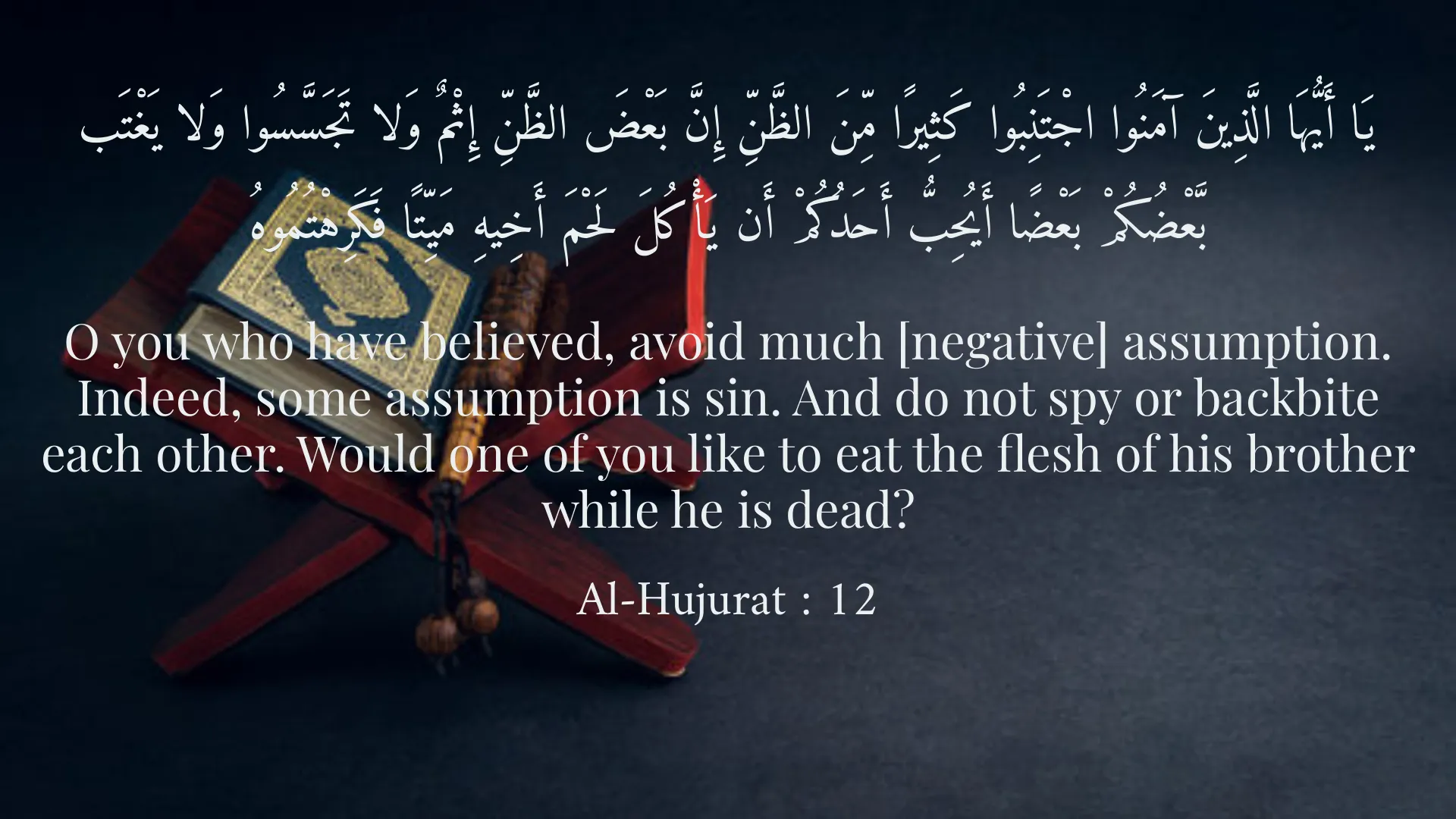
يَا أَيُّهَا الَّذِينَ آمَنُوا اجْتَنِبُوا كَثِيرًا مِّنَ الظَّنِّ إِنَّ بَعْضَ الظَّنِّ إِثْمٌ وَلا تَجَسَّسُوا وَلا يَغْتَب بَّعْضُكُمْ بَعْضًا أَيُحِبُّ أَحَدُكُمْ أَن يَأْكُلَ لَحْمَ أَخِيهِ مَيِّتًا فَكَرِهْتُمُوهُ
O you who have believed, avoid much [negative] assumption. Indeed, some assumption is sin. And do not spy or backbite each other. Would one of you like to eat the flesh of his brother while he is dead?
Al-Hujurat : 12
يَا أَيُّهَا الَّذِينَ آمَنُوا لَا يَسْخَرْ قَوْمٌ مِّن قَوْمٍ عَسَى أَن يَكُونُوا خَيْرًا مِّنْهُمْ
O believers! Let not a people ridicule [another] people; perhaps they may be better than them.
Al-Hujurat : 11
Short Story
Once upon a time, there was a man named Hassan who lived in a neighborhood where everyone talked about each other. Hassan decided to spend his time learning the verses of the Quran. When he returned home, he became familiar with the verses from Al-Hujurat and realized that backbiting and slander were very reprehensible. From that day onwards, Hassan never spoke ill of others, instead, he worked towards love and friendship.