Quranic Answer
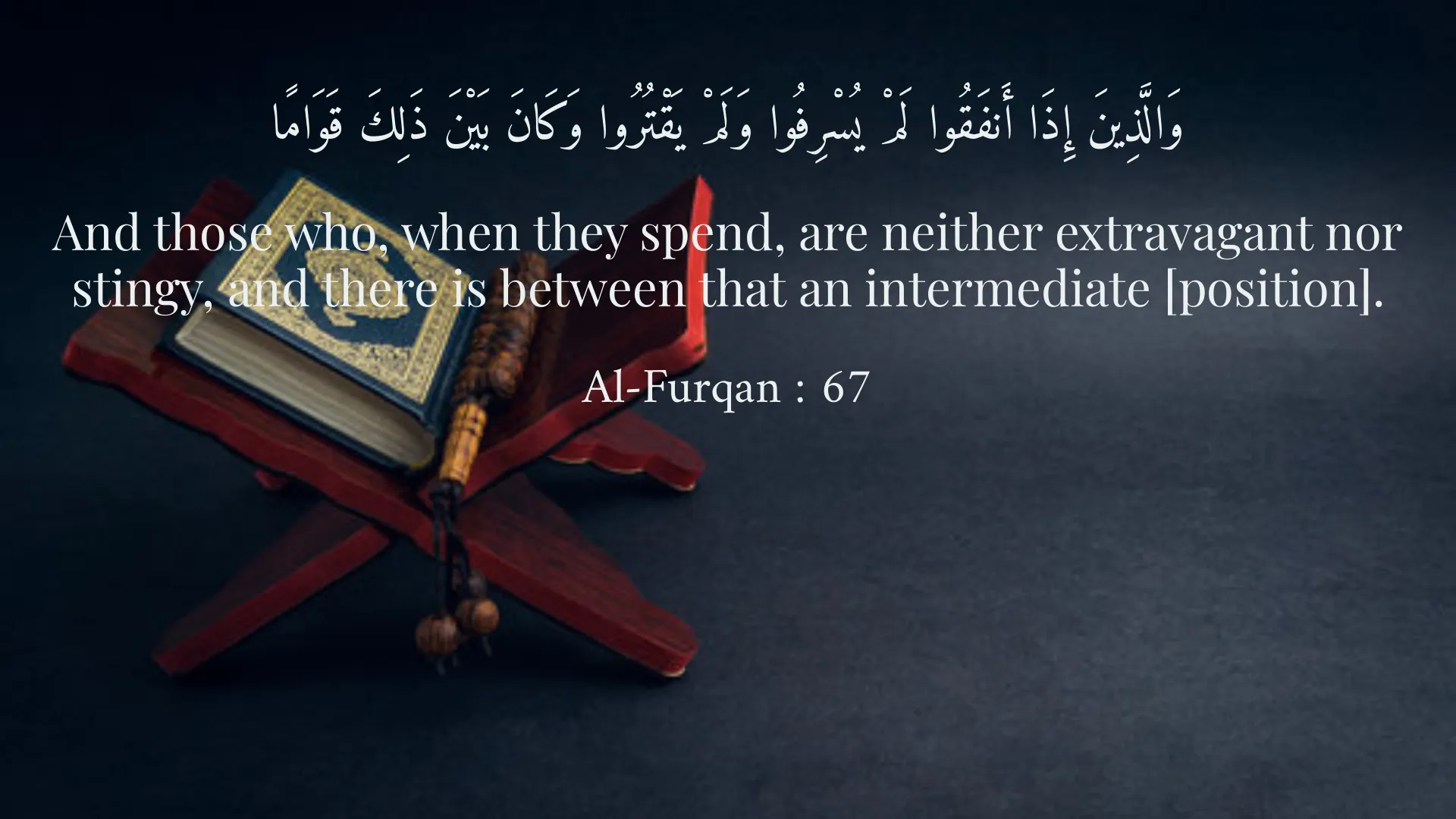
The Holy Quran stands as the foundational text of Islam, revered and respected by its followers for its divine guidance. It serves as a comprehensive manual that imparts principles and rules designed to achieve balance in life, advocating for a holistic approach to existence that encompasses the personal, social, spiritual, and material dimensions of human experience. In today's rapidly evolving society, individuals routinely encounter complexities and challenges in their daily lives, often leading to imbalances in their personal and communal spheres. The Quran addresses these issues with timeless wisdom, urging believers to adopt moderation and equilibrium in all aspects. A pertinent illustration of this teaching is found in Surah Al-Furqan, verse 67, where Allah instructs believers on the virtues of moderation when it comes to financial dealings. The verse states: "And those who, when they spend, are neither extravagant nor stingy, and there is between that an intermediate [position]." This statement encapsulates the essence of moderation, emphasizing that an individual’s approach to expenditure should not sway to extremes of either overspending or miserliness. It calls for a balanced stance, advocating for a practical yet considerate approach to financial management. This principle extends beyond mere spending; it encompasses the broader spectrum of social interactions, emotional states, and even professional conduct. In a world increasingly driven by consumerism and materialism, the Quran’s call for moderation serves as a crucial reminder of the importance of balance. Economic pressure and social expectations can easily lead to stress, anxiety, and financial instability. By adhering to the guideline of moderation proposed in Surah Al-Furqan, individuals can foster a more sustainable lifestyle that prioritizes not just their financial health but their overall well-being. This moderation encourages mindfulness, facilitating a deliberate and intentional approach to spending habits and material pursuits. Additionally, the Quran highlights the significance of justice and fairness in social interactions. Surah Al-An'am, verse 151 presents Prophet Muhammad (peace be upon him) as a paragon of equity, urging believers to conduct themselves with fairness and justice in all dealings. Equity requires balance, and through this verse, the Quran compels its followers to evaluate their behavior towards others. It discourages favoritism and prejudice, advocating instead for an inclusive approach that respects the rights and dignities of all individuals. This equity is paramount in maintaining harmonious communal relations and ensuring that social structures are fortified through mutual respect and acknowledgment. Furthermore, the Quran delves deeper into the theme of balance, emphasizing the necessity of striking a harmony not only between the worldly and the spiritual but also within one’s inner self. As conveyed in Surah Al-Qasas, balance emerges as an essential element that transcends personal life and permeates societal frameworks. While engaging with earthly matters, individuals are invariably encouraged to remain cognizant of their spiritual obligations and duties. This duality—where spiritual practice coexists alongside material engagement—can often lead to tension, thereby making it imperative to maintain equilibrium. By nurturing a relationship with the divine through prayer, patience, and dedication to spiritual practices, believers are reminded of their moral and ethical responsibilities. A balanced life, therefore, is one where faith informs everyday decisions, and spiritual nourishment aids in navigating life's adversities. Through such a framework, the Quran elucidates the necessity of intertwining worldly endeavors with a sense of spirituality, fostering a life imbued with purpose and significance. To further illustrate how balance manifests in the Quran’s teachings, consider the significance of patience and gratitude as recurring themes in various verses. Life inherently brings forth challenges, yet the Quran emphasizes patience (Sabr) as a virtue that enables individuals to navigate hardships with composure and resilience. Simultaneously, engaging in gratitude (Shukr) cultivates a positive outlook, allowing individuals to appreciate what they have, rather than focusing on what they lack. This dual practice of patience and gratitude aids in attaining emotional balance, fostering mental well-being, and contributing to overall happiness in life. In social contexts, the Quran advocates for compassion and kindness, emphasizing the importance of fostering love towards others. Engaging in acts of service or kindness not only strengthens community bonds but also serves to elevate personal moral stature. Importantly, the Quran underscores the notion that establishing relationships rooted in love and respect necessitates balance, where one’s interests do not overshadow another’s. Moreover, through the practice of community engagement and participation, believers are encouraged to contribute positively to societal development. This engagement solidifies social ties and enhances communal welfare, instilling a sense of collective responsibility that embodies the Quranic principles espoused throughout its verses. Thus, balance emerges not only as a personal goal but also as a communal responsibility, where individuals work in unison for the greater good of society. In essence, the teachings of the Quran imbue believers with comprehensive guidelines on how to navigate the multifaceted aspects of life with balance and moderation. Each principle presented throughout the Quran affirms that balance is achievable through adherence to divine teachings, which invariably enrich one’s personal and social realms. By integrating the values espoused in the Quran, such as moderation, justice, equity, patience, gratitude, and love, individuals can foster a life that is not only harmonious but also meaningful. The path to achieving balance lies in the commitment to these teachings, allowing believers to cultivate a life that reflects both their responsibilities to others and their obligations to themselves. Through this profound understanding of balance, the Quran ultimately guides its followers toward leading a fulfilling life, illuminating the path to divine acceptance and spiritual contentment.
Related Verses
وَالَّذِينَ إِذَا أَنفَقُوا لَمْ يُسْرِفُوا وَلَمْ يَقْتُرُوا وَكَانَ بَيْنَ ذَلِكَ قَوَامًا
And those who, when they spend, are neither extravagant nor stingy, and there is between that an intermediate [position].
Al-Furqan : 67
قُلْ تَعَالَوْا أَتْلُ عَلَيْكُمْ مَا حَرَّمَ رَبُّكُمْ عَلَيْكُمْ أَلَّا تُشْرِكُوا بِهِ شَيـًٔا وَبِالْوَالِدَيْنِ إِحْسَانًا
Say, 'Come, I will recite what your Lord has prohibited to you, that you not associate anything with Him and to parents, good treatment.'
Al-An'am : 151
وَابْتَغِ فِيمَا آتَاكَ اللّهُ الدَّارَ الْآخِرَةَ وَلَا تَنسَ نَصِيبَكَ مِنَ الدُّنْيَا
But seek the abode of the Hereafter in that which Allah has given you, and desire not less what has been given to you by Allah.
Al-Qasas : 77
Short Story
One day, a young boy named Hassan asked his mother, 'How can I have balance in my life?' His mother with a warm smile replied, 'Dear Hassan, the Quran is a great guide for us. Remember to allocate time between studying, exercising, and working, while maintaining balance in all these areas.' Upon hearing these words, Hassan realized that to reach his best self, he must follow the teachings of the Quran.