Quranic Answer
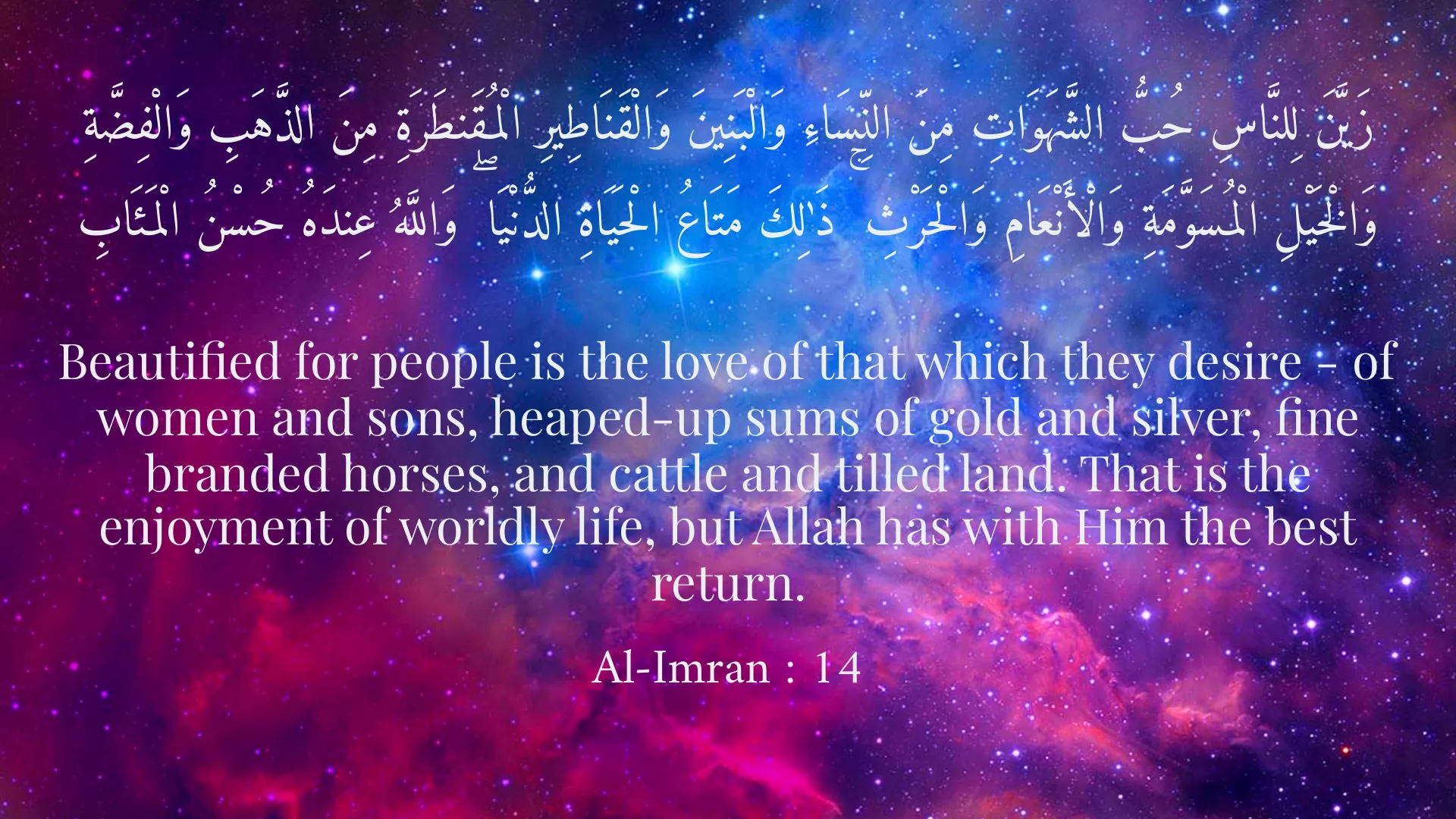
The Holy Quran serves as a complete and comprehensive guide in the lives of Muslims, offering recommendations for overcoming unhealthy attachments and achieving inner peace. Its verses encapsulate profound wisdom that aids individuals in understanding their purpose, priorities, and the transient nature of worldly possessions. Spirituality is at the heart of Islamic teaching, and the Quran encourages believers to rise above material desires to attain tranquility and fulfillment. In Surah Al-Imran, verse 14, Allah states, "Beautified for people is the love of that which they desire - of women and sons, heaped-up sums of gold and silver, fine branded horses, and cattle and tilled land. That is the enjoyment of worldly life, but Allah has with Him the best return." This verse draws attention to the intrinsic nature of human desire for material wealth and attraction to worldly pleasures. Despite their appeal, these attachments can lead people away from spiritual growth and a fulfilling life. The phrase "beautified for people" indicates that the allure of these worldly traits is part of a divine test. While Allah bestows upon people the ability to feel love for family, wealth, and possessions, He reminds them that such attachments, while natural, can serve as distractions from what truly matters – one’s relationship with the Divine. It is essential to understand that life on earth, with all its attractions, is fleeting. Hence, the quest for material possessions becomes, in the light of eternity, meaningless compared to the paradise that awaits the faithful in the hereafter. Acknowledging such transient nature encourages individuals to re-evaluate their priorities and aspirations. In their pursuit of happiness, many often delve deeper into these worldly desires, forgetting that the ultimate joy and peace reside with Allah. The message in Surah Al-Imran motivates Muslims to redirect their focus from the ephemeral nature of earthly possessions to the enduring eternal bliss that lies in a sincere connection with God. Furthermore, when individuals start to acknowledge their attachment to these temporary worldly matters, it becomes vital for them to seek spiritual enlightenment which brings balance and fulfillment. Engaging with divine teachings, reflecting on life's purpose, and nurturing one's relationship with Allah can play instrumental roles in breaking these worldly chains. Fostering spirituality thus emerges as a powerful antidote to overcoming unhealthy attachments. One of the verses that illustrate the greatness and omnipotence of Allah is found in Surah Al-Baqarah, verse 255, where Allah mentions Ayat al-Kursi: "Allah - there is no deity except Him, the Ever-Living, the Sustainer of existence..." This verse serves as a reminder of God's unparalleled greatness. Reflecting upon it reveals that all creations are under His dominion, and nothing holds permanence or offers security except Allah Himself. This recognition is liberating; it instills in individuals the understanding that no matter how complex human life becomes, it is but a temporary phase. Through Ayat al-Kursi, believers are called upon to focus on spirituality and the worship of the One who created all things, maintaining that no material attachment can suffice in filling the void or yearning for stability. Worshipping Allah not only deepens one’s faith but also inspires a profound sense of security and satisfaction that is often absent when one is engrossed in material pursuits. In this way, the Quran acts as a beacon, guiding individuals to concentrate on the everlasting rather than the ephemeral. Ultimately, the Quran, by offering solutions to detach from worldly attachments, continuously guides individuals toward inner peace and contentment. It encourages Muslims to embrace the philosophy that life should not be solely dedicated to the pursuit of desires but should also include a deep realization of spiritual objectives and community values. By nurturing one’s connection with Allah and engaging in acts of worship, individuals can cultivate a sense of serenity that surpasses material achievements. This journey towards inner peace is also about developing gratitude for what one has and finding joy in the simple, fulfilling aspects of life. Materialism, when left unchecked, can lead to feelings of emptiness and dissatisfaction, as people constantly seek more without recognizing the blessings that surround them. The Quran clears the path to a meaningful existence through reminders to be thankful for one's blessings, distract oneself from unbridled desires, and focus on spiritual growth. In conclusion, the Holy Quran emphasizes that true goodness and peace lie with God, inviting individuals to transcend material attachments and achieve inner fulfillment. By championing a connection with Allah and aligning one’s life purpose with divine teachings, Muslims are equipped to navigate life’s complexities and trials. In this light, the struggle against unhealthy attachments not only enhances personal spirituality but also weaves a richer, more meaningful communal tapestry that thrives within divine guidance. As such, the message of the Quran stands as a cornerstone in the quest for inner peace, guiding all who seek it along the transformative journey toward spiritual enlightenment.
Related Verses
زَيَّنَ لِلنَّاسِ حُبُّ الشَّهَوَاتِ مِنَ النِّسَاءِ وَالْبَنِينَ وَالْقَنَاطِيرِ الْمُقَنطَرَةِ مِنَ الذَّهَبِ وَالْفِضَّةِ وَالْخَيْلِ الْمُسَوَّمَةِ وَالْأَنْعَامِ وَالْحَرْثِ ۚ ذَٰلِكَ مَتَاعُ الْحَيَاةِ الدُّنْيَا ۖ وَاللَّهُ عِندَهُ حُسْنُ الْمَئَابِ
Beautified for people is the love of that which they desire - of women and sons, heaped-up sums of gold and silver, fine branded horses, and cattle and tilled land. That is the enjoyment of worldly life, but Allah has with Him the best return.
Al-Imran : 14
اللَّهُ لَا إِلَٰهَ إِلَّا هُوَ الْحَيُّ الْقَيُّومُ...
Allah - there is no deity except Him, the Ever-Living, the Sustainer of existence...
Al-Baqarah : 255
Short Story
One day, Masoud was walking in the park and reflecting on his life. He thought deeply about his attachments and wanted to find a way to distance himself from them. Suddenly, he recalled the verses of the Quran and realized he needed to get closer to his God to break free from those attachments. After that, he engaged in prayer and worship and felt a greater sense of peace and happiness in his life. From that day on, Masoud tried to distance himself from his attachments and always remembered God.