Quranic Answer
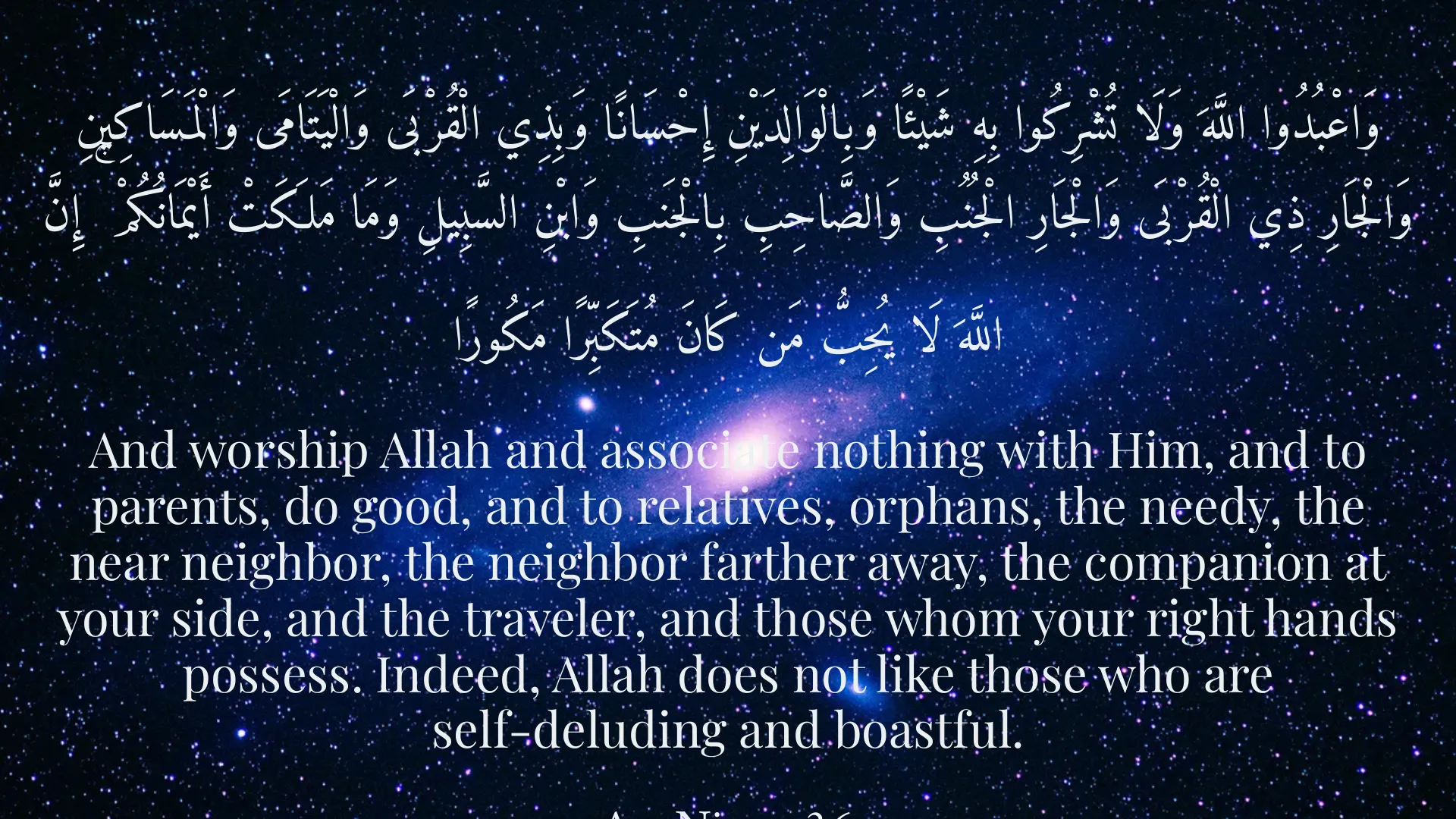
The Holy Quran emphasizes the behavior towards neighbors and the importance of kindness towards them. Islam, as a religion, has been a guiding light for billions of followers, cultivating a worldview that prioritizes compassion, charity, and respect. Among its many teachings, the treatment of neighbors holds a particularly significant place. The Quran and Hadiths provide continuous reminders regarding the ethical obligation Muslims have towards those who live in proximity to them. This article delves into the Quranic verses that illustrate the importance of neighborly conduct and expands upon the implications of such teachings in contemporary society. Firstly, it is crucial to acknowledge the profound message conveyed in Surah An-Nisa, verse 36: 'Worship Allah and associate nothing with Him, and to parents, do good, and to relatives, orphans, the needy, the near neighbor, the neighbor farther away, the companion at your side, the companion along the way, and those whom your right hand possesses. Indeed, Allah does not like those who are delusional and boastful.' This verse encompasses the core principle of social justice and responsibility, exhorting believers to foster an environment of goodwill that extends beyond familial ties to include neighbors of all degrees. The phrase 'the near neighbor' possesses significant implications. In a broader sense, neighbors refer not only to those who live directly next door but also to those within the community circles. Hence, the exhortation in this verse reflects the essence of an interconnected society where relationships form the very fabric of communal living. Neighbors, in this regard, hold rights and entitlements that must be acknowledged and honored. The instruction to treat neighbors with kindness encompasses actions ranging from simple gestures of friendliness to more consequential acts of service and support in times of need. Continuing in Surah Al-An'am, verse 151, Allah commands kindness towards neighbors: 'And do not approach the orphan's property except in a way that is best until he reaches maturity. And fulfill [every] commitment. Indeed, the commitment is ever [that which is] questioned.' This verse not only emphasizes the treatment of orphans but also signals a broader moral obligation towards individuals across various societal strata, including neighbors. The warning against the negligence of neighbors is a clear indication that the bonds between individuals should never be taken lightly. It serves as a reminder that neglecting these relationships can lead to social chaos and a breakdown of community trust. The thematic essence of these verses indicates that establishing loving and respectful relationships with neighbors is more than a societal nicety; it is an ethical and moral duty for Muslims. Such foundations are crucial in promoting peace, harmony, and understanding in diverse communities. Furthermore, the ethical principles of Islam are founded on love and mercy. Through the act of kindness towards neighbors, Muslims are encouraged to practice compassion and empathy. Acts of kindness could include providing assistance in various forms, whether through sharing food and resources, offering a listening ear in times of distress, or even participating in community activities aimed at fostering greater connections. Such gestures are integral in cultivating a robust neighborly rapport, leading to a society that not only thrives socially but also spiritually. Islamic narrations (Hadiths) further emphasize the significance of neighborly rights. The Prophet Muhammad (peace be upon him) stated: 'Jibril (Gabriel) kept recommending me about the neighbors until I thought that he would make them inherit.' This profound assertion illustrates that neighbors are considered an integral part of one's life and that their treatment should be on par with familial obligations. The strong emphasis on neighborly rights in Islamic teachings transcends mere civility, underscoring a deeper moral responsibility that Muslims are mandated to uphold. Additionally, the concept of good neighborliness acts as a tool against isolation, social fragmentation, and discord. Living in harmony with neighbors can foster understanding and promote diversity within communities. Today, the world is experiencing unprecedented levels of globalization, leading to a melding of cultures and lifestyles. In this context, the Islamic principle of neighborly kindness becomes ever more relevant. It reminds individuals that respect and compassion can bridge differences, enabling interactions that enhance communal bonds while reducing prejudices and stereotypes. In a modern context, applying these teachings can manifest in various ways such as organizing community service projects, participating in interfaith dialogues, or simply making an effort to know one’s neighbors personally. A simple act of sharing a meal or exchanging holiday greetings can break down barriers and establish strong friendships that can positively impact both the individual and community. Additionally, in times of crisis, the importance of neighborly relationships becomes apparent. Collective support systems can only arise from strong, healthy neighborly ties. COVID-19 has demonstrated the necessity of caring for one's neighbors, as communities banded together, providing assistance and support for those in need, thereby reflecting the very essence of mutual respect and kindness advocated by Islam. As we understand the Quran’s guidance, it becomes evident that build healthy community relationships starts from individual acts of goodwill. Therefore, the teachings of the Quran regarding neighbors extend beyond the spiritual realm into practical applications that influence Muslims’ everyday interactions. By remembering that our immediate environment and the people we live alongside deserve kindness and respect, we continue to nurture the bonds that define us as a community. In conclusion, the Holy Quran presents an unequivocal call to treat neighbors with kindness, compassion, and respect. This ethical stance is deeply rooted in Islamic teachings and shaped by the framework of love and mercy that characterizes the faith. The obligations set forth in the Holy Quran and reaffirmed through prophetic teachings are essential in fostering harmonious relationships within communities. Ultimately, acknowledging the rights of neighbors is not just a religious duty; it is a pathway toward achieving a more compassionate and united society.
Related Verses
وَاعْبُدُوا اللَّهَ وَلَا تُشْرِكُوا بِهِ شَيْئًا وَبِالْوَالِدَيْنِ إِحْسَانًا وَبِذِي الْقُرْبَى وَالْيَتَامَى وَالْمَسَاكِينِ وَالْجَارِ ذِي الْقُرْبَى وَالْجَارِ الْجُنُبِ وَالصَّاحِبِ بِالْجَنبِ وَابْنِ السَّبِيلِ وَمَا مَلَكَتْ أَيْمَانُكُمْ ۚ إِنَّ اللَّهَ لَا يُحِبُّ مَن كَانَ مُتَكَبِّرًا مَكُورًا
And worship Allah and associate nothing with Him, and to parents, do good, and to relatives, orphans, the needy, the near neighbor, the neighbor farther away, the companion at your side, and the traveler, and those whom your right hands possess. Indeed, Allah does not like those who are self-deluding and boastful.
An-Nisa : 36
قُلْ تَعَالَوْا أَتْلُ عَلَيْكُمْ مَا حَرَّمَ رَبُّكُمْ عَلَيْكُمْ أَلَّا تُشْرِكُوا بِهِ شَيْئًا وَبِالْوَالِدَيْنِ إِحْسَانًا وَأَلَّا تَقْرَبُوا مَالَ اليتيم إِلَّا بِالَّتِي هِيَ أَحْسَنُ حَتَّى يَبْلُغَ أَشُدَّهُ ۖ وَأَوفُوا الْكَيْلَ وَالْمِيزَانَ بِالْقِسْطِ ۚ لَا نُكَلِّفُ نَفْسًا إِلَّا وُسْعَهَا ۚ وَإِذَا قُلْتُمْ فَاعْدِلُوا وَلَوْ كَانَ ذَا قُرْبَى ۚ وَبِعَهْدِ اللَّهِ أَوْفُوا ۚ ذَٰلِكُمْ وَصَّاكم بِهِ لَعَلَّكُمْ تَذَكَّرُونَ
Say, 'Come, I will recite what your Lord has prohibited to you: that you not associate anything with Him and to parents, good treatment. And do not approach the orphan's property except in a way that is best until he reaches maturity. And give full measure and weight in justice. We do not burden a soul except according to its capacity. And when you speak, be just, even if it concerns a near relative. And fulfill the Covenant of Allah. This has He instructed you that you may remember.'
Al-An'am : 151
Short Story
One day, a man named Ahmad lived in a neighborhood where his neighbor always disrespected him. However, Ahmed decided to change his approach and treat his neighbor with love and respect. He greeted him every morning and helped him in times of need. Gradually, his neighbor was influenced by his kindness, and their relationship transformed into a deeper friendship. This change not only affected the neighbor's behavior but also created a friendly atmosphere among the residents of that street.