Quranic Answer
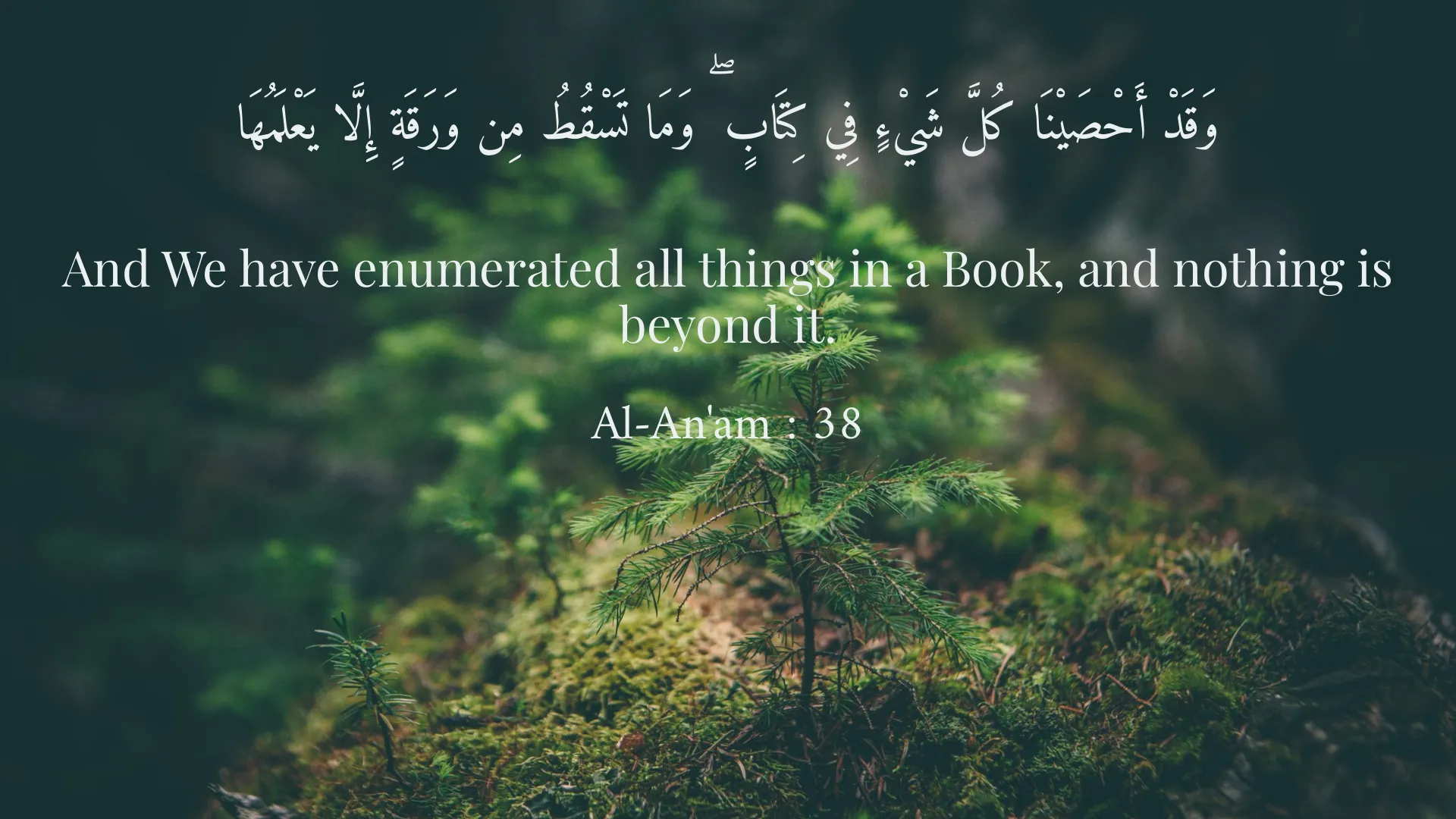
The Holy Quran is regarded as the central religious text of Islam, believed by Muslims to be the verbatim word of God as revealed to the Prophet Muhammad (peace be upon him) through the angel Gabriel. While its primary focus is on spirituality and morality, the Quran also emphasizes the importance of caring for the earth and the environment. This perspective is particularly striking in today’s context, where environmental degradation and climate change have become pressing global issues. In this article, we will explore the Quranic references to environmental preservation, examining how they underscore the responsibilities that humans hold towards nature and the implications of these teachings in contemporary society. The Quran recognizes the interdependence between humans and their environment. This relationship is beautifully illustrated in Surah Al-An'am (6:38): "And We have enumerated all things in a Book, and nothing is beyond it." This verse serves as a reminder that the natural world is a complex web of life, meticulously created and documented by God. Every living organism, as well as non-living elements, plays a significant role in maintaining the planet's ecosystem. Humans, as stewards of this creation, are called upon to recognize their indispensable role in safeguarding and nurturing it. The concept of stewardship is further emphasized in Surah Al-Baqarah (2:205), where Allah commands: "And when you return, do not cause corruption in the land or cause harm." This directive clearly delineates the expectation that humans should actively engage in the cultivation and preservation of the land, rather than exploiting it carelessly. The Arabic word used for "corruption" (fasad) encompasses a broad spectrum of actions detrimental to the earth, including pollution, deforestation, and overconsumption of resources. As such, the Quran challenges Muslims to not only avoid destructive behaviors but also to adopt sustainable practices in their relationship with the environment. Furthermore, the Quran continuously stresses the importance of balance within the natural world. Surah Al-Rahman (55:7-9) states, "And the earth He has put down for the creatures. In it are fruits, and palm trees having sheaths (of dates). And He has set the balance, that you may not transgress the balance." The metaphor of balance indicates that nature functions optimally when all elements operate in harmony, which conveys an important lesson about the consequences of disruption. Over-extraction, wastefulness, and neglect all contribute to ecological imbalance, leading to the destruction of habitats and loss of biodiversity. Moreover, the Quran's teachings on environmental responsibility are not abstract notions; they are integrally tied to the ethical and moral framework guiding the Muslims' daily actions. It compels individuals to consider the impact of their decisions on future generations, reminding them that their stewardship will be evaluated not only in this life but also in the Hereafter. As stated in Surah Al-Isra (17:31), "And do not kill your children for fear of poverty; We provide for them and for you. Killing them is a great sin." This verse not only addresses the sanctity of life but also underlines the divine assurance that sustenance will be provided. It encourages believers to trust in God’s provision, promoting an attitude of gratitude and responsibility towards the environment, fostering a culture of conservation and sustainability. In addition to individual responsibility, the Quran also calls for collective action and community efforts in environmental stewardship. It encourages Muslims to engage collectively in the protection of their surroundings, as seen in the concept of "Amr bil Ma‘ruf wa Nahi 'an al-Munkar," which refers to enjoining good and forbidding evil. This principle can extend to advocating for environmental justice, supporting policies that protect natural resources, and participating in conservation initiatives. By fostering a sense of community responsibility, the Quran transforms environmental preservation into a collective duty rather than a solitary endeavor. The relevance of Quranic teachings on environmental conservation is becoming increasingly urgent in light of modern environmental challenges, including climate change, deforestation, pollution, and loss of biodiversity. The Islamic community, both locally and globally, is beginning to recognize its responsibility to take an active role in addressing these challenges. From grassroots movements advocating for eco-friendly practices to Islamic organizations promoting sustainable development, the Quran's message is serving as an inspiration for a growing trend towards environmental consciousness among Muslims. One notable example of the intersection between Islamic teachings and environmental activism can be seen in the recent emergence of eco-Islamic initiatives, which aim to reconcile faith with environmental awareness. Numerous scholars, activists, and organizations are harnessing the Quran's teachings to promote sustainable behaviors, raise awareness of global warming, advocate for renewable energy, and preserve natural habitats. The efforts of these individuals and groups exemplify how a deeper understanding of the Quranic perspective can contribute positively to environmental practices and policies. Ultimately, the Holy Quran serves as a timeless guide, emphasizing humanity’s role as guardians of the earth. It holds individuals and societies accountable for the stewardship of natural resources, encouraging a lifestyle that balances spiritual practice with environmental ethics. By internalizing these teachings and applying them to contemporary issues, Muslims are empowered to take meaningful action in the fight against environmental degradation. In conclusion, the Quranic teachings on environmental preservation challenge Muslims to view their relationship with nature as one of responsibility and care. As custodians of the earth, it is imperative that they strive for sustainable living and advocate for the protection of the environment. By engaging with these teachings and translating them into action, Muslims can contribute to a healthier, more sustainable planet for future generations. The imperative to protect the earth is not just an environmental issue; it is a deeply spiritual one, reminding us of our connection to all creation and our duty to honor, protect, and cherish the world we inhabit.
Related Verses
وَقَدْ أَحْصَيْنَا كُلَّ شَيْءٍ فِي كِتَابٍ ۖ وَمَا تَسْقُطُ مِن وَرَقَةٍ إِلَّا يَعْلَمُهَا
And We have enumerated all things in a Book, and nothing is beyond it.
Al-An'am : 38
وَإِذَا تَوَلَّى سَعَى فِي الْأَرْضِ لِيُفْسِدَ فِيهَا وَيُهْلِكَ الْزَرْعَ وَالنَّسْلَ ۚ وَاللَّهُ لَا يُحِبُّ الْفَسَادَ
And when he goes away, he strives throughout the land to cause corruption therein and destroy crops and offspring. And Allah does not like corruption.
Al-Baqarah : 205
Short Story
One day, a Muslim man was sitting by a river and thinking about the beauty of nature. He said to himself, 'Allah created this place for us to enjoy, and we must strive to protect it.' He decided to come every day for cleaning by the river and continued this effort with his friends. His efforts inspired many others to take action in preserving the environment.