Quranic Answer
The Holy Quran, as a comprehensive guide for humanity's life, while not directly using modern terminology like "relentless pressure for productivity" or "excessive productivity," offers profound principles and frameworks that help us approach these phenomena in a balanced and constructive manner. The Quranic worldview is founded on balance, moderation, and purposefulness in life, and it explicitly prohibits any form of extremism, including being excessively engrossed in worldly and purely materialistic pursuits. In the current era, where humanity faces increasing challenges such as stress from intense competition, high societal expectations, and pressure to achieve maximum productivity, the teachings of the Quran shine as a guiding light. These teachings remind us that life is far more than mere production and accumulation of wealth; spiritual, physical, social, and moral dimensions are equally important and should not be sacrificed for the sake of one specific aspect. One of the most central Quranic concepts relevant to confronting relentless productivity pressures is the principle of "moderation" and "balance" (Mizaan). Allah in the Quran repeatedly emphasizes establishing justice and maintaining balance in all affairs. This balance must be observed not only in social and economic relations but also in an individual's lifestyle. A true believer is one who strikes a harmony between work and worship, between striving for livelihood and focusing on the Hereafter, and between their own rights and the rights of others. Verse 77 of Surah Al-Qasas beautifully articulates this principle: "But seek, through that which Allah has given you, the home of the Hereafter; and [yet], do not forget your share of the world. And do good as Allah has done good to you. And desire not corruption in the land. Indeed, Allah does not like corrupters." This verse explicitly states that one should not abandon the world entirely but should benefit from it, yet the ultimate and primary goal should be to attain divine pleasure and ultimate success in the Hereafter. This draws a delicate and vital balance that saves humans from drowning in purely worldly and material demands. In this verse, striving for the Hereafter is mentioned before benefiting from the world, indicating proper prioritization. However, not forgetting one's share of the world is also emphasized, meaning neither extremism in worldliness nor neglect of the world. When an individual focuses solely on material productivity, they might cause "corruption in the land"; this corruption can include neglecting the rights of others, damaging the environment, or even harming one's own mental and physical health. Such an approach, which leads to a loss of balance, is inconsistent with the Quranic perspective. Furthermore, the Quran identifies the primary purpose of human creation as "worship" and servitude to Allah. In Surah Adh-Dhariyat, verse 56, we read: "And I did not create the jinn and mankind except to worship Me." This verse reminds us that even at the peak of worldly activities and efforts for productivity, we must not lose sight of the fundamental purpose of creation. Relentless pressure for productivity often leads individuals to reduce their acts of worship, distance themselves from family and friends, and even jeopardize their physical and mental health. From a Quranic perspective, true productivity is that which serves higher human and divine objectives, rather than becoming an idol that consumes all of one's energy and time. If the pursuit of productivity reaches a point where it diverts a person from remembering Allah, from fulfilling religious duties, from family, and from their human responsibilities, then this productivity is not only not commendable but rather blameworthy. This neglect of the ultimate purpose is a profound loss that renders all worldly successes meaningless. Moreover, the Quran places significant emphasis on the importance of "rest" and appropriate "timing" for activities. In Surah Al-Furqan, verse 47, it states: "And it is He who made the night for you a covering and sleep a rest and made the day a [time for] movement." This verse indicates that Allah has appointed suitable times for every activity. Night is for rest and tranquility, allowing the body and soul to rejuvenate, and day is for striving and seeking lawful livelihood. Relentless productivity pressures often disrupt this natural and divine cycle; individuals are forced to work long hours, sacrifice sleep, and lose opportunities for rest and recovery. This not only leads to physical and mental exhaustion but also reduces long-term efficiency and creativity. Physical and mental health are divine trusts (amanah) that must be safeguarded, and disrupting this natural cycle is contrary to this trusteeship. The Quran implicitly opposes such a lifestyle that sacrifices human health and tranquility, because an exhausted person will not only lack the necessary efficiency in worldly matters but will also be hindered from performing spiritual duties. The issue of "contentment" (Qana'ah) and "reliance on Allah" (Tawakkul) are also crucial points that address productivity pressures. Much of this pressure stems from fear of poverty, desire for more wealth accumulation, or competition with others. The Holy Quran repeatedly invites people to rely on Allah and to avoid greed and avarice. In Surah At-Takathur, it explicitly condemns "rivalry in worldly increase" (takathur), stating: "Competition in [worldly] increase diverts you, Until you visit the graveyards." These verses serve as a serious warning for those who spend their lives in relentless competition to gather more and more, becoming heedless of the main purpose of life. This greed and avarice can be the source of internal and external pressures for unlimited productivity. The Quran teaches us that Allah is the Provider, and concern over sustenance should not lead us to unhealthy practices, unethical behaviors, or negligence of our primary duties. True reliance on Allah does not mean abandoning effort, but rather making reasonable effort and then entrusting the results to Allah, without falling into the abyss of anxiety, greed, and avarice. The concept of Barakah (blessings), a Quranic and Islamic concept, indicates that sometimes, with less frantic effort but with pure intention and reliance on Allah, greater achievements can be attained, because Allah places blessings in one's time and resources. In conclusion, it can be stated that the Quran, with its comprehensive and human-centered approach, provides a framework for life in which work and striving for livelihood are commendable, and idleness is discouraged, but this striving is never presented as the ultimate goal of life. Desirable productivity from the Quranic perspective is that which leads to human growth and elevation in all dimensions, not just the material. This approach helps us, in today's fast-paced world, while striving for success and lawful earnings, to escape the trap of excessive pressures and to live a life of meaning, tranquility, and purpose. The Quran reminds us that human worth is not measured by their output or wealth, but by their piety, faith, good character, and the service they render to humanity. Therefore, the Quran's response to relentless pressure for productivity is a call to re-evaluate values, prioritize correctly, and move towards a balanced and harmonious life in which the pleasure of Allah, physical and mental health, and inner peace are considered more important than any material gain or external success. This insight serves as a powerful antidote to the prevailing culture that often turns humans into machines for greater production, instead guiding them towards a higher quality and more meaningful life.
Related Verses
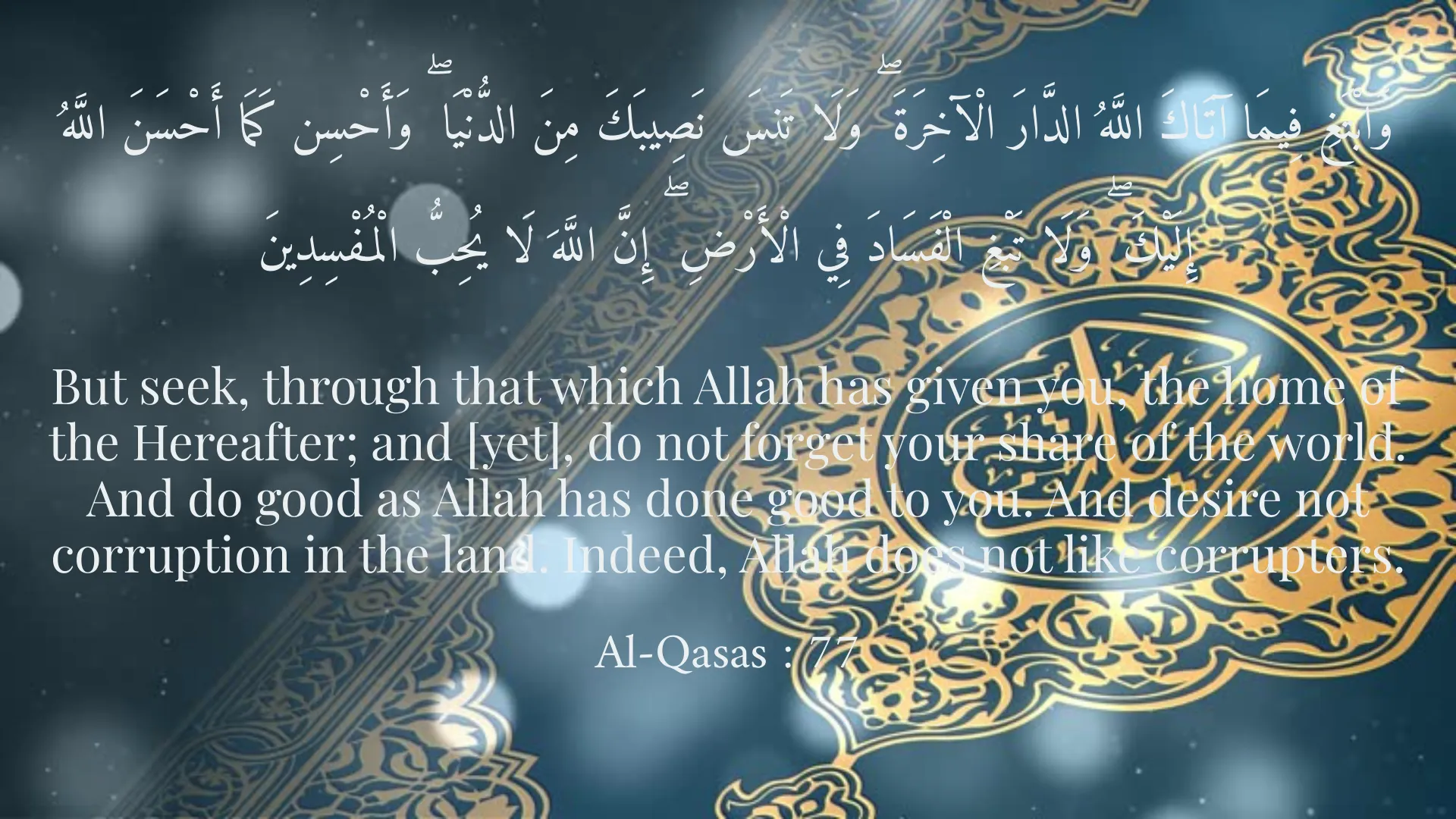
وَابْتَغِ فِيمَا آتَاكَ اللَّهُ الدَّارَ الْآخِرَةَ ۖ وَلَا تَنسَ نَصِيبَكَ مِنَ الدُّنْيَا ۖ وَأَحْسِن كَمَا أَحْسَنَ اللَّهُ إِلَيْكَ ۖ وَلَا تَبْغِ الْفَسَادَ فِي الْأَرْضِ ۖ إِنَّ اللَّهَ لَا يُحِبُّ الْمُفْسِدِينَ
But seek, through that which Allah has given you, the home of the Hereafter; and [yet], do not forget your share of the world. And do good as Allah has done good to you. And desire not corruption in the land. Indeed, Allah does not like corrupters.
Al-Qasas : 77
وَمَا خَلَقْتُ الْجِنَّ وَالْإِنسَ إِلَّا لِيَعْبُدُونِ
And I did not create the jinn and mankind except to worship Me.
Adh-Dhariyat : 56
وَهُوَ الَّذِي جَعَلَ لَكُمُ اللَّيْلَ لِبَاسًا وَالنَّوْمَ سُبَاتًا وَجَعَلَ النَّهَارَ نُشُورًا
And it is He who made the night for you a covering and sleep a rest and made the day a [time for] movement.
Al-Furqan : 47
أَلْهَاكُمُ التَّكَاثُرُ
Competition in [worldly] increase diverts you,
At-Takathur : 1
حَتَّىٰ زُرْتُمُ الْمَقَابِرَ
Until you visit the graveyards.
At-Takathur : 2
Short Story
It is related in Saadi's Bustan that there was a dervish who had withdrawn to a solitary corner, finding contentment and joy in remembrance of God. One day, a king from that land passed by him and asked: "O dervish, how do you spend your days in this solitude and poverty, and from where do you derive this peace?" The dervish smiled and replied: "O King, our comfort lies in being freed from the shackles of endless greed and desires. We are content with what the Almighty bestows upon us, and we do not allow the glitter of the world to blind our eyes, making us ceaselessly run after more. Whoever puts their heart in the world and spends day and night pursuing accumulation will never find peace and tranquility, even if they acquire all the treasures of the world." The king took heed from this saying and realized that true peace lies in contentment and liberation from the relentless pressures of acquiring more.