Quranic Answer
The Holy Quran, revealed over 1400 years ago, does not contain explicit verses mentioning terms like "digital upbringing," "internet," "smartphones," or "social media." This is naturally due to the historical context of its revelation, long before such technologies emerged. However, to conclude that the Quran has nothing to say on the matter would be a significant oversight. The Quran is a timeless divine guidance, offering universal principles and ethical frameworks that are profoundly applicable to every era and every human challenge, including the complexities of the modern digital landscape and the upbringing of the new generation within it. Its wisdom transcends technological advancements, providing a moral compass for navigating new realities. At its core, digital upbringing is about instilling values, discipline, critical thinking, and responsible behavior in children as they interact with digital technologies. The Quran addresses all these foundational aspects of human conduct, knowledge acquisition, and moral development. It lays down comprehensive guidelines for individual and societal well-being, which can be seamlessly applied to the digital realm. Firstly, the Quran strongly emphasizes the importance of seeking knowledge and truth (علم و حقیقت) and the necessity of verification (تثبت). In an age saturated with information, often unsubstantiated or false, this Quranic principle becomes critically important. Allah states in Surah Al-Hujurat (49:6): "O you who have believed, if there comes to you a disobedient person with information, investigate, lest you harm a people out of ignorance and become, over what you have done, regretful." This verse directly advises against accepting information blindly and urges thorough investigation. For children growing up in the digital age, where misinformation and fake news spread rapidly, teaching them to question sources, verify facts, and think critically before sharing is a direct application of this Quranic command. Parents are tasked with cultivating an environment where discernment is valued over superficial engagement. This involves teaching children to analyze content, identify biased sources, and understand the difference between reliable and unreliable information. Without this foundational skill, children are susceptible to manipulation and exploitation in the vast digital ocean. Secondly, the Quran places immense value on truthfulness (صدق) and strictly prohibits falsehood, slander, and backbiting (کذب، غیبت، بهتان). Online platforms can unfortunately become breeding grounds for these negative behaviors, from cyberbullying and spreading rumors to creating deceptive online personas. The Quran warns against such conduct. For instance, Surah An-Nur (24:19) states, "Indeed, those who like that immorality should be spread [or publicized] among those who have believed will have a painful punishment in this world and the Hereafter." This verse, while referring to immorality in general, can be extended to the rapid spread of falsehoods and harmful content online. Teaching children the sanctity of truth, the destructive nature of lies, and the responsibility that comes with communication – whether verbal or digital – is a core Quranic value. It means teaching them not to engage in cyberbullying, not to spread hurtful messages, and to respect the privacy and dignity of others online. Furthermore, parental guidance in this area involves monitoring online interactions and fostering open communication about online experiences. Thirdly, the principle of moderation and balance (اعتدال و قسط) is recurrent in the Quran. It encourages avoiding extremes in all aspects of life. While not specifically mentioning screen time, the concept of balanced living certainly applies to digital consumption. Excessive screen time can lead to various issues, including physical inactivity, social isolation, and exposure to inappropriate content. The Quran praises those who are moderate in their ways, as seen in Surah Al-Furqan (25:67) which describes the servants of the Most Merciful as those who, when they spend, "are neither extravagant nor stingy, but moderate between that." While this verse directly addresses spending, its underlying principle of balance is universally applicable. Parents should guide their children to use digital devices purposefully and moderately, ensuring they also engage in physical activities, face-to-face interactions, and other beneficial pursuits. It's about integrating technology as a tool for learning and connection, not allowing it to dominate or displace other essential aspects of life and development. Fourthly, the Quran emphasizes responsibility and accountability (مسئولیت و محاسبه) for one's actions, both in this world and the Hereafter. Every click, every share, every comment online leaves a trace and carries implications. Surah Al-Isra (17:36) highlights this: "And do not pursue that of which you have no knowledge. Indeed, the hearing, the sight and the heart - about all those [one] will be questioned." This verse underscores the importance of critical engagement with information and the responsibility for what one hears, sees, and feels – which applies directly to digital content consumption. Parents must teach children that their online actions have real-world consequences and that they are accountable for their digital footprint. This includes respecting intellectual property, refraining from illegal downloads, and understanding the ethical implications of their online behavior. Finally, the Quran places a significant burden of parental responsibility (مسئولیت والدین) on guardians to protect and guide their families. Surah At-Tahrim (66:6) instructs: "O you who have believed, protect yourselves and your families from a Fire whose fuel is people and stones..." This verse is a powerful reminder that parents are entrusted with the spiritual and moral well-being of their children. In the digital age, this responsibility extends to guiding children through the online world, protecting them from its harms, and teaching them how to use technology constructively and ethically. This might involve setting boundaries, using parental controls, educating children about online dangers, fostering open dialogue about their digital experiences, and modeling responsible digital behavior themselves. It's not about prohibiting technology, but about empowering children with the wisdom and self-control to use it in a way that benefits them and society, aligning with Islamic values of righteousness, knowledge, and integrity. In conclusion, while the Quran does not explicitly mention "digital upbringing," its timeless principles concerning knowledge, truthfulness, responsibility, moderation, and parental guidance provide a comprehensive and robust framework for raising children in the digital age. These principles empower parents to foster a generation that can leverage technology for good, while safeguarding themselves and others from its potential pitfalls, ensuring their holistic development aligns with divine wisdom. The challenge for parents is to interpret and apply these enduring values to the ever-evolving technological landscape, shaping a generation that is not merely digitally literate but also ethically conscious and morally upright.
Related Verses
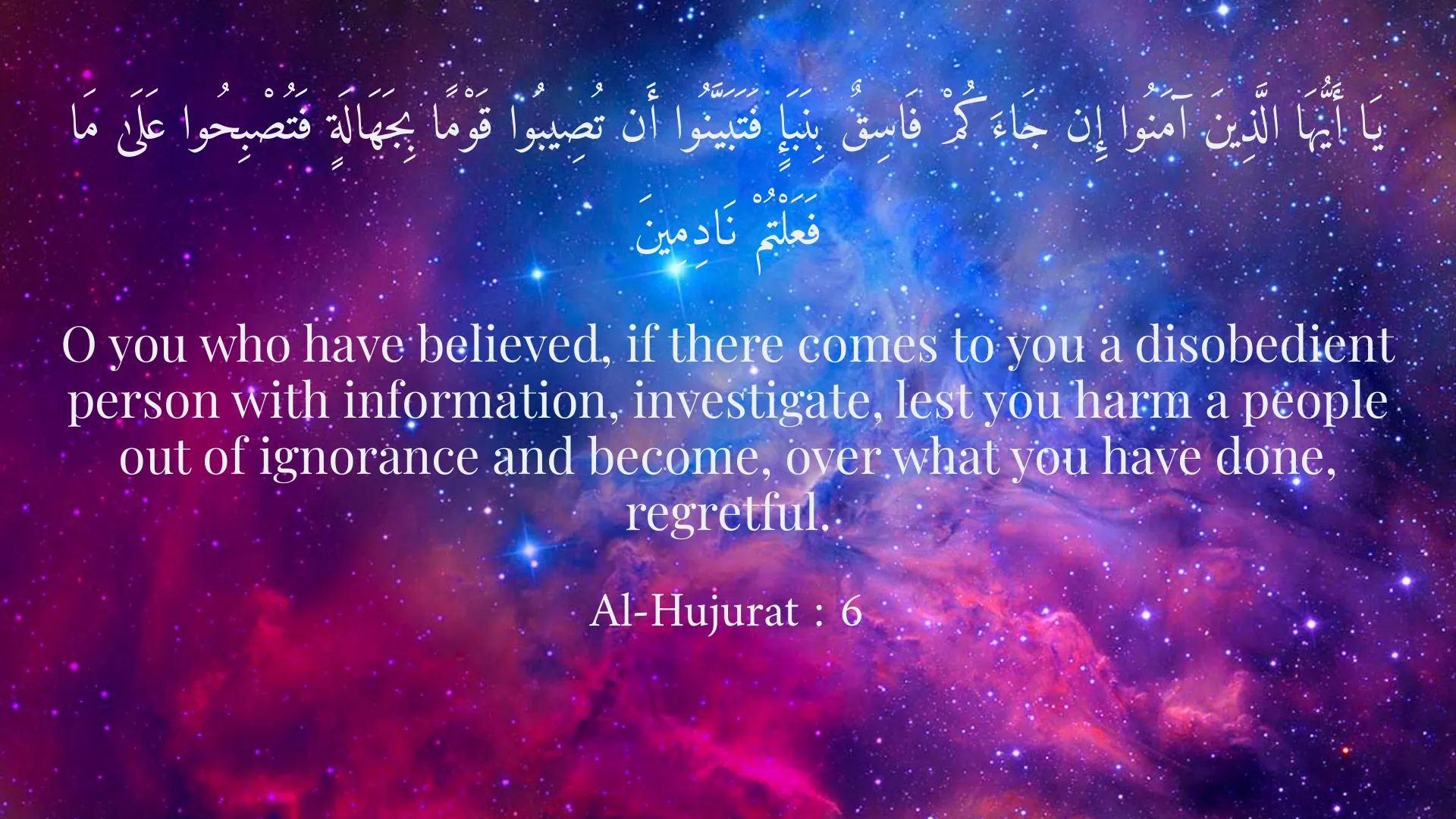
يَا أَيُّهَا الَّذِينَ آمَنُوا إِن جَاءَكُمْ فَاسِقٌ بِنَبَإٍ فَتَبَيَّنُوا أَن تُصِيبُوا قَوْمًا بِجَهَالَةٍ فَتُصْبِحُوا عَلَىٰ مَا فَعَلْتُمْ نَادِمِينَ
O you who have believed, if there comes to you a disobedient person with information, investigate, lest you harm a people out of ignorance and become, over what you have done, regretful.
Al-Hujurat : 6
وَلَا تَقْفُ مَا لَيْسَ لَكَ بِهِ عِلْمٌ ۚ إِنَّ السَّمْعَ وَالْبَصَرَ وَالْفُؤَادَ كُلُّ أُولَٰئِكَ كَانَ عَنْهُ مَسْئُولًا
And do not pursue that of which you have no knowledge. Indeed, the hearing, the sight and the heart - about all those [one] will be questioned.
Al-Isra : 36
يَا أَيُّهَا الَّذِينَ آمَنُوا قُوا أَنفُسَكُمْ وَأَهْلِيكُمْ نَارًا وَقُودُهَا النَّاسُ وَالْحِجَارَةُ عَلَيْهَا مَلَائِكَةٌ غِلَاظٌ شِدَادٌ لَّا يَعْصُونَ اللَّهَ مَا أَمَرَهُمْ وَيَفْعَلُونَ مَا يُؤْمَرُونَ
O you who have believed, protect yourselves and your families from a Fire whose fuel is people and stones, over which are [appointed] angels, harsh and severe; they do not disobey Allah in what He commands them but do what they are commanded.
At-Tahrim : 6
Short Story
One day, a wise Sadi-esque teacher said to his young, knowledge-thirsty student: 'My son, cultivate the tree of knowledge and virtue by continuously watering it with reflection and discernment. Know that in every garden, alongside beautiful flowers, weeds also grow. Your duty is to inspect the garden of your heart and mind daily and meticulously root out anything that is not beneficial and harms your soul and spirit. The beauty of a garden is not merely in planting good seeds, but in continuous care and keeping away pests.' The student, taking this advice to heart, sought to distinguish truth from falsehood and the beneficial from the harmful in everything he saw and heard, not just in books. He learned how to find pure pearls from the sea of information and avoid the chaff, and thus the garden of his being remained ever fresh and fruitful.