Quranic Answer
Respecting parents is not just a moral obligation in many cultures, it has a profound significance in Islam as emphasized by the teachings of the Holy Quran. The Quran offers clear and compelling injunctions against disrespecting parents, indicating that this reverence is closely intertwined with worship and obedience to Allah. In Islam, the family unit is considered sacred, and one of the cornerstones of a righteous life is the treatment of one’s parents with utmost kindness and respect. In Surah Al-Isra, verse 23, Allah commands believers to worship Him alone and then immediately follows this directive with the instruction to treat parents with kindness. This sequential order highlights the importance of family and parental respect within the framework of worship. The Quran explicitly states, "And your Lord has decreed that you not worship except Him, and to parents, good treatment." This verse serves as a reminder that honoring one’s parents holds a paramount place in Islam, ranking right after the worship of Allah. The emphasis on kindness is further underscored by the admonition that even in old age, individuals are called to refrain from uttering the slightest disrespectful remark, such as the Arabic word "uff," which signifies annoyance or disdain. Instead, believers are urged to speak kindly to their aging parents and to maintain a demeanor of gentleness and compassion. This strong directive in the Quran reminds us that, as parents age, they require more understanding, patience, and love from their children, rather than frustration or irritation. Moreover, this practice of respecting parents is not only a matter of personal development; it is also a means to attain divine favor. Disrespecting one’s parents is viewed not just as a worldly misdeed but as a significant spiritual transgression. The consequences of such actions, as articulated in the Quran, can result in divine punishment and in distancing oneself from Allah’s mercy. Thus, the repercussions of not adhering to this principle extend beyond earthly concerns, reflecting a broader spiritual imperative. In Surah Luqman, verse 14, the Quran further elaborates on this relationship by stating that gratitude towards parents is itself a form of gratitude towards Allah. This concept intertwines the notions of parental respect, gratitude, and spirituality. The verse articulates, "And We have enjoined upon man [care] for his parents. But if they endeavor to make you associate with Me that of which you have no knowledge, do not obey them. To Me is your return, and I will inform you about what you used to do." Here, the Quran recognizes the complexities of familial relationships, especially when one’s faith is tested against familial expectations. It ultimately reaffirms that Allah’s commands take precedence, yet it also emphasizes maintaining respect and kindness toward parents. The Quran beautifully frames the treatment of parents within the context of larger Islamic teachings. The concept of respect is not limited to mere obedience; it requires a proactive approach to understanding and empathizing with the conditions and feelings of one’s parents. In Islam, acts of service, kindness, and love toward parents are among the noblest deeds one can perform, and these acts are often rewarded both in this life and the hereafter. The prohibitions against disrespecting parents are further echoed in the teachings of the Prophet Muhammad (peace be upon him). He spent a significant portion of his teachings stressing the importance of treating parents well. Stories of the Prophet’s interactions with his mother and the reverence he showed toward his family serve as powerful examples for Muslims. In one narration, he was asked about the actions that are most beloved to Allah, and among them was the kindness shown to one’s parents. This clearly signifies that such behavior is not only a cultural expectation but also a deeply spiritual directive in the Islamic faith. Furthermore, the teachings of Islam recognize that parents are not perfect; they may indeed make mistakes. However, the emphasis on forgiveness and understanding is crucial. Islam teaches believers to look beyond their parents’ shortcomings and to appreciate the sacrifices they have made. This perspective encourages a harmonious relationship built upon compassion and mutual respect. Ultimately, the call to respect parents in Islam extends beyond mere obligation; it is a pathway towards a fulfilling spiritual life. The moral teachings of the Quran, alongside the sayings of the Prophet Muhammad (peace be upon him), lay an essential groundwork for fostering familial bonds infused with respect, love, and understanding. By adhering to these teachings, believers can expect not only to strengthen their familial ties but also to move closer to Allah’s mercy and blessings. In conclusion, respecting parents is not only a critical duty enshrined in the Holy Quran but a fundamental aspect of Islamic ethics. As believers navigate their spiritual journeys, they should continuously reflect on how they treat their parents. The Quranic verses serve as a guiding light, encouraging individuals to honor their parents throughout their lives, cherishing and recognizing the significant role they play in shaping their character and faith. In honoring our parents, we not only fulfill a divine command but also cultivate a spirit of compassion and gratitude that enhances our own lives and those around us.
Related Verses
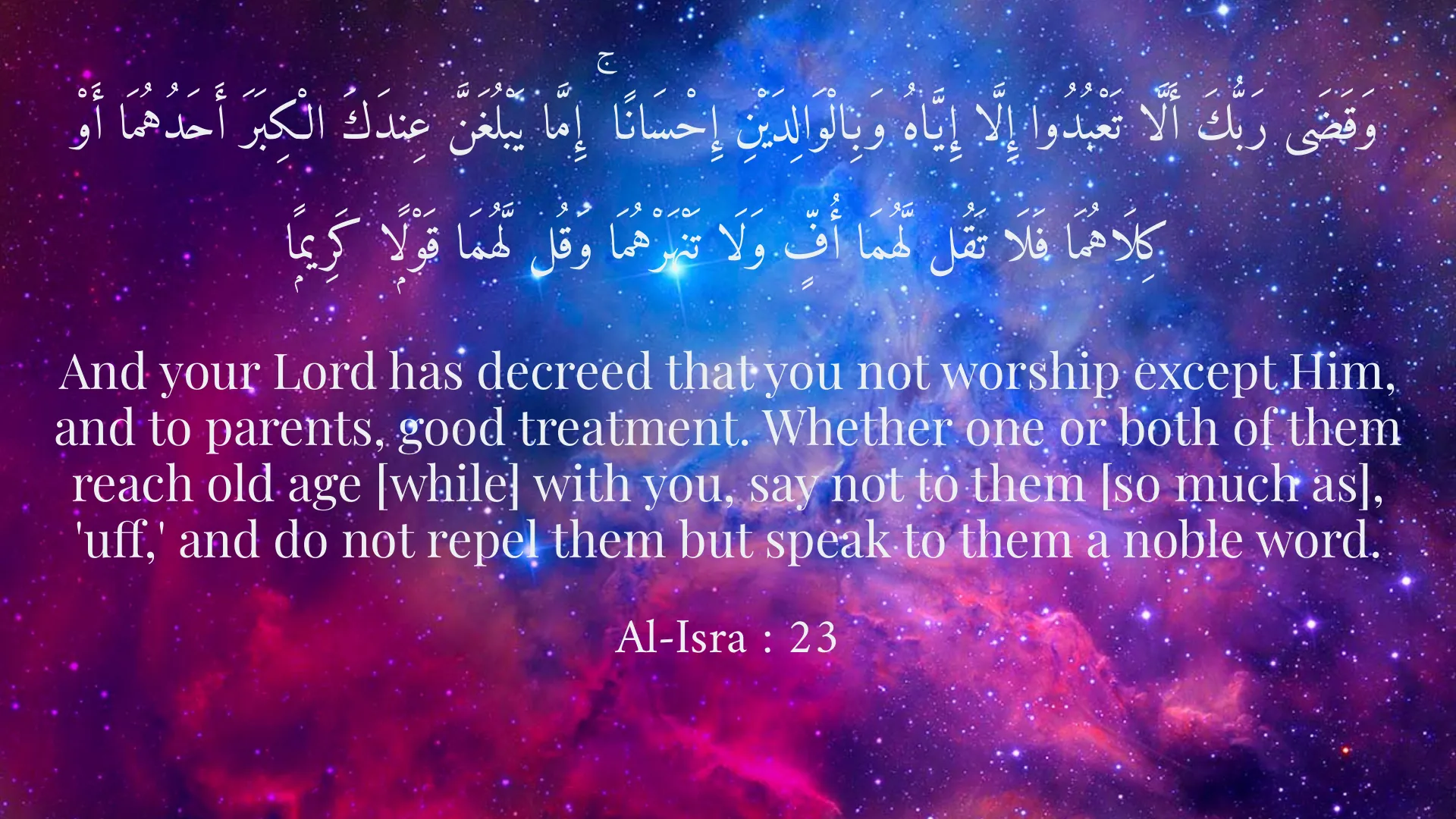
وَقَضَى رَبُّكَ أَلَّا تَعْبُدُوا إِلَّا إِيَّاهُ وَبِالْوَالِدَيْنِ إِحْسَانًا ۚ إِمَّا يَبْلُغَنَّ عِندَكَ الْكِبَرَ أَحَدُهُمَا أَوْ كِلَاهُمَا فَلَا تَقُل لَّهُمَا أُفٍّ وَلَا تَنْهَرْهُمَا وَقُل لَّهُمَا قَوْلًۭا كَرِيمًۭا
And your Lord has decreed that you not worship except Him, and to parents, good treatment. Whether one or both of them reach old age [while] with you, say not to them [so much as], 'uff,' and do not repel them but speak to them a noble word.
Al-Isra : 23
وَوَصَّيْنَا الْإِنْسَانَ بِوَالِدَيْهِ ۚ أَن اشْكُرْ لِي وَلِوَالِدَيْكَ ۚ إِلَيَّ الْمَصِيرُ
And We have enjoined upon man [care] for his parents. But if they endeavor to make you associate with Me that of which you have no knowledge, do not obey them. To Me is your return, and I will inform you about what you used to do.
Luqman : 14
Short Story
One day, a young man named Masoud faced a significant challenge with his parents. He felt that they did not understand him, and out of frustration, he was disrespectful to them. However, one day, he decided to share his struggle with a friend. His friend reminded him of the verses of the Quran that stress the importance of respecting parents. Reflecting on this, Masoud made an effort to communicate more with his parents and treat them with respect. He observed that they, in turn, started to be more open and affectionate towards him, leading to a joyful and peaceful relationship.