Quranic Answer
Yes, undoubtedly, the suffering of others has a profound and multifaceted impact on our faith. In truth, one of the core pillars of faith in Islam is empathy, compassion, and responsibility towards others. The Holy Quran repeatedly emphasizes the importance of paying attention to the plight of the needy, the oppressed, and the vulnerable, considering aid to them a characteristic of true believers. From a Quranic perspective, faith is not merely an intellectual conviction or the performance of rituals; it is a dynamic and active force that manifests in interaction with the external world, especially in confronting the sufferings and problems of fellow human beings. Ignoring the pain and suffering of others or being indifferent to it can gradually harden the heart and dim the flame of faith within a person. One of the central teachings of the Quran is the concept of the "Ummah Wahidah" (one community or nation). This concept is clearly expressed in Surah Al-Hujurat, verse 10: "The believers are but brothers, so make reconciliation between your brothers and fear Allah that you may receive mercy." This verse and many others consider the Islamic community as a single body, where if one limb suffers, the rest of the body feels its pain. When we witness the pain and suffering of our brothers and sisters in faith, and indeed, fellow human beings, this pain should resonate within us. This sense of shared suffering inherently strengthens faith and the feeling of brotherhood. If this feeling does not arise within us, we should question the quality of our faith. Indifference to the suffering of others is a sign of a weak connection with Allah and a lack of proper understanding of His teachings. True faith, in fact, manifests in the degree of a person's sensitivity to social justice and public welfare. The greater this sensitivity, the deeper and stronger the roots of faith become in the individual's heart. The Holy Quran considers helping the needy and alleviating their suffering as signs of piety and true faith. In Surah Al-Baqarah, verse 177, it is explicitly stated that righteousness is not merely turning one's face towards the East or the West, but true righteousness is "to believe in Allah and the Last Day and the angels and the Scripture and the prophets and to give wealth, in spite of love for it, to relatives, orphans, the needy, the traveler, those who ask, and for freeing slaves; and to establish prayer and to give zakah." This noble verse indicates that true faith is inextricably linked with good deeds, particularly helping the deprived and the suffering. Witnessing the suffering of others is an opportunity to act upon this divine command, and by doing so, we not only help others but also nurture and strengthen our own faith. The more we tread this path, the deeper and richer our faith becomes. These practical actions are not merely a social duty, but an inseparable part of the concept of worship and servitude to Allah. Every morsel of bread we give to the hungry, every smile we bring to the sorrowful, and every burden we lift from the oppressed, is in fact, a brick in the strong edifice of our faith. Furthermore, indifference to the suffering of others can lead to a hardening of the heart and the loss of compassion and mercy. The Holy Quran severely criticizes those who are unkind to orphans and do not encourage the feeding of the poor (Surah Al-Ma'un). This surah demonstrates that ignoring the suffering of others can even place a person among those who "deny the religion." Therefore, the suffering of others not only affects our faith but also the lack of a proper and compassionate reaction to it can weaken our faith and even destroy it. When a person's heart becomes stone towards the pain and suffering of fellow human beings, their connection with the primary source of mercy, Allah, also weakens, and they can no longer receive that divine light. This hardening of the heart gradually distances a person from spirituality and leads them towards emptiness and meaninglessness. Moreover, the suffering of others can be a test of our faith. Does this suffering lead us to despair, or does it inspire us to strive more to change conditions and rely on Allah? Does it discourage us from divine justice, or does it make us believe that Allah is All-Wise, and every suffering has a wisdom behind it, and it is our duty to help alleviate it as much as possible? Our answers to these questions reveal the depth of our faith. If, upon seeing suffering, instead of helping, we become doubtful and ask why Allah allows these things to happen, this itself is a sign of a need to strengthen certain aspects of our faith. But if these sufferings lead us to prayer, supplication, and practical action to help the oppressed and the needy, our faith will be strengthened. In such circumstances, patience and insight in the face of hardships and efforts to improve the situation are considered essential components of faith. These trials are an opportunity for soul purification and a measure of one's faith. A sense of gratitude is also another aspect that is strengthened by observing the suffering of others. When we see others enduring such hardships, we become more appreciative of the countless divine blessings we ourselves enjoy. This feeling of gratitude is the foundation of thankfulness, and thankfulness is also a crucial pillar of faith. Consequently, the suffering of others can serve as a reminder of Allah's blessings and favors, thereby strengthening our faith in the path of gratitude and servitude. This comparison not only increases appreciation but also guides a person towards humility and modesty, removing pride and arrogance from them. In conclusion, faith in Islam is not a static concept; rather, it is a dynamic and living process that is constantly being tested and developed. How we react to the suffering of others is a reflection of the quality and depth of our faith. The more compassionate, responsible, and active we are in alleviating the suffering of our fellow human beings, the more complete and vibrant our faith will be. This responsibility not only benefits society but, first and foremost, contributes to our own spiritual and moral growth and brings us closer to Allah. Therefore, we should never be indifferent to the sufferings around us, because this indifference is not only an injustice to others but also a blow to the depth of our own faith and spirit. True faith is intertwined with good deeds, and when confronted with the suffering of others, it drives a person towards aid and assistance.
Related Verses
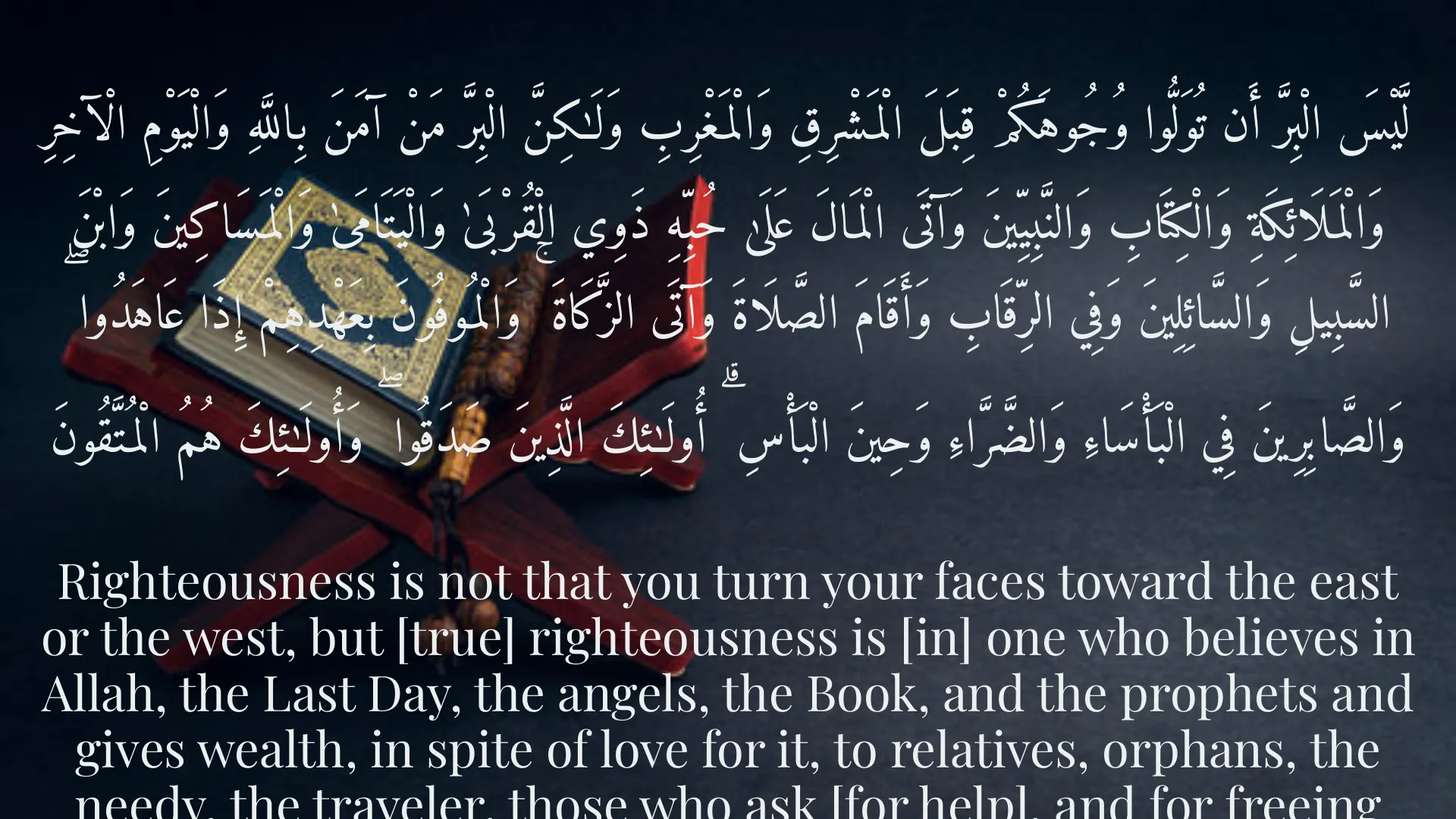
لَّيْسَ الْبِرَّ أَن تُوَلُّوا وُجُوهَكُمْ قِبَلَ الْمَشْرِقِ وَالْمَغْرِبِ وَلَٰكِنَّ الْبِرَّ مَنْ آمَنَ بِاللَّهِ وَالْيَوْمِ الْآخِرِ وَالْمَلَائِكَةِ وَالْكِتَابِ وَالنَّبِيِّينَ وَآتَى الْمَالَ عَلَىٰ حُبِّهِ ذَوِي الْقُرْبَىٰ وَالْيَتَامَىٰ وَالْمَسَاكِينَ وَابْنَ السَّبِيلِ وَالسَّائِلِينَ وَفِي الرِّقَابِ وَأَقَامَ الصَّلَاةَ وَآتَى الزَّكَاةَ ۚ وَالْمُوفُونَ بِعَهْدِهِمْ إِذَا عَاهَدُوا ۖ وَالصَّابِرِينَ فِي الْبَأْسَاءِ وَالضَّرَّاءِ وَحِينَ الْبَأْسِ ۗ أُولَٰئِكَ الَّذِينَ صَدَقُوا ۖ وَأُولَٰئِكَ هُمُ الْمُتَّقُونَ
Righteousness is not that you turn your faces toward the east or the west, but [true] righteousness is [in] one who believes in Allah, the Last Day, the angels, the Book, and the prophets and gives wealth, in spite of love for it, to relatives, orphans, the needy, the traveler, those who ask [for help], and for freeing slaves; [and who] establishes prayer and gives zakah; and [those who] fulfill their promise when they promise; and [those who] are patient in poverty and hardship and during battle. Those are the ones who have been true, and it is those who are the righteous.
Al-Baqarah : 177
أَرَأَيْتَ الَّذِي يُكَذِّبُ بِالدِّينِ
Have you seen the one who denies the Recompense?
Al-Ma'un : 1
فَذَٰلِكَ الَّذِي يَدُعُّ الْيَتِيمَ
For that is the one who drives away the orphan
Al-Ma'un : 2
وَلَا يَحُضُّ عَلَىٰ طَعَامِ الْمِسْكِينِ
And does not encourage the feeding of the poor.
Al-Ma'un : 3
إِنَّمَا الْمُؤْمِنُونَ إِخْوَةٌ فَأَصْلِحُوا بَيْنَ أَخَوَيْكُمْ ۚ وَاتَّقُوا اللَّهَ لَعَلَّكُمْ تُرْحَمُونَ
The believers are but brothers, so make reconciliation between your brothers and fear Allah that you may receive mercy.
Al-Hujurat : 10
Short Story
Once upon a time, there lived a wealthy and affluent merchant named Khwaja Mahmud, who was deeply engrossed in worldly pleasures and oblivious to the plight of the poor and needy. His wealth and possessions consumed him so much that he paid no attention to the pain and suffering of others, believing his faith was complete with outward religious observances. One day, Khwaja Mahmud fell gravely ill. All physicians were helpless in treating him, and the intensity of his pain robbed him of sleep and peace. In his weakened state, a humble and simple dervish came to visit him. With a kind smile and eyes full of compassion, the dervish said, "O Khwaja, you thought your wealth would protect you from all calamities, but now you see that even your riches cannot grant you a moment of peace. Do you know what true wealth is?" The Khwaja weakly shook his head. The dervish continued, "True wealth lies in a heart that feels the pain of others and a hand that extends to help the needy. True faith is in the connection you forge with your fellow human beings, in the tears you shed for the oppressed, and the smiles you bring to the faces of orphans. For faith is not merely in the mosque, but it finds its meaning in the marketplace of life and amidst the sufferings of people." The dervish's words resonated so deeply with Khwaja Mahmud that it was as if a veil had been lifted from his eyes. He recalled how he had been indifferent to the suffering and poverty of his neighbors in the past. With tears of remorse, he apologized to the dervish and vowed that if he recovered, he would spend all his wealth in the path of God and helping the needy. By the grace of his sincere intention and true repentance, Allah granted him healing. Khwaja Mahmud was never the same man after that. He dedicated all his efforts to helping people and realized that every time he extended a hand, his faith deepened, and his heart became more enlightened. He understood that the suffering of others is not distant from us; rather, it is a mirror that shows us the depth of our own faith.