Quranic Answer
The question of whether true justice exists in the world has been one of humanity's deepest and most fundamental concerns throughout history. Every individual encounters instances of injustice and inequality in their lives, prompting the question: Is the world truly just? Does a form of justice exist that transcends human-made laws and their inherent flaws? From the perspective of the Holy Quran, answering this question requires a comprehensive understanding of the philosophy of creation, the human position in existence, and the ultimate outcome of deeds. In divine discourse, the concept of justice is presented not merely as an ideal but as a pivotal and foundational truth in creation and the management of existence. Allah Almighty describes Himself with the attributes of "Al-Adl" (The Just) and "Al-Hakim" (The Wise), which testify to the truth that no injustice or unfairness ever emanates from Him, and that the cosmic order is founded upon justice. However, our understanding of "true justice in the world" must be clarified in light of the human role and the nature of this world as a testing ground. Divine Justice: The Foundation of Existence on Justice The Holy Quran explicitly states that Allah is absolutely just and no injustice ever proceeds from Him. "Indeed, Allah does not wrong the people at all, but it is the people who wrong themselves" (Quran 10:44). This verse clearly indicates that any injustice or unfairness observed in the world is the result of human actions and their choices, not a deficiency in divine justice. Allah Himself states, "And the word of your Lord has been fulfilled in truth and in justice" (Quran 6:115), meaning that all divine decrees and commands are founded on truth and justice, and everything He has ordained is perfectly just. The system of creation is also built upon justice. From the astonishing order of stars and galaxies to the unparalleled balance in living organisms' bodies, all signify the "Mizan" (balance) and justice that Allah has placed in creation. "And the heaven He raised and set the balance" (Quran 55:7). This verse points to a cosmic principle: the universe is founded on precise and just measures. Therefore, divine justice flows not only in religious laws but also in the existential laws governing the world. Any disorder or injustice in nature ultimately returns to balance, which itself is a sign of divine justice. So, in response to the question, "Does true justice exist in the world?" one must say: Yes, divine justice, in the sense of a just system and wise principles in creation and divine governance, certainly exists. However, what we refer to as "lack of justice" in the world primarily pertains to the domain of human actions. The World: A Realm of Test and Human Free Will One of the primary reasons for the existence of what appears to be "injustice" is the nature of the present world. This world is a "realm of action" and a "realm of trial," not a "realm of recompense." Allah created humans with free will and choice so they could choose their path in life. This free will is an opportunity for growth and transcendence, but it can also lead to abuse, oppression, and corruption. "Indeed, We guided him to the way, whether grateful or ungrateful" (Quran 76:3). Therefore, humans, through their choices, can opt for the path of justice or oppression. When humans deviate from the path of justice, the result is injustice, tyranny, and inequality in society. This does not mean the absence of divine justice, but rather that Allah has allowed humans to experience the consequences of their choices and learn from them. If every act of injustice were to be met with immediate and complete punishment, the concept of free will and trial would cease to exist, and the world would no longer be a place of free choice. Many calamities and hardships in the world can also serve as trials and means for purifying the soul or elevating the spiritual ranks of believers, as Allah says: "And We will surely test you with something of fear and hunger and a loss of wealth and lives and fruits, but give good tidings to the patient" (Quran 2:155). This perspective indicates that even within what appears to us as injustice, there is a divine wisdom that ultimately leads to the good and welfare of humanity or to the manifestation of ultimate justice. Human Responsibility in Establishing Justice The Holy Quran not only speaks of the existence of divine justice but also strongly emphasizes human responsibility in upholding justice in society. Clear Quranic commands to establish fairness and justice attest to this. "Indeed, Allah commands justice and good conduct" (Quran 16:90). This verse is a general principle for all aspects of individual and social life. In the realm of judgment, the Quran explicitly commands: "And when you judge between people to judge with justice" (Quran 4:58). These commands indicate that Allah expects humans, despite their free will, to choose the path of truth and justice and strive to realize it on Earth. Therefore, striving for justice in the world is a divine and moral duty for every Muslim. This endeavor includes combating oppression, supporting the oppressed, and establishing just social systems. The existence of these commands itself signifies that the capacity and possibility for establishing relative justice in the world are available, but its full realization depends on the collective effort and commitment of humans. This does not mean denying widespread injustices in the world, but rather that the root of these injustices lies in the weakness of human will or ill intentions, not in the absence of a divine system of justice. In fact, the Holy Quran calls on humanity to fight against oppression and tyranny, as this struggle is part of their divine duty to establish justice. The Day of Judgment: The Full and Flawless Manifestation of Divine Justice The most crucial point in answering "Does true justice exist in the world?" is that the Islamic perspective does not limit justice to this world alone. Many injustices and oppressions in the world may remain seemingly unpunished, or rights may be trampled upon without compensation in this life. However, the Holy Quran promises that a day will come when all accounts will be settled, and justice will fully manifest itself: "And We will set up the scales of justice for the Day of Resurrection, and no soul will be wronged in anything. Even if it is the weight of a mustard seed, We will bring it forth. And sufficient are We as accountants" (Quran 21:47). In this verse, Allah promises to establish the scales of justice on the Day of Resurrection, and no soul will be wronged even by the weight of a mustard seed. Every action, small or large, will be revealed and accounted for. This day is the Day of "Fasl al-Khitab" (distinguishing truth from falsehood) and "Yawm al-Hisab" (Day of Reckoning). On that day, the oppressed will reclaim their rights from the oppressor, and even animals will be brought to account for their dealings with each other. This concept brings peace to hearts that have tasted the bitterness of injustice in the world. This belief in the Day of Judgment not only keeps alive the hope for the realization of ultimate justice but also serves as a deterrent for oppressors and an encouragement for those who walk the path of justice and truth. Therefore, true and complete justice, meaning the full payment of dues and meticulous accounting of all deeds, certainly exists in the Hereafter and will be perfectly realized. This belief assures us that no action, good or bad, will ultimately go unrewarded or unpunished. Conclusion: Justice on Two Levels In final summation, from the Quranic perspective, justice exists on two levels: 1. Divine Existential and Legislative Justice: This level of justice always exists and is manifest in the laws governing the universe and the commands of Allah. God is just, and His system is based on justice. 2. Justice in Human Experience in This World: This level of justice is not complete. Due to human free will, abuses and oppressions occur. The world is a testing ground, and its purpose is to distinguish good from bad and provide an opportunity for choice. Nevertheless, humans are obliged to strive for the establishment of relative justice in their society. 3. Complete and Absolute Justice in the Hereafter: This day marks the pinnacle of the manifestation of divine justice, where every atom's weight of human action, whether good or bad, is accounted for, and no injustice goes unpunished, nor any violated right remains unaddressed. So, in response to whether true justice exists in the world, one must say: Yes, justice as a divine and fundamental principle exists in creation and God's commands. However, its full and flawless manifestation for all individuals and in all matters is deferred to the Day of Judgment. In this world, we are tasked with striving for justice, while understanding that its completion will be realized in the Hereafter. This perspective both offers us hope and reminds us of our responsibility to uphold truth and fight against oppression. This justice is a light that, even in the darkest times, illuminates the path for humanity and assures them that no suffering is without reason and no action without accountability.
Related Verses
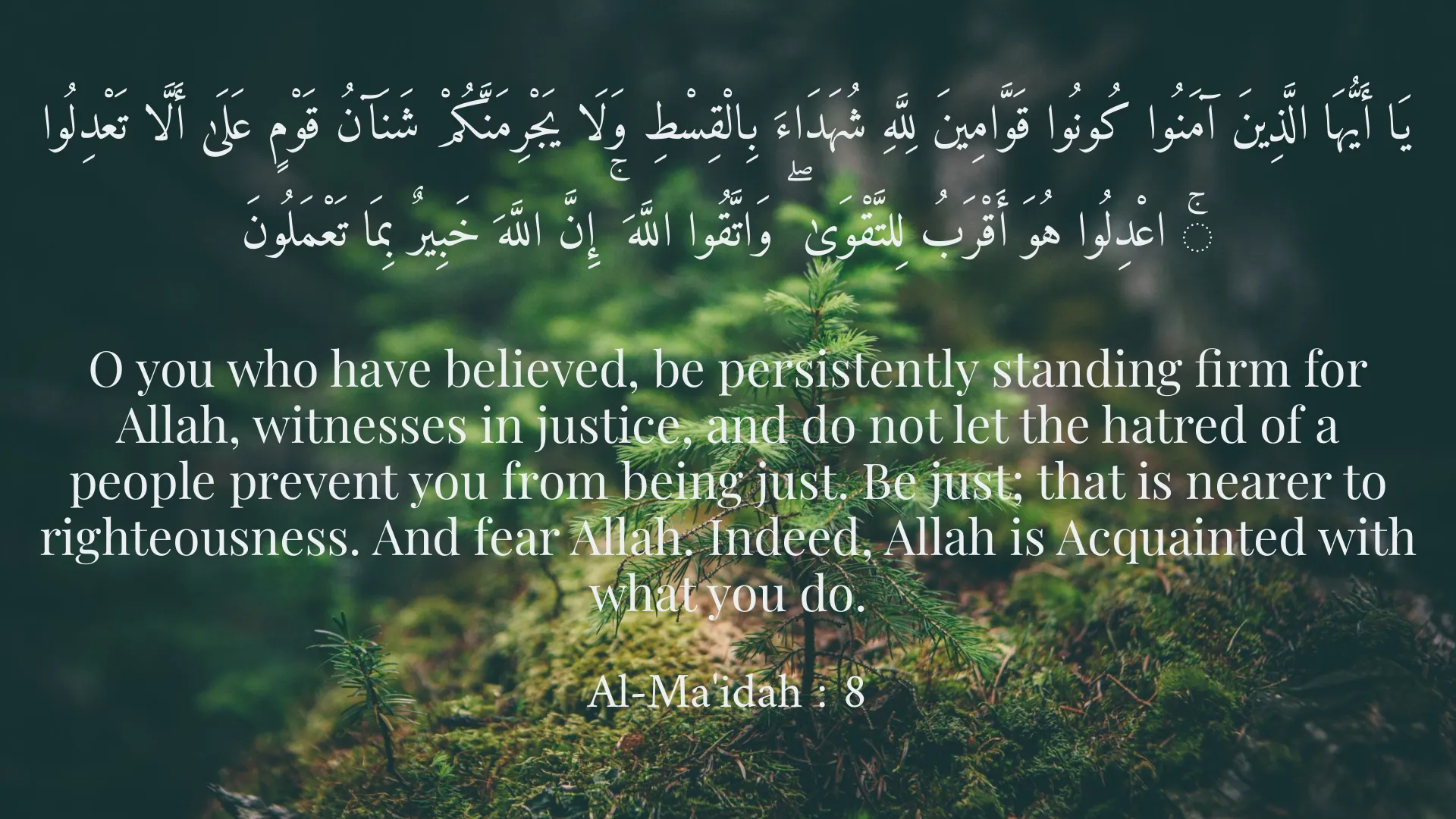
يَا أَيُّهَا الَّذِينَ آمَنُوا كُونُوا قَوَّامِينَ لِلَّهِ شُهَدَاءَ بِالْقِسْطِ وَلَا يَجْرِمَنَّكُمْ شَنَآنُ قَوْمٍ عَلَىٰ أَلَّا تَعْدِلُوا ۚ اعْدِلُوا هُوَ أَقْرَبُ لِلتَّقْوَىٰ ۖ وَاتَّقُوا اللَّهَ ۚ إِنَّ اللَّهَ خَبِيرٌ بِمَا تَعْمَلُونَ
O you who have believed, be persistently standing firm for Allah, witnesses in justice, and do not let the hatred of a people prevent you from being just. Be just; that is nearer to righteousness. And fear Allah. Indeed, Allah is Acquainted with what you do.
Al-Ma'idah : 8
إِنَّ اللَّهَ يَأْمُرُكُمْ أَن تُؤَدُّوا الْأَمَانَاتِ إِلَىٰ أَهْلِهَا وَإِذَا حَكَمْتُم بَيْنَ النَّاسِ أَن تَحْكُمُوا بِالْعَدْلِ ۚ إِنَّ اللَّهَ نِعِمَّا يَعِظُكُم بِهِ ۗ إِنَّ اللَّهَ كَانَ سَمِيعًا بَصِيرًا
Indeed, Allah commands you to render trusts to whom they are due and when you judge between people to judge with justice. Excellent is that which Allah instructs you. Indeed, Allah is ever Hearing and Seeing.
An-Nisa : 58
وَنَضَعُ الْمَوَازِينَ الْقِسْطَ لِيَوْمِ الْقِيَامَةِ فَلَا تُظْلَمُ نَفْسٌ شَيْئًا ۖ وَإِن كَانَ مِثْقَالَ حَبَّةٍ مِّنْ خَرْدَلٍ أَتَيْنَا بِهَا ۗ وَكَفَىٰ بِنَا حَاسِبِينَ
And We will set up the scales of justice for the Day of Resurrection, and no soul will be wronged in anything. Even if it is the weight of a mustard seed, We will bring it forth. And sufficient are We as accountants.
Al-Anbiya : 47
Short Story
They say that in ancient times, there was a farmer whose small plot of land lay beside the estate of a tyrannical minister. The minister, mercilessly, sought to forcibly seize the farmer's land. The oppressed farmer appealed everywhere, but having neither power nor wealth, his pleas went unheard. Despairing, he raised his hands in prayer, seeking help from the Just God. Years passed. The tyrannical minister, swollen with pride due to his immense wealth and limitless power, went bankrupt in his trades and suffered continuous misfortunes. His children fell into corruption, and his assets were lost one after another, until he became a wanderer and destitute. But the farmer, through patience and effort, regained his lost land through legal channels and with the help of benevolent people, and his life slowly began to improve. A wise man, witnessing these events, remarked: "Beware! Do not imagine that in this abode, the account of deeds is lost! Although this world is a realm of action, the seed of Divine Justice is sown within it and bears fruit on the Last Day. Sometimes, even in this very world, God reveals a glimpse of His justice to His servants so that they may know that no cry from the oppressed goes unanswered, and no righteous deed goes unrewarded, even if its time is delayed."