Quranic Answer
Is enduring oppression sometimes better than confronting it? This is a profound and multifaceted question that requires careful consideration in light of the teachings of the Holy Quran. At first glance, it might seem that Islam always calls for confronting injustice and standing firm against oppressors, and this understanding is largely correct. The Quran repeatedly condemns oppression (zulm) and encourages believers to establish justice. However, alongside this call for justice, concepts such as “patience” (sabr), “wisdom” (hikmah), and “prioritization” (awlawiyyat) are also introduced, which complicate the answer. Firstly, it must be acknowledged that in the fundamental principles of Islam, submission to oppression is by no means approved. Allah explicitly states in the Quran that He does not love oppressors and does not guide them. In several verses, such as Surah Ash-Shura, verses 41-42, Allah says: “And whoever avenges himself after he has been wronged - those have not upon them any cause [for blame]. The cause is only against those who oppress people and tyrannize upon the earth without right. Those will have a painful punishment.” This verse clearly indicates that confronting oppression and defending one's rights is a legitimate and even desirable act. Believers are commanded to stand for justice, even if it is against themselves, their parents, or their relatives (as in Surah An-Nisa, verse 135). This emphasis on establishing equity and justice forms the backbone of Islam's view on social and legal matters, demonstrating that denying oppression and striving to establish justice is a religious and moral duty that cannot be overlooked. A society where oppression persists and no one stands up against it has deviated from its divine path. However, the issue becomes complex when we discuss “enduring” or “tolerating.” Does “enduring” mean “absolute silence” and “acquiescence to injustice”? No. In many instances, patience (sabr) and endurance in the Quran mean “steadfastness,” “passive resistance,” “perseverance,” and “not despairing,” rather than giving up. For example, in Surah Al-Baqarah, verse 153, we read: “O you who have believed, seek help through patience and prayer. Indeed, Allah is with the patient.” This patience is an active patience that aids the believer in their struggle against hardships and oppression to achieve their goal, enabling them to resist pressures and neutralize the oppressor's plans. This type of patience is itself a form of struggle, a calm and fundamental struggle that paves the way for victory. Under certain specific circumstances, direct and violent confrontation with oppression, instead of solving the problem, might lead to far greater harms and damages that exceed the initial oppression. Here, the concept of “averting a greater harm by enduring a lesser harm” comes into play. This jurisprudential and rational principle states that if a revolutionary act or direct confrontation leads to the killing of innocents, widespread destruction of infrastructure, or the weakening of the religion and the Muslim community to an irreparable extent, then in such circumstances, pause and reflection, finding alternative ways (such as civil resistance, public awareness campaigns, or forming a resilient front), or even temporary endurance to find better opportunities and reduce harm, might be preferable from the perspective of “wisdom” and “higher Islamic interests.” This endurance does not mean permanent acceptance of oppression but rather a temporary strategy to prevent a greater catastrophe and to create conditions for more effective confrontation in the future. Islamic history and the Seerah (biography) of Prophet Muhammad (peace be upon him) provide clear examples of this approach. The Prophet (PBUH) faced countless acts of oppression and torture during the initial 13 years of his mission in Mecca. Instead of direct military confrontation (which at that time would have meant the complete annihilation of the nascent Muslim community and yielded no positive outcome), he and his companions employed “strategic patience.” This patience involved steadfastness in belief, uncompromising adherence to principles, migration to Abyssinia, and ultimately, migration to Medina. This migration itself was a form of struggle and a change of strategy. In Medina, when the power and suitable environment were established and the Muslim community became militarily and socially strong, he engaged in military confrontation with the oppression of Quraish. This example clearly shows that sometimes endurance (in a strategic and temporary sense) and not engaging in a confrontation that leads to irreparable and fruitless damages is not a sign of weakness but the pinnacle of wisdom and foresight. Furthermore, a distinction must be made between “individual oppression” and “systemic and widespread oppression.” Regarding individual oppression inflicted upon a specific person, the Quran also offers the solution of “forgiveness and pardon” (Surah Ash-Shura, verse 40: “The recompense for an evil is an evil like thereof. But whoever pardons and makes reconciliation - his reward is [due] from Allah. Indeed, He does not like wrongdoers.”). This forgiveness, if it does not encourage the oppressor and does not endanger the public interest, is recommended and can even affect the oppressor's heart and help in their reform. However, this approach is usually not applicable against systemic and widespread oppression that infringes upon the rights of a large number of people, where confrontation and efforts to change the oppressive structure are necessary, and one should not shirk social and religious responsibility under the pretext of forgiveness. Ultimately, the answer to this question depends on specific circumstances, the type of oppression, the capability of the one confronting, the scope and depth of the oppression, and the potential consequences. Islam never calls for submission to oppression but advises believers to choose the best and most effective way to combat injustice and establish justice with wisdom, insight, and patience. Sometimes this path may involve soft resistance, raising awareness, exposure, or even migration, and at other times it may require direct confrontation and legitimate defense. What is important is a pure intention for the sake of Allah and an effort to establish justice on earth, in a way that yields the least harm and the greatest benefit for humanity. Therefore, “enduring oppression” does not mean passivity and absolute silence in the face of it but rather means intelligently and strategically choosing the most effective path to confront it, even if this path appears to require more endurance and patience in the short term to achieve the desired outcome in the long term. This approach ensures that the struggle against oppression will be not only just but also effective and sustainable, and instead of creating a greater discord, it will pave the way for true justice and peace.
Related Verses
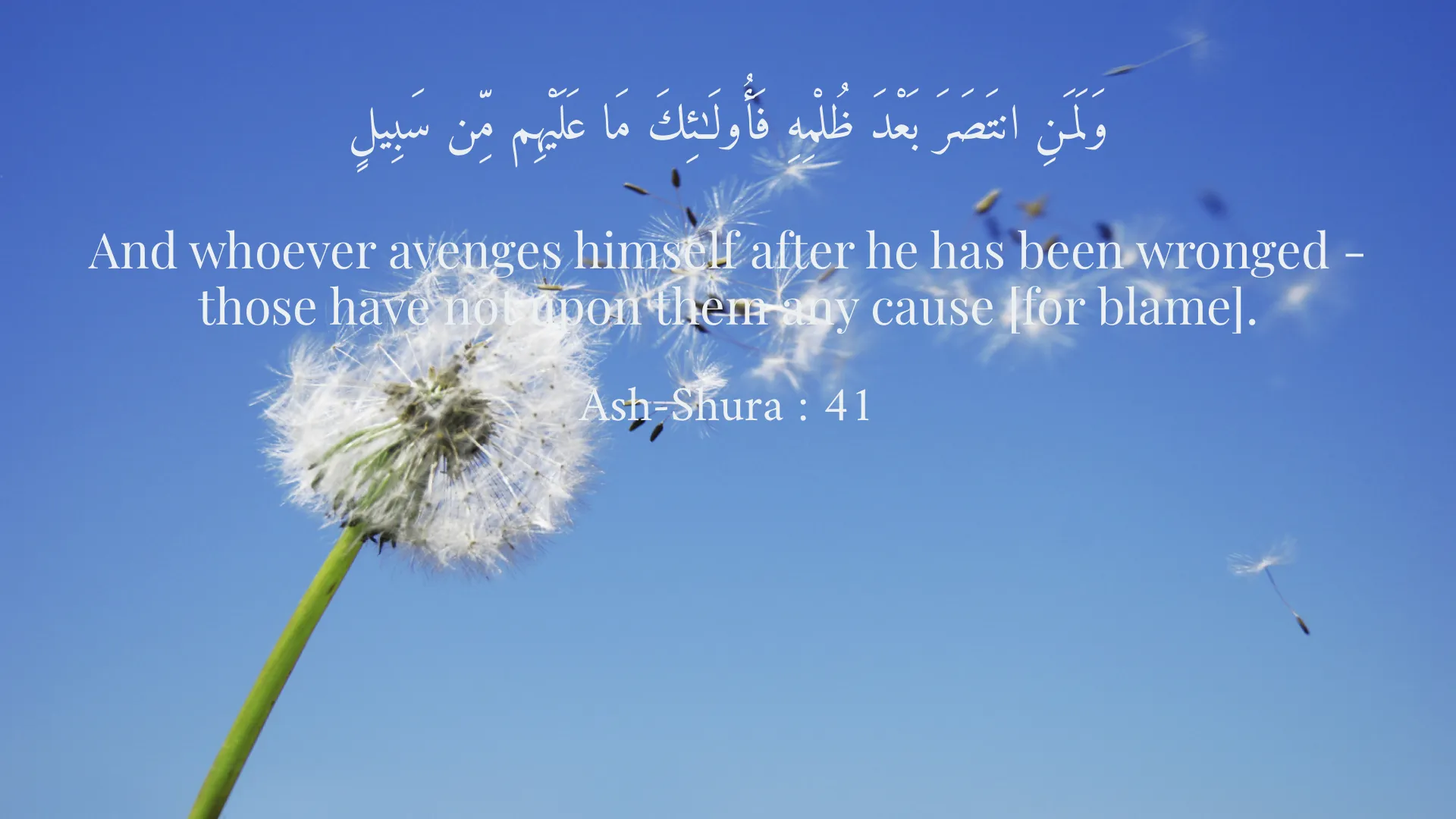
وَلَمَنِ انتَصَرَ بَعْدَ ظُلْمِهِ فَأُولَٰئِكَ مَا عَلَيْهِم مِّن سَبِيلٍ
And whoever avenges himself after he has been wronged - those have not upon them any cause [for blame].
Ash-Shura : 41
إِنَّمَا السَّبِيلُ عَلَى الَّذِينَ يَظْلِمُونَ النَّاسَ وَيَبْغُونَ فِي الْأَرْضِ بِغَيْرِ الْحَقِّ ۚ أُولَٰئِكَ لَهُمْ عَذَابٌ أَلِيمٌ
The cause is only against those who oppress people and tyrannize upon the earth without right. Those will have a painful punishment.
Ash-Shura : 42
يَا أَيُّهَا الَّذِينَ آمَنُوا اسْتَعِينُوا بِالصَّبْرِ وَالصَّلَاةِ ۚ إِنَّ اللَّهَ مَعَ الصَّابِرِينَ
O you who have believed, seek help through patience and prayer. Indeed, Allah is with the patient.
Al-Baqarah : 153
يَا أَيُّهَا الَّذِينَ آمَنُوا كُونُوا قَوَّامِينَ بِالْقِسْطِ شُهَدَاءَ لِلَّهِ وَلَوْ عَلَىٰ أَنفُسِكُمْ أَوِ الْوَالِدَيْنِ وَالْأَقْرَبِينَ ۚ إِن يَكُنْ غَنِيًّا أَوْ فَقِيرًا فَاللَّهُ أَوْلَىٰ بِهِمَا ۖ فَلَا تَتَّبِعُوا الْهَوَىٰ أَن تَعْدِلُوا ۚ وَإِن تَلْوُوا أَوْ تُعْرِضُوا فَإِنَّ اللَّهَ كَانَ بِمَا تَعْمَلُونَ خَبِيرًا
O you who have believed, be persistently firm in justice, witnesses for Allah, even if it be against yourselves or parents and relatives. Whether one is rich or poor, Allah is more worthy of both. So follow not [personal] inclination, lest you deviate. And if you distort [your testimony] or turn away [from truth], then indeed Allah is ever, with what you do, Acquainted.
An-Nisa : 135
Short Story
One day, a dervish pondered, "Good nature is better than brute force." He recalled Saadi's words: "He who has no garment of his own, it is better to be naked than to wear a thief's garment." A dervish was walking on a path when an injustice was inflicted upon him. Instead of immediately retaliating and showing his anger, the dervish remained silent and continued on his way. His companions asked him, "O Sheikh, why did you remain silent in the face of the injustice done to you?" The dervish replied, "It is better that I bear a small burden in my heart today and save my life from a greater fire. If I were to confront this oppressor now, not only would I endanger myself, but perhaps a greater discord would arise, causing harm to many. Wise is he who foresees the consequences and understands that sometimes patience itself is a battle, a hidden battle for a better opportunity and a clearer path." His companions learned a lesson from his words and understood that patience is not always a sign of weakness; rather, sometimes it is the peak of wisdom and foresight.