Quranic Answer
The Holy Quran, as the divine word and guide for humanity, attaches immense value and importance to knowledge and, especially, to those who are its true bearers—the real scholars. This appreciation and honoring of true, righteous scholars are explicitly and subtly expressed in various verses. In the Quranic view, a true scholar is someone whose knowledge not only expands their information but also profoundly impacts their inner being, leading them to a deeper understanding of God and a greater awe and fear of Him. This fear is not born of dread of punishment, but rather of the majesty and grandeur of the Divine, which causes the heart of the knowing one to tremble and prompts them to humility, meekness, and piety. One of the most prominent verses in this regard is Surah Fatir, verse 28, which states: “Indeed, only those who are learned among His servants fear Allah.” This verse clearly establishes that the true criterion of knowledge is reaching the stage of divine awe (khashyah). A scholar who attains this stage is not limited to theoretical knowledge; rather, this knowledge manifests in their actions and conduct, transforming them into an obedient, humble, and benevolent servant. This awe ensures that the scholar is always mindful of their actions and does not transgress divine limits, for they have grasped God's infinite greatness and power. This characteristic distinguishes true scholars from those who have merely accumulated information. The Quran demonstrates that true knowledge is not about memorizing and repeating words, but about deeply comprehending realities, attaining divine gnosis (ma'rifah), and acting upon its implications. The true scholar carries divine light within their heart, and this light illuminates their path towards truth. Another verse that indicates appreciation for true scholars is Surah Al-Mujadila, verse 11: “Allah will raise those who have believed among you and those who were given knowledge, by degrees.” This verse explicitly demonstrates the superiority and merit of the people of knowledge. The Quran establishes a close link between faith and knowledge, stating that true faith is accompanied by knowledge, and true knowledge leads to faith. Those who are adorned with these two virtues hold higher ranks and greater statuses in the sight of Allah. This elevation of status encompasses respect and influence in this world and leads to degrees in Paradise and proximity to God in the Hereafter. Raising in degrees means an increase in insight, wisdom, effectiveness, and the ability to comprehend the realities of existence. True scholars, through this insight, can guide society and lead people from the darkness of ignorance and misguidance towards the light of guidance and knowledge. Furthermore, in Surah Al-Imran, verse 18, the Quran places true scholars in a position where their testimony is alongside that of God and the angels: “Allah bears witness that there is no deity except Him, and [so do] the angels and those of knowledge, upholding justice.” This verse not only highlights the grandeur of knowledge but also shows that the testimony of true scholars holds such credibility that it is placed alongside the testimony of God and His angels. However, these “people of knowledge” (ulu al-ilm) are those who also “uphold justice” (qa'iman bil-qist). This crucial condition indicates that knowledge without action and without upholding justice will never reach this elevated status. True knowledge has an inseparable link with piety, ethics, and striving for justice in society. True scholars, with their knowledge, not only comprehend the oneness of God but also remain steadfast in acting upon it, striving with God's help to spread justice and truth. Additionally, in several verses, the role of scholars in guiding people and answering questions is mentioned. For example, in Surah An-Nahl, verse 43 (and Surah Al-Anbiya, verse 7), it is stated: “So ask the people of the message if you do not know.” This verse emphasizes the necessity of referring to people of knowledge and expertise in religious matters and divine sciences. These “people of the message” (ahl al-dhikr) are the righteous scholars who have drawn their knowledge from authentic divine sources and have blended it with piety and action. This appreciation for scholars means endorsing their role as the religious and intellectual authority of society. These verses teach us that in complex and unknown matters, we should not rely on conjecture, but rather refer to the pure springs of knowledge and wisdom, i.e., the true scholars. This consultation is necessary not only for finding answers to questions but also for gaining insight and intellectual and spiritual growth. In summary, the Holy Quran appreciates true scholars as those who: 1. Attain awe and fear of God through their knowledge. 2. Hold elevated ranks in the sight of God due to their faith and knowledge. 3. Their testimony is placed alongside that of God and His angels, provided they uphold justice. 4. Are considered the intellectual and religious authority of society, to whom people refer for understanding truths. This appreciation is not just empty praise but an encouragement for all humans to strive in the path of acquiring true knowledge, and to make their knowledge a guiding light for piety and righteous deeds. The Quran teaches us to appreciate these overflowing springs of knowledge and virtue and to benefit from their light. These righteous scholars are the heirs of the prophets and show us the path to salvation. Appreciating them is, in fact, appreciating the light that God has bestowed upon humanity.
Related Verses
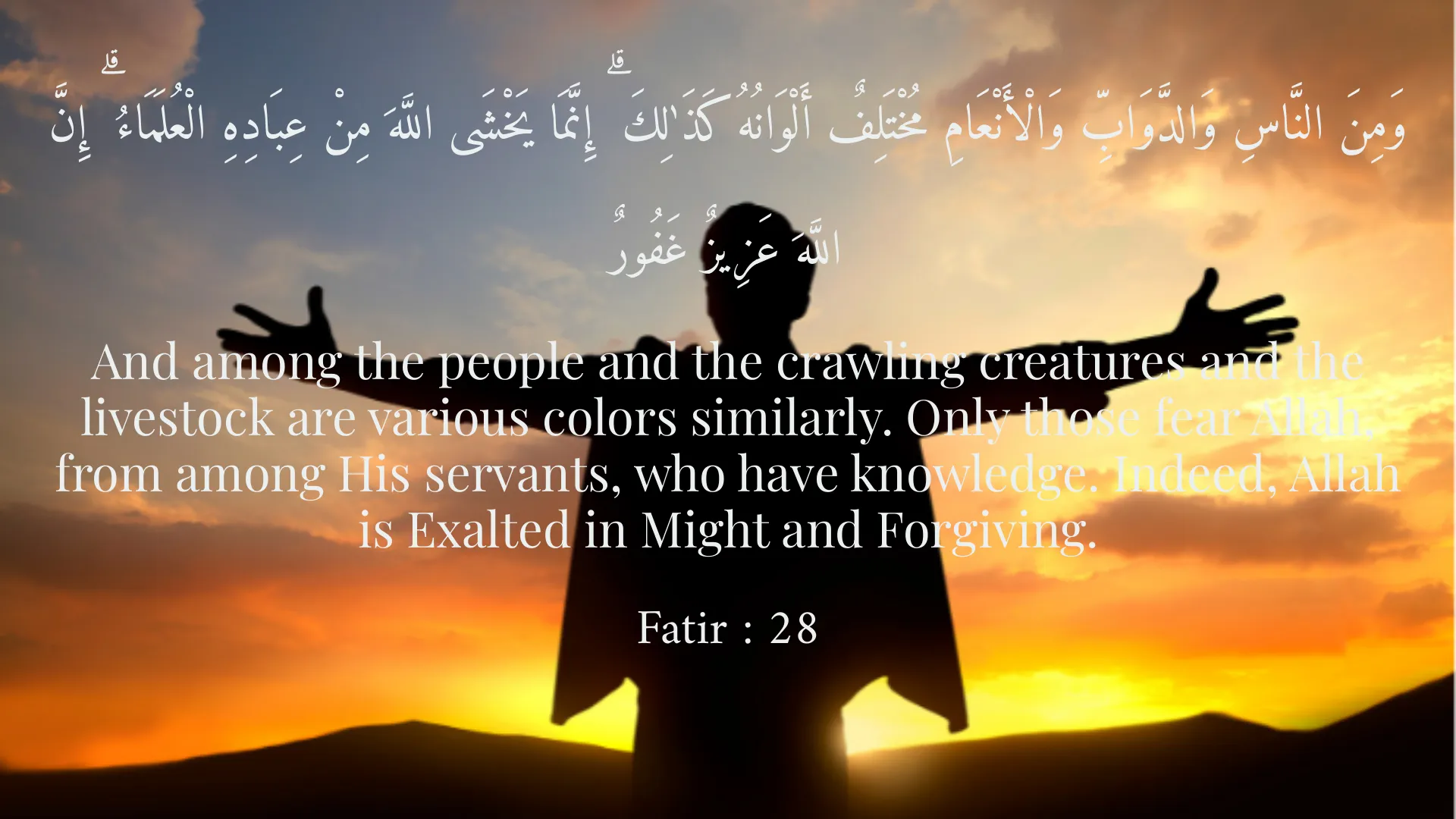
وَمِنَ النَّاسِ وَالدَّوَابِّ وَالْأَنْعَامِ مُخْتَلِفٌ أَلْوَانُهُ كَذَٰلِكَ ۗ إِنَّمَا يَخْشَى اللَّهَ مِنْ عِبَادِهِ الْعُلَمَاءُ ۗ إِنَّ اللَّهَ عَزِيزٌ غَفُورٌ
And among the people and the crawling creatures and the livestock are various colors similarly. Only those fear Allah, from among His servants, who have knowledge. Indeed, Allah is Exalted in Might and Forgiving.
Fatir : 28
يَا أَيُّهَا الَّذِينَ آمَنُوا إِذَا قِيلَ لَكُمْ تَفَسَّحُوا فِي الْمَجَالِسِ فَافْسَحُوا يَفْسَحِ اللَّهُ لَكُمْ ۖ وَإِذَا قِيلَ انشُزُوا فَانشُزُوا يَرْفَعِ اللَّهُ الَّذِينَ آمَنُوا مِنكُمْ وَالَّذِينَ أُوتُوا الْعِلْمَ دَرَجَاتٍ ۚ وَاللَّهُ بِمَا تَعْمَلُونَ خَبِيرٌ
O you who have believed, when you are told, 'Make room in assemblies,' then make room; Allah will make room for you. And when you are told, 'Arise,' then arise; Allah will raise those who have believed among you and those who were given knowledge, by degrees. And Allah is Acquainted with what you do.
Al-Mujadila : 11
شَهِدَ اللَّهُ أَنَّهُ لَا إِلَٰهَ إِلَّا هُوَ وَالْمَلَائِكَةُ وَأُولُو الْعِلْمِ قَائِمًا بِالْقِسْطِ ۚ لَا إِلَٰهَ إِلَّا هُوَ الْعَزِيزُ الْحَكِيمُ
Allah bears witness that there is no deity except Him, and [so do] the angels and those of knowledge - upholding justice. There is no deity except Him, the Exalted in Might, the Wise.
Al-Imran : 18
Short Story
It is narrated that in ancient times, a great king had heard much about a man who claimed vast knowledge and virtue. This man would speak eloquently and articulately in gatherings, quoting books and narrations from every field of knowledge, proclaiming himself the most learned of his time. The king, initially captivated by his rhetoric, held him in high regard. However, in the same city lived another scholar, who lived very quietly and unpretentiously. His words were few, but each was brimming with profound wisdom and insight. He rarely showcased himself in gatherings and was more engaged in acting upon his knowledge and serving the people.<br><br>One day, the king faced a problem whose solution was beyond the capabilities of his ministers and advisors. He first sent for the boastful scholar. With grandiosity and bombastic speech, the scholar offered complex and impractical answers that only confused the king further. Then, upon the advice of one of his close associates, the king sought out the humble scholar. When they approached him, they found him helping the needy. The king, surprised, asked him for guidance. The humble scholar, with a few brief but profound and sincere sentences, offered a simple and practical solution that stemmed from a deep understanding of truths and compassion for people. The king found peace upon hearing his words, and his problem was easily resolved. That day, the king realized that true knowledge lies not in the breadth of words and ostentation, but in profound understanding, sincerity, humility, and the awe that originates from divine gnosis, leading to righteous action and benefiting creation. As Saadi has said: "Knowledge is not merely to speak much, and action is not merely to see much." Meaning, true knowledge is that which leads to action and fear of God, not merely repetition and claim.