Quranic Answer
Sincerity, known as "Ikhlas" in Islamic terminology, is a rare gem in the ocean of human actions, holding an immensely high status in Islamic culture, particularly within the teachings of the Holy Quran. Ikhlas signifies the purification of one's intention from any non-divine motive, performing actions solely to seek the pleasure and closeness of Almighty Allah. It is not merely an ethical recommendation but the very backbone of every righteous deed deemed valuable in the sight of God. The Quran repeatedly emphasizes its importance, considering it a prerequisite for the acceptance of deeds. Without sincerity, even the greatest and seemingly most virtuous actions may become worthless and fruitless, devoid of the true spirit of worship and servitude. Allah explicitly states in Surah Al-Bayyinah, verse 5: “And they were not commanded except to worship Allah, [being] sincere to Him in religion, inclining to truth, and to establish prayer and to give zakah. And that is the correct religion.” This verse clearly demonstrates that the core of religion is sincere worship for Allah alone. To cultivate and establish sincerity in our actions, we must take conscious and continuous steps. The first and most crucial step is to gain a proper understanding of God and the purpose of creation. When a person realizes the magnificent power, infinite knowledge, and boundless mercy of the Almighty, their motivation to perform actions solely for Him is strengthened. This profound understanding eradicates the roots of hypocrisy (riya') and showing off from the heart, as one comprehends that no eye except the all-seeing eye of God can perceive the depths of their intention, and no power except divine power can bestow true and lasting reward. This deep understanding of the Creator shifts a person from worldly concerns and seeking the approval of creation towards seeking the Creator’s pleasure. One practical method for nurturing sincerity is "Muhasabah al-Nafs" (self-reckoning or introspection). This means reviewing our daily actions and intentions every night before sleep or at a specific time. We should ask ourselves: "For whom did I perform this action today? Was it for the pleasure of God, or to gain people's attention? Was my intention pure, or was there an element of showing off or worldly gain involved?" This continuous self-assessment gradually makes a person aware of impure intentions and helps them to link their future actions with divine intentions more carefully. This process of self-discovery and self-correction acts like a mirror, revealing the hidden impurities of intention. Another step is "Muraqabah" (vigilance). Muraqabah means constantly monitoring one's intention during the performance of an action. When I am helping someone, am I secretly expecting gratitude? When I pray, am I conscious of whether someone is watching me? This moment-by-moment vigilance over intentions prevents the infiltration of hidden afflictions of sincerity such as riya' (showing off), 'ujb (self-admiration), and sum'ah (performing for reputation). The Holy Quran strongly warns against those whose actions are mixed with hypocrisy, likening their deeds to scattering seeds on a smooth rock, which will never bear fruit. In Surah Al-Baqarah, verse 264, we read: “O you who have believed, do not invalidate your charities with reminders or [other] injury like one who spends his wealth [only] to be seen by the people and does not believe in Allah and the Last Day. His example is like that of a [smooth] stone upon which is dust and then a torrential rain falls upon it, leaving it bare. They are unable [to retain] anything of what they earned. And Allah does not guide the disbelieving people.” This verse clearly shows that ostentatious actions are futile and void of true merit. Concealing good deeds, especially those of worship or charity, can significantly help in strengthening sincerity. When a person performs an action secretly, and no one but God is aware of it, the opportunity for showing off is eliminated, and their intention becomes purer. This does not mean avoiding public good deeds, but rather emphasizing that in both cases, the intention must be pure, and if performing it secretly contributes more to sincerity, then it takes precedence. Because in solitude, a person faces only themselves and their God, leaving no room for pretense. Continuous supplication (Du'a) and remembrance (Dhikr) are also powerful tools for cultivating sincerity. When a person is constantly connected with God and seeks His help, their heart is illuminated by divine light, and the ego's temptations for hypocrisy and showing off diminish. The remembrance “La hawla wa la quwwata illa billah” (There is no might or power except with Allah) can prevent a person from relying on themselves and falling into the trap of self-admiration during the performance of an action. Furthermore, the supplications of prophets and divine saints for sincerity and protection from minor shirk (riya') are also beneficial. In Surah Az-Zumar, verse 2, we also read: “Indeed, We have sent down to you the Book, [O Muhammad], in truth; so worship Allah, [being] sincere to Him in religion.” This verse re-emphasizes the obligation of sincerity in all aspects of religion. It is crucial to understand that sincerity is not a destination but a continuous journey. The commanding self (nafs al-ammarah) and Satan are constantly lurking to corrupt human intentions. Therefore, continuous struggle against the ego, combating arrogance and self-admiration, and always focusing on the reward of the hereafter are essential pillars for preserving and strengthening sincerity. One who truly seeks reward from God will not give weight to the praise and admiration of people. The Quran specifies the fate of those who desire only worldly life and perform their deeds to achieve it, stating that in the hereafter, they will have no share except what they earned in this world. However, those who consistently seek divine pleasure and strive for their hereafter will receive a great and everlasting reward. This difference in motivation and intention determines the value of deeds in the sight of God. In Surah Al-Kahf, verse 110, it is stated: “So whoever would hope for the meeting with his Lord - let him do righteous work and not associate anyone with the worship of his Lord.” This verse indicates that the condition for attaining the meeting with Allah and His mercy is to perform righteous deeds accompanied by complete monotheism and sincerity. Ultimately, sincerity transforms an action from a mere physical movement into a spiritual act of worship, imbuing it with divine depth and meaning. Without it, a person's spiritual life would be baseless, and any effort to draw closer to God would remain incomplete. This is the secret that Allah has pointed to in the Holy Quran, stating that all worship and servitude must be performed sincerely for Him. This not only brings blessings to one's actions but also grants spiritual peace and inner contentment, aiding the individual on their path of spiritual growth. Achieving this level of sincerity requires continuous effort, deep awareness, and complete reliance on God.
Related Verses
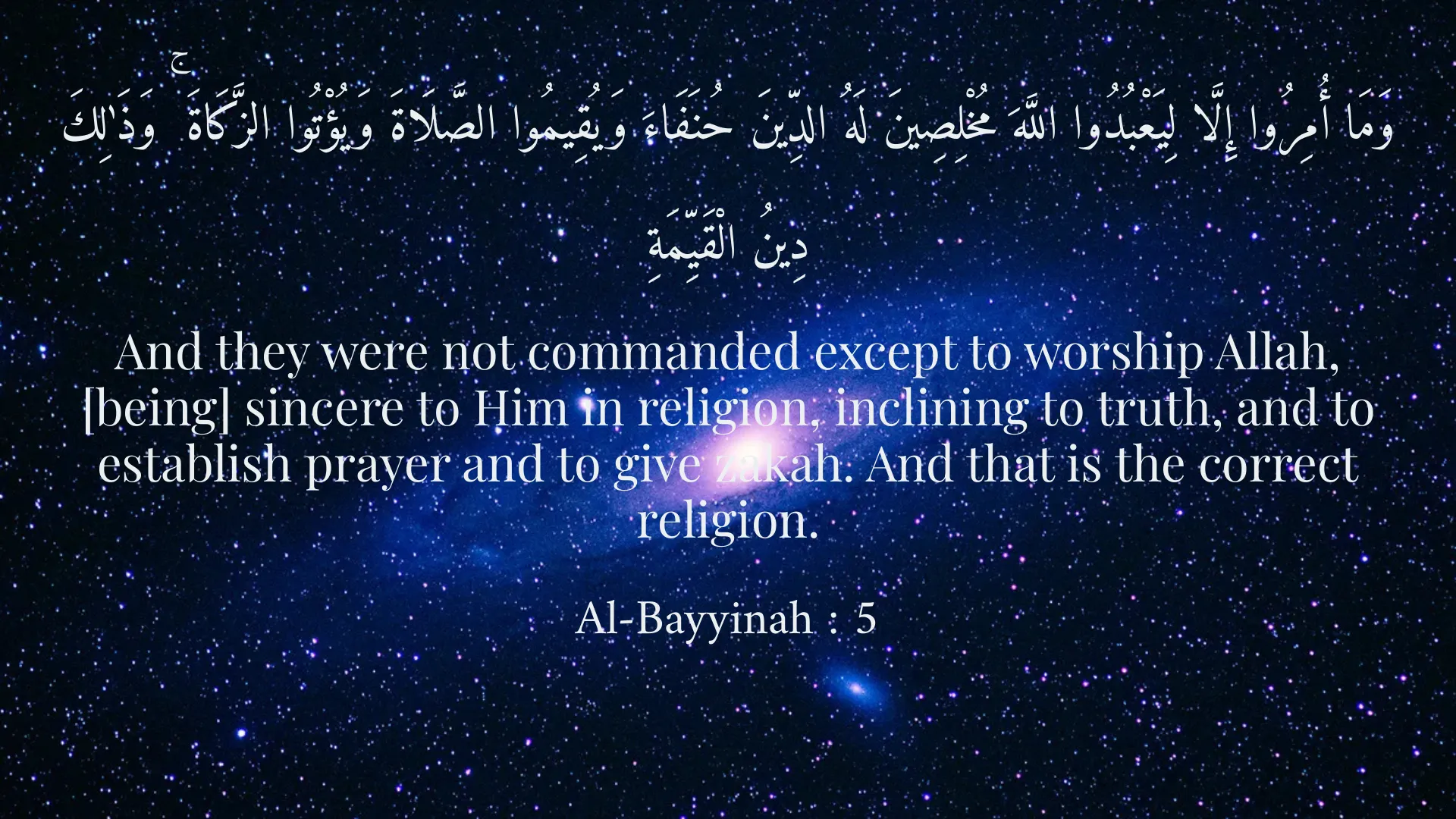
وَمَا أُمِرُوا إِلَّا لِيَعْبُدُوا اللَّهَ مُخْلِصِينَ لَهُ الدِّينَ حُنَفَاءَ وَيُقِيمُوا الصَّلَاةَ وَيُؤْتُوا الزَّكَاةَ ۚ وَذَٰلِكَ دِينُ الْقَيِّمَةِ
And they were not commanded except to worship Allah, [being] sincere to Him in religion, inclining to truth, and to establish prayer and to give zakah. And that is the correct religion.
Al-Bayyinah : 5
يَا أَيُّهَا الَّذِينَ آمَنُوا لَا تُبْطِلُوا صَدَقَاتِكُم بِالْمَنِّ وَالْأَذَىٰ كَالَّذِي يُنفِقُ مَالَهُ رِئَاءَ النَّاسِ وَلَا يُؤْمِنُ بِاللَّهِ وَالْيَوْمِ الْآخِرِ ۖ فَمَثَلُهُ كَمَثَلِ صَفْوَانٍ عَلَيْهِ تُرَابٌ فَأَصَابَهُ وَابِلٌ فَتَرَكَهُ صَلْدًا ۖ لَّا يَقْدِرُونَ عَلَىٰ شَيْءٍ مِّمَّا كَسَبُوا ۗ وَاللَّهُ لَا يَهْدِي الْقَوْمَ الْكَافِرِينَ
O you who have believed, do not invalidate your charities with reminders or [other] injury like one who spends his wealth [only] to be seen by the people and does not believe in Allah and the Last Day. His example is like that of a [smooth] stone upon which is dust and then a torrential rain falls upon it, leaving it bare. They are unable [to retain] anything of what they earned. And Allah does not guide the disbelieving people.
Al-Baqarah : 264
إِنَّا أَنزَلْنَا إِلَيْكَ الْكِتَابَ بِالْحَقِّ فَاعْبُدِ اللَّهَ مُخْلِصًا لَّهُ الدِّينَ
Indeed, We have sent down to you the Book, [O Muhammad], in truth; so worship Allah, [being] sincere to Him in religion.
Az-Zumar : 2
فَمَن كَانَ يَرْجُو لِقَاءَ رَبِّهِ فَلْيَعْمَلْ عَمَلًا صَالِحًا وَلَا يُشْرِكْ بِعِبَادَةِ رَبِّهِ أَحَدًا
So whoever would hope for the meeting with his Lord - let him do righteous work and not associate anyone with the worship of his Lord.
Al-Kahf : 110
Short Story
In ancient times, in a remote village, there lived an ascetic and benevolent dervish renowned for his piety and good deeds, highly esteemed by the people. One day, a wealthy merchant, who also performed many charitable acts but always made sure everyone knew about his generosity, approached the dervish and said: “O wise one, I spend much of my wealth in charity, build mosques, and feed the poor. Yet, I do not feel the peace you seem to possess. What is your secret?” The dervish smiled gently and replied: “My friend, your hands are open in generosity, but your heart also seeks the praise of men. True peace comes when your left hand does not know what your right hand gives, and when the only gaze you seek is that of the Creator. It is said that a deed done for God alone, even if small, weighs more heavily on the scales than mountains of good deeds performed for human applause. Seek to polish the mirror of your intention, not the facade of your actions.” The merchant, humbled, began to reflect on his intentions, and slowly, the true sweetness of selfless giving began to fill his heart.