Quranic Answer
In the Holy Quran, the subject of faith (Iman) and its formation holds immense importance. The Quran, instead of encouraging blind imitation and merely accepting what has been inherited from ancestors, consistently invites humanity to ponder, reflect, and utilize their intellect. True faith is that which is built upon awareness, insight, and personal understanding, not merely following the majority or what others believe. This path helps you to build a strong and deeply rooted faith from the depths of your own being, rather than relying on the beliefs of others. One of the central concepts emphasized by the Quran is "Tadabbur," which means deep contemplation and profound reflection on divine verses and the signs of creation. In numerous verses, Allah invites people to ponder over the horizons and within themselves, so that through observing the order and wisdom in existence, they may recognize the presence of an All-Wise and All-Capable Creator and come to believe in Him. This type of faith is firm and deeply rooted; it is not easily shaken by doubts or opposing views because it originates from within the individual, based on reasoning and proof. For instance, in Surah Al Imran, verse 191, Allah speaks of "those of understanding" who "remember Allah while standing or sitting or [lying] on their sides and reflect upon the creation of the heavens and the earth, [saying], 'Our Lord, You did not create this in vain; exalted are You [above such a thing]; then protect us from the punishment of the Fire.'" This verse clearly illustrates that the path to profound faith is through contemplation and reflection. The Quran strongly condemns the approach of those who merely follow something because their fathers or elders were upon it. In Surah Al-Baqarah, verse 170, it is stated: "And when it is said to them, 'Follow what Allah has revealed,' they say, 'Rather, we will follow that which we found our fathers doing.' Even though their fathers understood nothing, nor were they guided?" This verse clearly delineates the difference between faith based on intellect and proof, and blind imitation. Faith should not be an inheritance accepted without question; rather, it must be acquired through research, questioning, and the pursuit of truth. The responsibility of faith in the Quran is entirely individual. Every human being is accountable for their own actions and beliefs, and no one carries the burden of another's sin. This principle itself necessitates that each person's faith is the result of their own understanding and choice. In Surah Al-An'am, verse 164, we read: "And no bearer of burdens will bear the burden of another." This verse indicates that on the Day of Judgment, everyone must present themselves with their own faith and deeds, not with the faith and deeds of others. Therefore, for our faith to be real and accepted by Allah, we must acquire it ourselves and steadfastly adhere to it. To avoid blind imitation in faith, the Quran offers several strategies: 1. Thought and Intellect (Ta'aqqul): Always use your reason and intellect. Ponder over the realities of existence and divine knowledge. Look at the signs of Allah in creation, within yourselves, and in the verses of the Quran. 2. Seeking Knowledge (Talab al-Ilm): The Quran places immense importance on knowledge and considers it a path to truth. In Surah Taha, verse 114, it states: "And say, 'My Lord, increase me in knowledge.'" Study, research, and inquiry are tools for achieving conscious faith. 3. Direct Connection with the Quran: Read the Quran yourself, reflect on its meanings, and refer to authentic commentaries. The Quran itself is a source of guidance and insight that can strengthen your faith. 4. Sincerity in Seeking Truth (Ikhlas): A pure intention to find the truth, without bias or prejudice, is crucial. Allah guides those who sincerely seek the truth. 5. Accepting Guidance from Prophets and Imams: Alongside individual thought and reasoning, the Quran also emphasizes the necessity of following divine prophets and messengers, for they are guides from Allah, and their teachings are based on divine revelation. This following is not blind imitation but obedience to a trustworthy and infallible source affirmed by Allah Himself. In summary, the Quran emphasizes that faith must be attained through "Yaqin" (certainty). Yaqin is a state of knowledge where no doubt remains, and this certainty can only be achieved through deep reflection, contemplation on the verses, and a conscious pursuit of truth. Imitation means accepting without reason or research, whereas Quranic faith is based on reason and proof. Therefore, to avoid imitating the faith of others, we must illuminate our path with the light of reason and the guidance of revelation, seek truth ourselves, and with an open heart and inquisitive mind, delve into a deeper discovery and understanding of divine teachings. This leads to a personal, firm, and stable faith that is neither borrowed from others nor easily shaken. This path is blessed and full of spiritual growth, leading humanity to the true source of peace and knowledge. Authentic faith, rooted in certainty, is the result of an inner and outer journey. This journey includes contemplating the world around and within oneself, questioning the purpose of existence, and seeking answers in divine scripture. When an individual arrives at these conclusions independently, their faith is not only deeper and more enduring but also has a greater capacity to impact their life and the lives of others. Such faith withstands temptations and doubts because its roots are embedded in the depths of the individual's heart and mind, nourished by the light of insight and knowledge. In the Quran, Allah consistently speaks of "Ulul-Albab" (people of understanding/intellect), those who possess the power of reason and discernment and can distinguish truth from falsehood. This indicates that Allah expects His servants to look at the world and religion with open eyes and active minds. The difference between "Taba'iyyah" (following/obedience) and "Taqlid" (imitation) lies precisely in this: Taba'iyyah to divine guidance is the conscious acceptance of truth, whereas Taqlid is the uncritical acceptance of others' words without thought or research. Islam not only negates imitation in the fundamental principles of faith but even in the secondary rulings of religion, it refers to the authority and knowledge of experts (Mujtahids) whose rulings are based on scholarship and reasoning, not merely on repeating what ancestors said. Thus, the path to avoiding imitation in faith is the path of self-improvement, self-knowledge, and knowledge of God. This path requires courage in facing wrong traditions, steadfastness against societal pressures, and humility in the face of truth. This is how we can achieve a faith that is not only salvific but also fills our lives with meaning, purpose, and tranquility. This faith is what Allah refers to in the Quran as "Hablu Llah al-Matin" (the firm rope of Allah), to which whoever holds fast will attain eternal felicity. This process involves continuous deepening of knowledge and insight, constant questioning, and reviewing beliefs, rather than stopping at a point others have reached. This itself is a major inner struggle (Jihad al-Akbar) to achieve ultimate certainty (Haqq al-Yaqin).
Related Verses
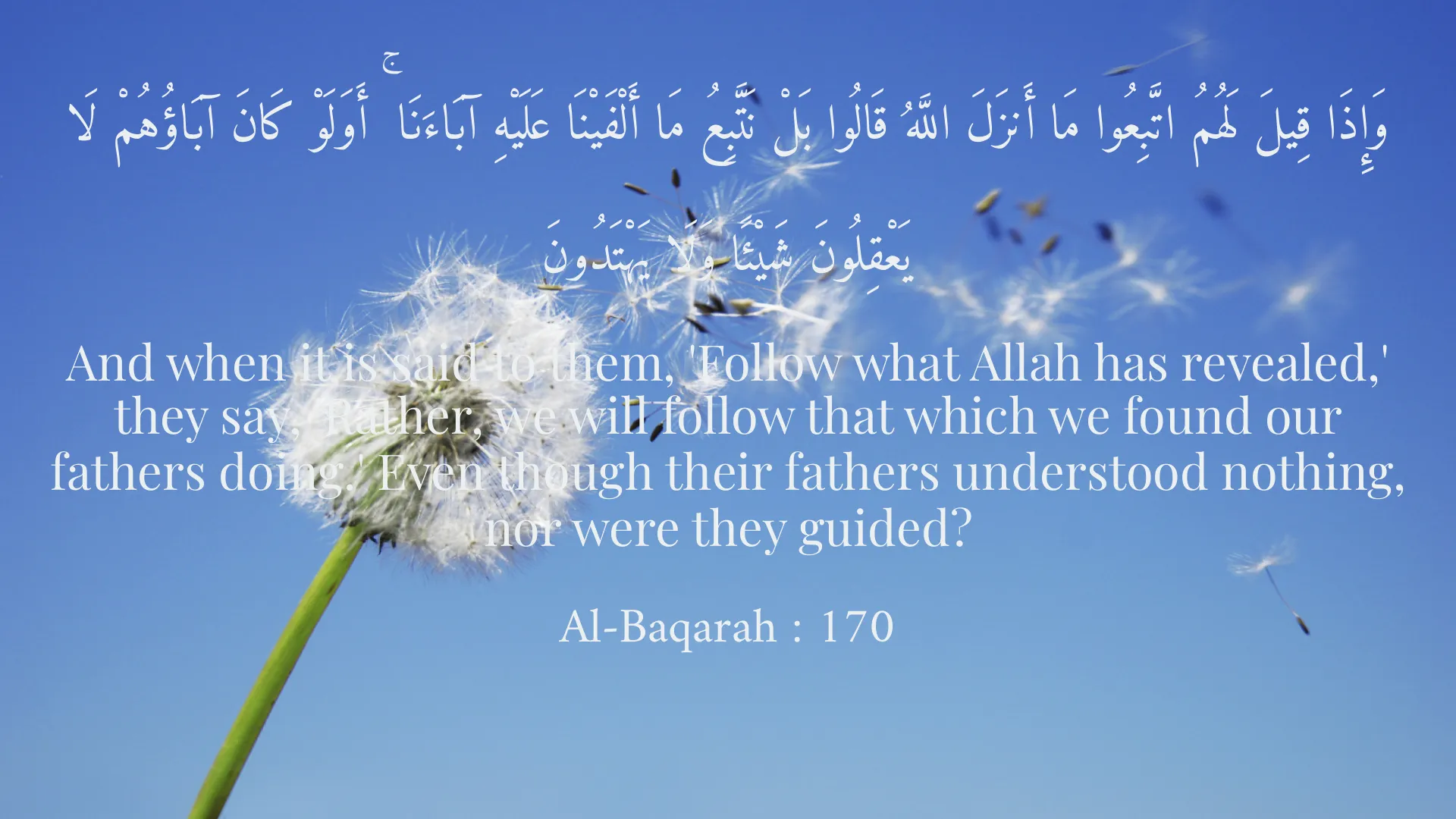
وَإِذَا قِيلَ لَهُمُ اتَّبِعُوا مَا أَنزَلَ اللَّهُ قَالُوا بَلْ نَتَّبِعُ مَا أَلْفَيْنَا عَلَيْهِ آبَاءَنَا ۚ أَوَلَوْ كَانَ آبَاؤُهُمْ لَا يَعْقِلُونَ شَيْئًا وَلَا يَهْتَدُونَ
And when it is said to them, 'Follow what Allah has revealed,' they say, 'Rather, we will follow that which we found our fathers doing.' Even though their fathers understood nothing, nor were they guided?
Al-Baqarah : 170
الَّذِينَ يَذْكُرُونَ اللَّهَ قِيَامًا وَقُعُودًا وَعَلَىٰ جُنُوبِهِمْ وَيَتَفَكَّرُونَ فِي خَلْقِ السَّمَاوَاتِ وَالْأَرْضِ رَبَّنَا مَا خَلَقْتَ هَٰذَا بَاطِلًا سُبْحَانَكَ فَقِنَا عَذَابَ النَّارِ
Who remember Allah while standing or sitting or [lying] on their sides and reflect upon the creation of the heavens and the earth, [saying], 'Our Lord, You did not create this in vain; exalted are You [above such a thing]; then protect us from the punishment of the Fire.'
Al Imran : 191
قُلْ أَغَيْرَ اللَّهِ أَبْغِي رَبًّا وَهُوَ رَبُّ كُلِّ شَيْءٍ ۚ وَلَا تَكْسِبُ كُلُّ نَفْسٍ إِلَّا عَلَيْهَا ۚ وَلَا تَزِرُ وَازِرَةٌ وِزْرَ أُخْرَىٰ ۚ ثُمَّ إِلَىٰ رَبِّكُم مَّرْجِعُكُمْ فَيُنَبِّئُكُم بِمَا كُنتُمْ فِيهِ تَخْتَلِفُونَ
Say, 'Is it other than Allah I should seek as a lord while He is the Lord of all things? And every soul earns not [evil] except against itself, and no bearer of burdens will bear the burden of another. Then to your Lord is your return, and He will inform you concerning that over which you used to differ.'
Al-An'am : 164
Short Story
It is narrated that a devout man used to sit in a monastery with a group of outwardly religious people. Every day, they spoke of faith and piety, yet their hearts remained heedless of the true essence. One day, a knowing dervish passed by and observed their state. The devout man said, 'Every day, we speak of faith and guide others to the straight path.' The dervish smiled and replied, 'Until faith settles deep within the soul and the heart is illuminated by the light of certainty, a thousand repetitions of words and hearings are of no avail. If someone merely accepts what they hear without contemplating it themselves, their faith is like a house built on sand, which trembles with every gust of wind. But if one seeks the truth for themselves and reaches understanding, their faith will be like a steadfast mountain.' The devout man understood from these words that the essence of faith lies within him, not in repeating the words of others. Thereafter, he strove to build his faith through his own reflection and knowledge.