Quranic Answer
Feeling the Divine Presence in solitude is a profoundly personal and spiritual experience rooted in our understanding of God's majesty and proximity. The Holy Quran repeatedly emphasizes that Allah is always with us, closer to us than our jugular vein. This closeness doesn't imply physical proximity but rather His encompassing knowledge and sustenance over all existence, and His absolute awareness of our states and intentions. Indeed, solitude itself offers a unique opportunity to detach from the world's clamor and establish a purer connection with the One Creator. To attain this sense of presence, we need consistent practice and adherence to a set of actions and heartfelt states, which are detailed below. The first step towards feeling the Divine Presence in solitude is 'Dhikr,' or the remembrance of Allah. Dhikr is not merely the repetition of words; it signifies the presence of the heart while remembering God. This remembrance can include Tasbihat (Subhanallah, Alhamdulillah, Allahu Akbar), Istighfar (Astaghfirullah Rabbi wa atubu ilayh – I seek forgiveness from Allah, my Lord, and I repent to Him), blessings upon the Prophet (PBUH) and his family, or the repetition of Allah's beautiful names (Asma ul Husna). In Surah Ar-Ra'd, verse 28, Allah states: “Those who have believed and whose hearts are assured by the remembrance of Allah. Unquestionably, by the remembrance of Allah hearts are assured.” This verse clearly indicates that Dhikr is the key to heart's tranquility and feeling the Divine Presence. When one engages in Dhikr in solitude, by eliminating external distractions, they can focus more deeply on the words and allow the divine light to illuminate their heart. Consistent Dhikr gradually enables a person to maintain a sense of connection with Allah in all circumstances, even amidst the busyness of daily life, but this feeling reaches its peak in solitude. The second step is 'Salat' (prayer) and other acts of worship. Prayer, especially the daily obligatory prayers and even more so the night prayer (Tahajjud), represents the pinnacle of solitude with the Lord. In Salat, the servant stands face-to-face with their Creator, converses with Him, and surrenders their entire being to His will. To feel the Divine Presence in prayer, we must prioritize 'Khushoo',' which means humility and profound concentration of both heart and body before Allah's majesty. When a person experiences the closest state to Allah in prostration (sujud), they can feel their entire being present in the Divine Presence. Night prayer, performed in the silence and tranquility of midnight, offers an unparalleled opportunity for sincere supplication and a deeper understanding of the Lord's presence. During these hours, worldly connections are minimized, and the soul is freer to connect with the source of existence. 'Recitation and contemplation of the Holy Quran' is also a primary means of feeling the Divine Presence. The Quran is the word of God, and reading it with contemplation and understanding its meanings is akin to directly hearing God's speech. When you recite the Quran in your solitude and reflect on the meanings of its verses, it is as if a window opens to divine truths. Each verse can guide you towards Allah's majesty, wisdom, mercy, and power. For instance, verses related to the creation of the heavens and earth, life and death, and divine promises can turn the heart towards the Creator and Sustainer of existence. This contemplation not only aids in a deeper understanding of religion but also makes you feel as though you are in the presence of the One who revealed this magnificent word. 'Reflection and contemplation on creation' is another way to perceive the Divine Presence. When a person in their solitude contemplates the majesty and beauty of creation, the order governing the universe, the complexities of the human body, or the wonders of nature, they inevitably realize the boundless power, knowledge, and wisdom of the Creator. Every particle in existence is a sign of Allah's presence and greatness. This reflection detaches the heart from worldly attachments and guides it towards the source of all beauty and perfection. This type of meditation leads one to believe that even in the smallest phenomena, the hand of God is evident, thus strengthening the sense of His presence. 'Sincere supplication and intimate prayers (Dua and Munajat)' are also fundamental pillars for feeling the Divine Presence. Dua is a direct conversation between the servant and the Lord. In solitude, a person can, without any intermediary, share all their needs, desires, fears, and hopes with God. The feeling of being heard, the sense that an absolute and merciful power listens to and understands them, is profoundly comforting. In Surah Al-Baqarah, verse 186, Allah says: “And when My servants ask you, [O Muhammad], concerning Me - indeed I am near. I respond to the invocation of the supplicant when he calls upon Me.” This verse reinforces hope and a sense of closeness, assuring the individual that in their solitude, they are not alone, and God is the hearer of their prayers. Furthermore, 'sincerity in intention (Ikhlas)' and 'reliance on Allah (Tawakkul)' play significant roles. Any action performed sincerely and solely for the pleasure of Allah, no matter how small it may seem, can open a door to the Divine Presence. Sincerity purifies the heart from worldly impurities and makes it receptive to divine light. Tawakkul means complete trust in Allah and entrusting all matters to Him. When a person in their solitude surrenders all their worries and problems to Allah, they experience a sense of peace and liberation, and this tranquility itself is a sign of divine presence and support. Finally, 'repentance (Tawbah) and seeking forgiveness (Istighfar)' are essential for purifying the heart from obstacles to the Divine Presence. Sins and spiritual impurities create veils between the servant and the Lord. Through sincere Istighfar and genuine remorse, these veils are lifted, and the heart becomes more ready to receive divine light. The feeling of lightness and purity after repentance can be a sign of renewed connection with the source of purity and divine presence. To strengthen this feeling in your solitude, it is recommended to create a quiet and serene space, free from noise. Put away your phone and any other distractions. Dedicate a specific time each day (e.g., early morning or late night) to this solitude and maintain consistency. Enter this time with a prepared heart and mind. Initially, you might not feel anything specific, but with practice and sincerity, this feeling will deepen over time. The Divine Presence in solitude is not a momentary event but a process of spiritual growth and continuous connection with the Creator, achievable through effort and pure intention. In summary, feeling the Divine Presence in solitude is achieved through a combination of Dhikr, Salat, Quran recitation and contemplation, reflection on creation, sincere supplication, sincerity, reliance on Allah, and repentance. These are tools that polish the heart and prepare it to perceive God's constant and omnipresent presence. This experience is not only comforting but also illuminates the path of life and imbues it with deeper meaning.
Related Verses
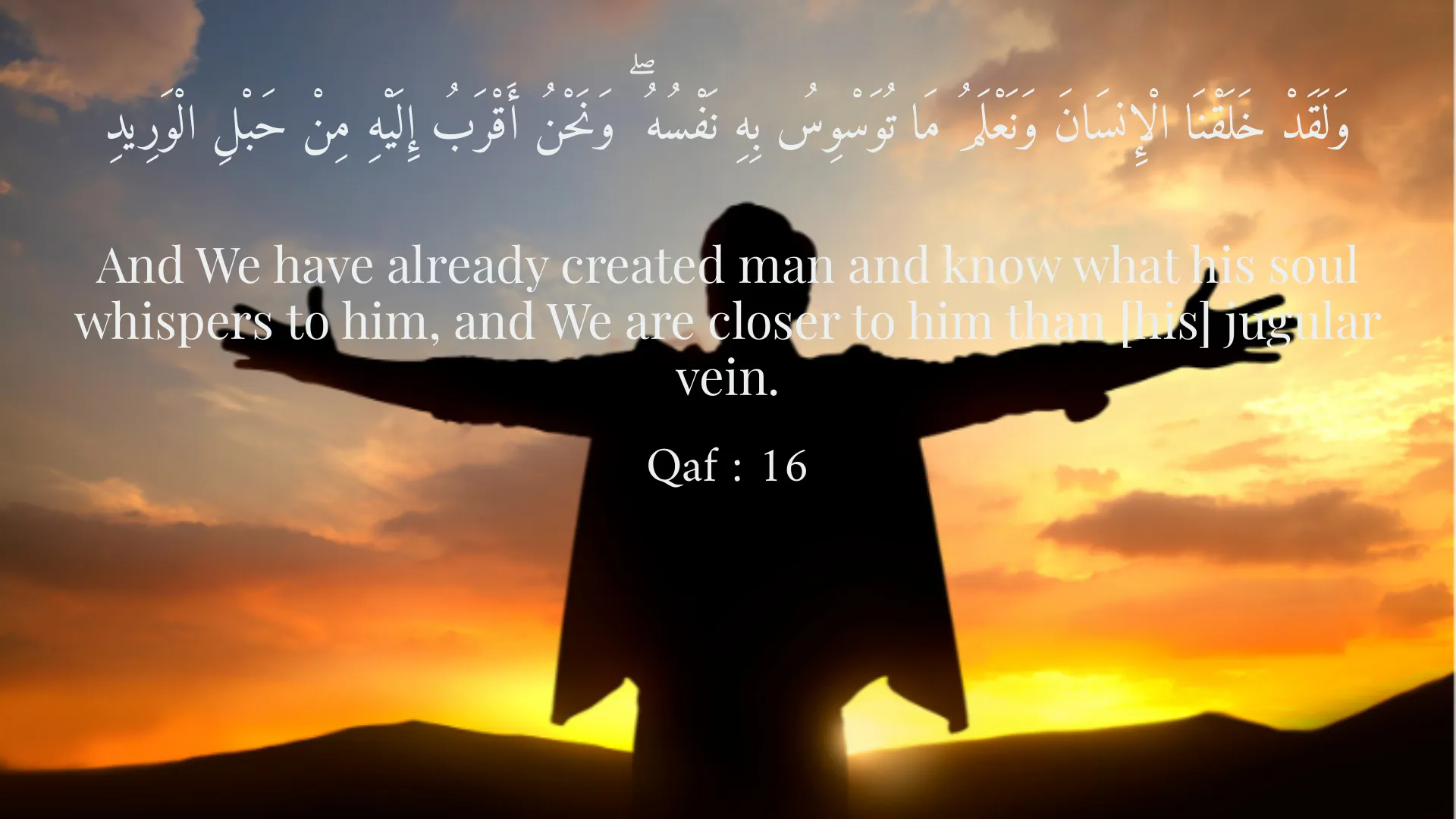
وَلَقَدْ خَلَقْنَا الْإِنسَانَ وَنَعْلَمُ مَا تُوَسْوِسُ بِهِ نَفْسُهُ ۖ وَنَحْنُ أَقْرَبُ إِلَيْهِ مِنْ حَبْلِ الْوَرِيدِ
And We have already created man and know what his soul whispers to him, and We are closer to him than [his] jugular vein.
Qaf : 16
وَإِذَا سَأَلَكَ عِبَادِي عَنِّي فَإِنِّي قَرِيبٌ ۖ أُجِيبُ دَعْوَةَ الدَّاعِ إِذَا دَعَانِ ۖ فَلْيَسْتَجِيبُوا لِي وَلْيُؤْمِنُوا بِي لَعَلَّهُمْ يَرْشُدُونَ
And when My servants ask you, [O Muhammad], concerning Me - indeed I am near. I respond to the invocation of the supplicant when he calls upon Me. So let them respond to Me [by obedience] and believe in Me that they may be [rightly] guided.
Al-Baqarah : 186
الَّذِينَ آمَنُوا وَتَطْمَئِنُّ قُلُوبُهُم بِذِكْرِ اللَّهِ ۗ أَلَا بِذِكْرِ اللَّهِ تَطْمَئِنُّ الْقُلُوبُ
Those who have believed and whose hearts are assured by the remembrance of Allah. Unquestionably, by the remembrance of Allah hearts are assured.
Ar-Ra'd : 28
Short Story
One day, a distressed dervish, seeking solace from the city's clamor, took refuge in a secluded corner of the mountains. In that solitude, there was no sound but the whispering wind, no sight but the sky and stones. Despondency had enveloped him, and he wondered, "In this isolation and loneliness, who will listen to me?" He sat contemplating for an hour, recalling a saying from the elders: "God is in the solitude of hearts." With this thought, he began to engage in remembrance (Dhikr) and supplication. The more he remembered God, the less lonely he felt, and a profound peace enveloped him. It was as if the walls of his solitude had opened, and he was embraced by an infinite Presence. That day, the dervish realized that the Divine Presence is neither in crowds nor in a specific place, but in the silence and purity of the heart, and solitude is the best ground for finding that hidden treasure. His heart was illuminated by divine light, and he returned to the city, but with a peaceful and assured heart.