Quranic Answer
Feeling the presence of God in every moment of our lives is a profound aspiration for any believing heart. This deep sense of connection not only brings tranquility and peace to the soul but also guides all our actions and intentions. The Holy Quran provides numerous pathways to achieve this spiritual station. From a Quranic perspective, God's presence in existence is perpetual and all-encompassing; it is we who must prepare our hearts to perceive this divine presence and open our inner eyes to His signs. One of the most fundamental ways to feel God's presence is through “Dhikr” – the remembrance of Him. Dhikr means recollection and bringing to mind, and it's not merely about repeating words but involves a heartfelt presence and continuous awareness of the Lord's greatness, power, and mercy. True Dhikr transcends mere utterance; it penetrates deep into the soul and manifests in every thought and action. The Quran states in Surah Ar-Ra’d, verse 28: “Those who have believed and whose hearts are assured by the remembrance of Allah. Unquestionably, by the remembrance of Allah hearts are assured.” This verse clearly indicates that true peace of heart lies in the remembrance of God. Dhikr can involve performing Salat (prayer) with mindfulness, reciting the Quran, saying glorifications (Tasbih), and supplication (Du’a). However, beyond these, Dhikr means remembering God's presence and observation in every task, even the simplest daily activities. When we drink tea and enjoy its flavor, we should reflect on who created this blessing with such delicacy and pleasure. When we gaze at the starry sky, we should recall the Creator's majesty and His infinite power that brought this vast universe into order. This form of Dhikr elevates our lives beyond mere routine and heedlessness, imbuing them with deeper meaning. We should perceive every success and achievement as coming from Him and be grateful for it, and every hardship and challenge as an opportunity to draw closer to Him, for we know that He is the sole solver of problems and fulfiller of needs. A second approach is “Tafakkur” – reflection on creation. The Quran repeatedly invites humanity to ponder over God's signs and indications in the universe, thereby opening the doors of knowledge to them. Surah Al-Imran, verses 190 and 191, state: “Indeed, in the creation of the heavens and the earth and the alternation of the night and the day are signs for those of understanding. Who remember Allah while standing or sitting or [lying] on their sides and reflect upon the creation of the heavens and the earth.” When we observe nature—its astonishing order, the growth of a tiny plant from an insignificant seed, the movement of clouds and the life-giving rain, the cycle of life and death—we are, in fact, witnessing divine signs. Every raindrop, every snowflake, every sunrise and sunset, all testify to the existence of a Wise and Powerful Creator who is never for a moment heedless of the universe's management and has created everything with precise calculation. This deep and continuous reflection leads us to believe that God is not only found in mosques or sacred places but that His presence is evident and flowing in every particle of the universe. This perspective keeps His perpetual presence alive in our hearts, making us more humble before His grandeur and more grateful for His kindness. Thirdly, “Taqwa” (piety) and “Ihsan” (excellence in deeds) are crucial. The Quran states in Surah An-Nahl, verse 128: “Indeed, Allah is with those who fear Him and those who are doers of good.” Taqwa means refraining from sins and walking on the path of divine pleasure by observing religious limits and principles, while Ihsan means doing good and performing righteous deeds with the highest quality and with pure intention. When a person strives in their life to avoid prohibitions and fulfill divine obligations correctly, they are essentially treading the path of closeness to God and perceiving themselves in His presence. This piety and righteousness open the doors of the heart to perceive God's presence and illuminate the heart with the light of knowledge. Every good deed we do, every help we offer to others, every injustice we avert from ourselves and others, are all manifestations of feeling the divine presence in our lives, reminding us that God is observing our actions. When we serve others with pure intention and without expectation, it is as if we feel the hand of God in our hands, providing assistance to His servants through us. When we forgive and overlook wrongs, it is as if we have submitted our soul to the divine will, having come to believe that the true reward is with Him. These righteous actions build a bridge between us and the Lord, strengthening our sense of divine companionship and presence, and blessing our lives. The fourth key point is “Shukr” – gratitude. Allah says in Surah Ibrahim, verse 7: “If you are grateful, I will surely increase you [in favor].” True gratitude is not just saying “Alhamdulillah” (praise be to Allah), but it's about seeing the countless blessings God has bestowed upon us at every moment. From the blessings of breathing, seeing, hearing, to physical health and family peace, all come from Him. When a person constantly enumerates God's blessings and expresses gratitude for them, their heart becomes filled with love and awareness of the source of these blessings, sensing His presence in their life every moment. This state deepens the feeling of closeness to God, and they find Him present and observing in every blessing they perceive, realizing His greatness and generosity. Gratitude pulls us out of heedlessness and opens the eye of the heart to the boundless divine favors, making every event, however small, an opportunity to see the divine hand. Finally, “Tawakkul” – reliance on God – also plays a pivotal role in feeling His presence. When a person relies on God in all matters of their life, whether small or large, and knows that He is their supporter and protector, this reliance brings them unparalleled peace and assurance. In Surah At-Talaq, verse 3, we read: “And whoever relies upon Allah - then He is sufficient for him.” This verse paints a beautiful picture of God's unfailing support and assures us that we are never alone. When we have faith that God is with us in every situation and plans the best for us, we feel His presence even in hardships and challenges, and we come to understand His hidden wisdom behind events. This reliance not only relieves stress and anxiety but also makes us feel that an unseen hand is always watching over us, and we are never abandoned in difficulties. This belief empowers us to continue our path with tranquility and faith, knowing that our support is an infinite power. In summary, experiencing God's constant presence in life is an inner journey achieved through continuous remembrance (Dhikr) through speech, action, and heart; reflection on creation (Tafakkur) to understand divine greatness and wisdom; practicing piety and good deeds (Taqwa and Ihsan) in every step and decision; genuine gratitude (Shukr) for the smallest to the largest blessings; and complete reliance on Him (Tawakkul). All these work hand in hand to make our hearts a perfect mirror reflecting His presence, filling our lives with meaning, tranquility, and purpose. This path requires consistent effort and perseverance, but its reward is nothing short of divine closeness and a perpetual sense of companionship with the Creator of the universe, bringing a life full of blessings and contentment.
Related Verses
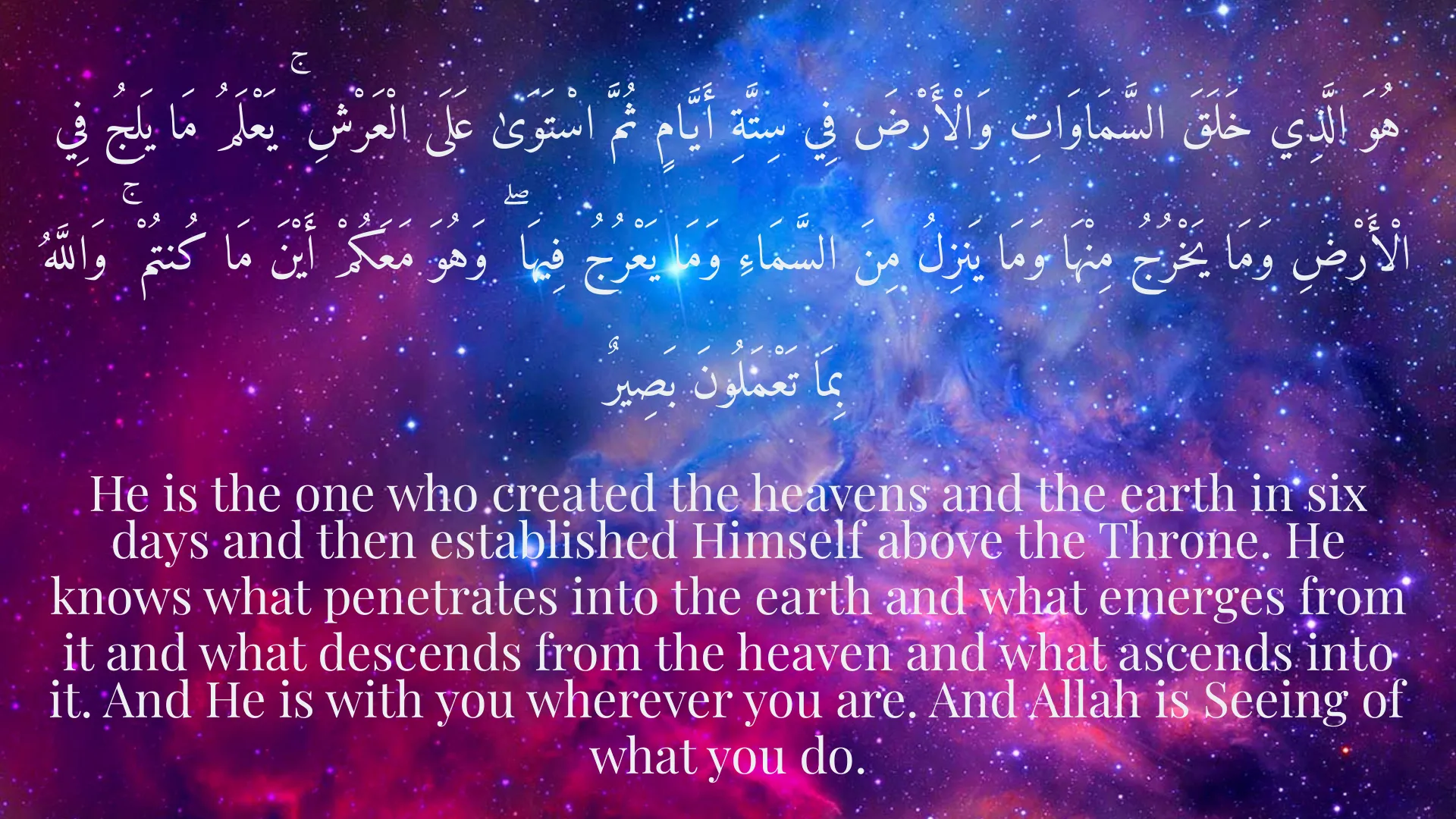
هُوَ الَّذِي خَلَقَ السَّمَاوَاتِ وَالْأَرْضَ فِي سِتَّةِ أَيَّامٍ ثُمَّ اسْتَوَىٰ عَلَى الْعَرْشِ ۚ يَعْلَمُ مَا يَلِجُ فِي الْأَرْضِ وَمَا يَخْرُجُ مِنْهَا وَمَا يَنزِلُ مِنَ السَّمَاءِ وَمَا يَعْرُجُ فِيهَا ۖ وَهُوَ مَعَكُمْ أَيْنَ مَا كُنتُمْ ۚ وَاللَّهُ بِمَا تَعْمَلُونَ بَصِيرٌ
He is the one who created the heavens and the earth in six days and then established Himself above the Throne. He knows what penetrates into the earth and what emerges from it and what descends from the heaven and what ascends into it. And He is with you wherever you are. And Allah is Seeing of what you do.
Al-Hadid : 4
الَّذِينَ آمَنُوا وَتَطْمَئِنُّ قُلُوبُهُم بِذِكْرِ اللَّهِ ۗ أَلَا بِذِكْرِ اللَّهِ تَطْمَئِنُّ الْقُلُوبُ
Those who have believed and whose hearts are assured by the remembrance of Allah. Unquestionably, by the remembrance of Allah hearts are assured.
Ar-Ra'd : 28
إِنَّ فِي خَلْقِ السَّمَاوَاتِ وَالْأَرْضِ وَاخْتِلَافِ اللَّيْلِ وَالنَّهَارِ لَآيَاتٍ لِّأُولِي الْأَلْبَابِ
Indeed, in the creation of the heavens and the earth and the alternation of the night and the day are signs for those of understanding.
Al-Imran : 190
إِنَّ اللَّهَ مَعَ الَّذِينَ اتَّقَوا وَّالَّذِينَ هُم مُّحْسِنُونَ
Indeed, Allah is with those who fear Him and those who are doers of good.
An-Nahl : 128
Short Story
One day, a detached worshipper lived in a corner of the desert, content with utmost humility with all that he had. A wealthy merchant passed by and, seeing the worshipper's tranquility, asked, 'How can you be so joyful and content without any worldly possessions?' The worshipper smiled and replied, 'My dear friend, my heart is filled with the remembrance of the Creator, and my eyes observe His magnificent artistry in every grain of sand and every star. When you seek contentment in fleeting possessions, you find restlessness; but when you seek Him in every breath you take, you find an eternal presence that no wealth can buy. My possessions are merely my awareness of His presence, and that is a treasure beyond measure.' The merchant, humbled, began to reflect on his own life, realizing that true richness lay not in what he owned, but in how deeply he perceived the Divine presence in all things.