Quranic Answer
In the intricate journey of life, every human being is bound to encounter moments of darkness, overwhelming challenges, and feelings of despair and hopelessness. This darkness can stem from personal, social, economic, or even spiritual difficulties that engulf the human soul. However, the Holy Quran, which is itself a guiding light in times of gloom, offers profound solutions and principles for finding hope and illumination in the heart of any darkness. The answer to this question lies not merely in finding momentary relief, but in establishing a robust intellectual and spiritual framework for confronting all of life's hardships. The first and most fundamental step in reaching hope amidst darkness is complete 'reliance upon Allah Almighty' (Tawakkul). Tawakkul does not simply mean surrendering affairs; rather, it is a combination of sincere effort and heartfelt trust in divine wisdom and planning. The Holy Quran repeatedly emphasizes this concept, stating that Allah is the best supporter and disposer of affairs. When a person believes with all their being that not a single leaf falls without His permission, and no problem is beyond His power, a window of tranquility and hope opens in their heart. In numerous verses, we are reminded that Allah is sufficient for His servants, and whoever relies upon Him, He is enough for them. This belief withers the roots of despair in the heart and fills it with certainty in divine assistance. In moments when all doors seem closed, reliance on Allah brings unexpected breakthroughs and makes one realize that the absolute power transcends material limitations. It teaches us that what seems like an insurmountable obstacle from our limited perspective is merely a small detail in the grand scheme of Allah's infinite wisdom. The second pillar of hope in darkness is 'patience and steadfastness' (Sabr). The Holy Quran portrays patience as a light in darkness and a great helper in tribulations. Allah, in many verses, praises the patient and promises them immense rewards. Patience, from a Quranic perspective, is not merely enduring hardship; rather, it is actively standing firm, not losing hope, and continuously striving on the path of truth and divine pleasure. This does not mean passive surrender to problems but accepting divine decree with an understanding of its wisdom, while striving to improve the situation with Allah's help. Patience enables individuals to learn lessons from crises, refine their character, and strengthen their faith. With every hardship overcome with patience and endurance, a person becomes stronger and closer to Allah, and this itself is an infinite source of hope. It is through patience that we develop resilience and a deeper appreciation for the moments of ease that follow difficulty, confirming the divine promise that ease is always intertwined with hardship. The third illuminating path is 'remembrance and contemplation of Allah' (Dhikr). The Quran states: "Unquestionably, by the remembrance of Allah hearts are assured" (Ar-Ra'd: 28). In moments of darkness and anxiety, when thoughts and minds are preoccupied with temptations and worries, Dhikr guides the heart towards the primary source of peace and power. This remembrance can include reciting verses from the Quran, glorifying Allah (Subhanallah, Alhamdulillah, Allahu Akbar), seeking forgiveness (Astaghfirullah), and reflecting on divine creation. When the tongue and heart are engaged in the remembrance of Allah, there is no room for negative and despairing thoughts. The remembrance of Allah keeps His divine presence alive in one's mind and heart, assuring them that they are not alone and that a loving and powerful Observer is always with them. This deep connection with the Creator gives strength and hope, preventing one from drowning in the quicksand of despair. It transforms internal turmoil into spiritual serenity, anchoring the soul in divine awareness. The fourth source of hope is 'supplication and prayer' (Du'a). Du'a is the direct channel of communication between the servant and the Lord. Allah states in the Quran that He is near to His servants and answers the supplication of the supplicant when they call upon Him. In the peak of darkness and helplessness, when a person raises their hands in need towards the sky, they not only feel less alone but are also overcome by an immense strength and an indescribable peace. Even if the specific request is not granted in the desired form, the act of supplication itself—an expression of servitude, humility, and trust in divine power—instills hope in the heart. Du'a purifies and clarifies the soul, paving the way for the reception of unseen divine aid. It reinforces the belief that Allah listens, cares, and responds in ways that are ultimately best for us, even if they are not immediately apparent. The fifth key principle is 'never despairing of Allah's vast mercy.' One of the greatest sins in the Quranic view is despairing of Allah's mercy. Allah says in Surah Az-Zumar, verse 53: "Say, 'O My servants who have transgressed against themselves [by sinning], do not despair of the mercy of Allah. Indeed, Allah forgives all sins. Indeed, it is He who is the Forgiving, the Merciful.'" This verse is a beacon of hope for those who have committed many sins or are caught in the most difficult circumstances. Allah's mercy is infinite and encompasses everything. Despairing of divine mercy essentially means not recognizing the greatness and vastness of Allah's attributes. This belief that Allah is always ready to forgive and help, even in the deepest darkness, keeps the window of light open and provides motivation for repentance, self-improvement, and renewed effort. It reminds us that no matter how far we feel we have strayed or how overwhelming our challenges, Allah's door of mercy is always open. And the sixth point, which is critically important, is the 'firm belief in the divine promise of ease after hardship.' In Surah Al-Inshirah, verses 5 and 6, Allah emphasizes twice: "For indeed, with hardship [will be] ease. Indeed, with hardship [will be] ease." This means that ease is not merely after hardship but with and intertwined with hardship. Within every problem, there is an opening; within every challenge, a lesson; and within every darkness, a hidden light. This definitive divine promise assures humans that their current situation is not permanent, and after every storm, there will be calm, and after every night, there will be a dawn. This perspective changes one's view of problems; instead of seeing them as destructive obstacles, one sees them as opportunities for growth and divine tests. This promise is a powerful source of resilience, reminding us that difficulty is a transient state and a precursor to relief, fostering an unwavering spirit of optimism. Ultimately, to find hope in the midst of darkness, we must practically apply all these Quranic teachings in our lives. This path is an inner journey that begins with self-awareness, knowing Allah, and relying on His illuminating verses. Whenever we feel lonely, weak, or despairing, we must remember that Allah is near, He hears our prayers, He rewards the patient, and He never abandons us from His mercy. In the heart of the fiercest storms, faith in Allah Almighty and the teachings of the Quran illuminate the path like a lighthouse in the darkness, filling the heart with the light of hope. So, let us return to Him, practice patience, pray, keep His remembrance alive in our hearts, and never despair of His endless relief and mercy, for He is the best helper and the opener of all affairs.
Related Verses
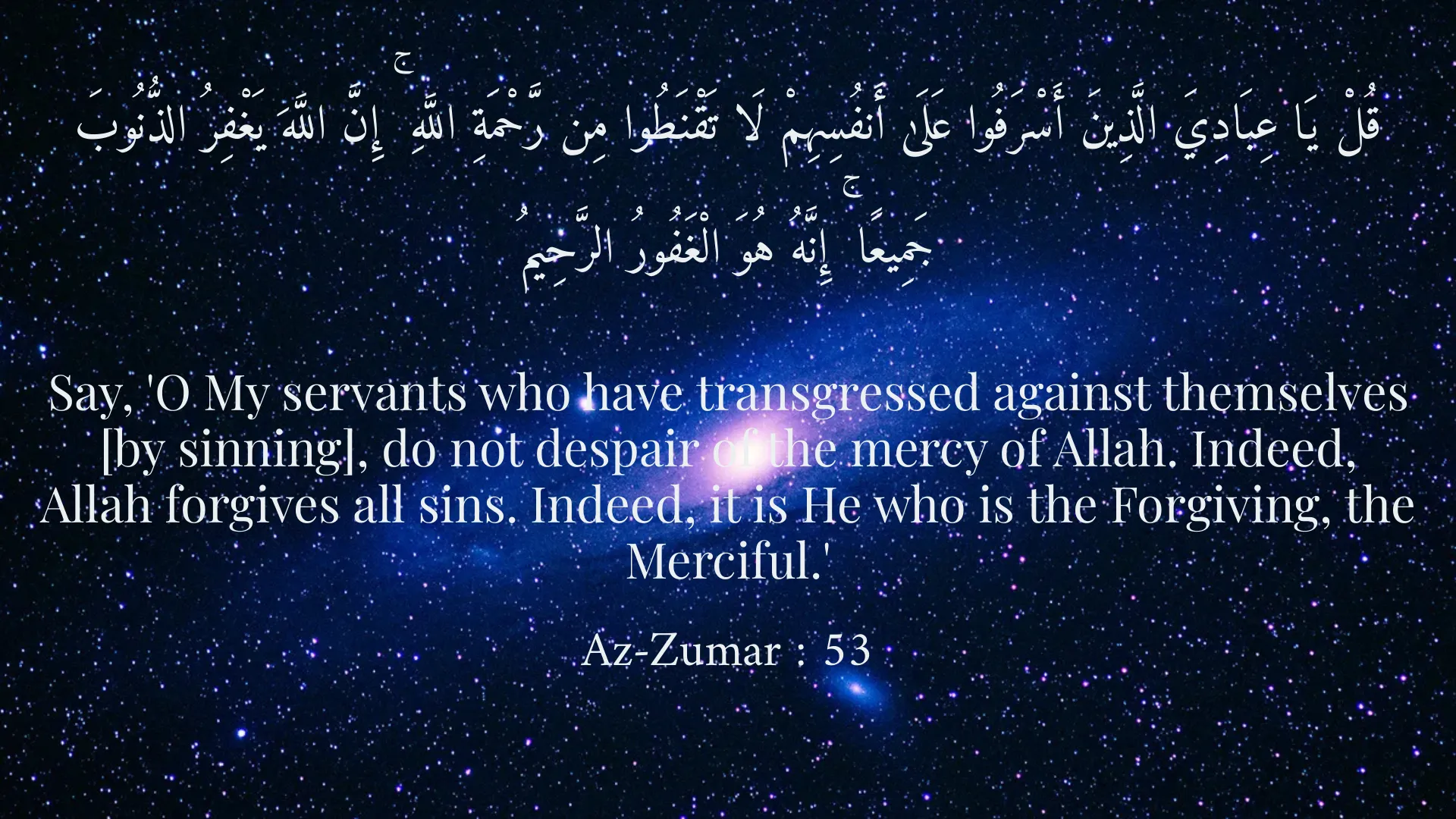
قُلْ يَا عِبَادِيَ الَّذِينَ أَسْرَفُوا عَلَىٰ أَنفُسِهِمْ لَا تَقْنَطُوا مِن رَّحْمَةِ اللَّهِ ۚ إِنَّ اللَّهَ يَغْفِرُ الذُّنُوبَ جَمِيعًا ۚ إِنَّهُ هُوَ الْغَفُورُ الرَّحِيمُ
Say, 'O My servants who have transgressed against themselves [by sinning], do not despair of the mercy of Allah. Indeed, Allah forgives all sins. Indeed, it is He who is the Forgiving, the Merciful.'
Az-Zumar : 53
فَإِنَّ مَعَ الْعُسْرِ يُسْرًا
For indeed, with hardship [will be] ease.
Al-Inshirah : 5
إِنَّ مَعَ الْعُسْرِ يُسْرًا
Indeed, with hardship [will be] ease.
Al-Inshirah : 6
يَا بَنِيَّ اذْهَبُوا فَتَحَسَّسُوا مِن يُوسُفَ وَأَخِيهِ وَلَا تَيْأَسُوا مِن رَّوْحِ اللَّهِ ۖ إِنَّهُ لَا يَيْأَسُ مِن رَّوْحِ اللَّهِ إِلَّا الْقَوْمُ الْكَافِرُونَ
O my sons, go and find out about Joseph and his brother and do not despair of the relief of Allah. Indeed, no one despairs of the relief of Allah except the disbelieving people.
Yusuf : 87
Short Story
It is said that in ancient times, a pious man named 'Basir' lost his way in a dry, barren desert. Night fell, and absolute darkness enveloped everything. Basir, overwhelmed by exhaustion and thirst, collapsed on the side, and despair struck him like a hammer. He recalled a story from Sa'di's Golestan that said: 'They asked a dervish: 'Why is your cloak torn?' He replied: 'Because I sleep under the sky, in the shade of trees, with hope in the Lord's generosity.'' With this story in his heart, Basir took a fresh breath and whispered: 'O Almighty Lord, You who turn night into day and darkness into light, how could You abandon me in this desert?' He prostrated himself and prayed with tears. Suddenly, a cool breeze blew, and the scent of water reached him. Basir rose with renewed strength and followed the scent. In the heart of darkness, he found a clear spring that restored his life. He knew that one should never despair of divine mercy and providence, even in the darkest moments.