Quranic Answer
The question of how to harmonize human love with divine love delves into one of the most profound and fundamental aspects of Islamic thought and Quranic spirituality. By nature, humans are endowed with the capacity to love. This love can be directed towards parents, children, spouses, friends, wealth, status, nature, and the beauty of the world. However, the Holy Quran teaches us that amidst this multitude of human affections, there exists a superior, comprehensive, and eternal love: the love for Allah Almighty. The key to harmonizing these two types of love lies in correctly understanding the place of each and establishing a spiritual hierarchy where divine love serves as the ultimate axis and destination, while human loves act as bridges and means to reach that sublime goal. The Quran explicitly states that love for Allah must supersede all other loves. In Surah At-Tawbah, verse 24, Allah Almighty addresses the believers, saying: "Say, [O Muhammad], 'If your fathers, your sons, your brothers, your wives, your relatives, the wealth which you have obtained, and the commerce in which you fear decline, and the dwellings in which you delight are more beloved to you than Allah and His Messenger and jihad in His cause, then wait until Allah executes His command. And Allah does not guide the defiantly disobedient people.'" This verse clearly indicates that worldly attachments and human loves, if they conflict with divine love and His commands, must be set aside. This does not mean negating human loves, but rather correctly prioritizing and orienting them. Love for Allah should be the overarching canopy under which all other loves reside and from which they draw light. But how can this harmonization be practically achieved? 1. A Monotheistic Perspective on Human Loves: Every human love, be it for a spouse, child, parent, or friend, is in reality a manifestation of Allah's affection and mercy. Allah is "Al-Wadud," meaning The Most Loving and The Beloved. It is He who has sown the seed of affection in hearts. When we show affection to our spouses, it is truly because Allah has placed this capacity for love within us, and He is the one who has made this relationship a source of tranquility (Mawaddah and Rahmah), as He states in Surah Ar-Rum, verse 21: "And of His signs is that He created for you from yourselves mates that you may find tranquility in them; and He placed between you affection and mercy. Indeed in that are signs for a people who give thought." Recognizing this truth—that every blessing and affection comes from Him—ensures that human love, instead of distancing us from God, becomes a bridge connecting us to Him. This means we love our dear ones for the sake of Allah and treat them well with the intention of earning His pleasure. 2. Orienting Human Loves Towards Divine Pleasure: Human love should never reach a point where it hinders obedience to Allah or transforms into subtle polytheism (shirk). For instance, if love for a child leads one to violate the rights of others or transgress divine limits, this love has deviated from its correct path. However, if love for a child guides one towards proper upbringing, teaching religious values, and becoming a righteous individual, then this love is aligned with the divine path. The same applies to love for a spouse or parents. Kindness to parents (Ihsan), which is emphasized in Surah Al-Isra, verses 23 and 24, is a clear example of human love that is precisely an act of obedience to divine command: "And your Lord has decreed that you not worship except Him, and to parents, good treatment. Whether one or both of them reach old age [while] with you, say not to them [so much as], 'uff,' and do not repel them but speak to them a noble word." This kindness and benevolence, stemming from love and respect, are considered acts of worship. 3. Connecting Love with Righteous Deeds: In Islam, true love for Allah manifests itself in righteous deeds and adherence to His commands. Surah Aal-Imran, verse 31, states: "Say, [O Muhammad], 'If you should love Allah, then follow me, [so] Allah will love you and forgive you your sins. And Allah is Forgiving and Merciful.'" This verse illustrates that love for Allah is not merely a heartfelt emotion; it is proven by following the Prophet (PBUH) and, consequently, by acting upon divine law. When our human loves also manifest through righteous deeds, such as respecting the rights of others, showing kindness, acting justly, and helping the needy, then these loves become intertwined with divine love and transform into acts of worship. Whenever we perform a good deed for the sake of a spouse, child, or community that pleases Allah, this human love transforms into divine love. 4. Freedom from Limiting Attachments: Harmonizing human and divine love means freeing oneself from excessive attachments and hidden idolatry. When a person loves something so much that they are willing to disregard God for it, this love has become an idol. Imam Ali (AS) states: "Love of the world blinds and deafens." This blindness and deafness hinder not only the understanding of divine love but also the true essence of human love. One must accept that everything is perishable except the Sacred Essence of Allah. Therefore, human loves must be understood within the context of their perishability and used as means to reach the infinite. Ultimately, harmonizing human love with divine love is not about negating earthly loves but elevating them. This process involves purifying the self and refining the heart so that all affections and attachments take on a divine color and are employed in His path. This not only imbues an individual's life with deep meaning and tranquility but also ensures that human relationships are built upon ethics, justice, and mercy, because the ultimate goal of all loves is to reach the clear spring of boundless divine affection. When a person attains this station, they see a manifestation of God's love in every affection and seek the boundless ocean of divine love in every thirst. It is here that human love is not only not in contradiction with divine love but becomes a mirror of it and a path toward it.
Related Verses
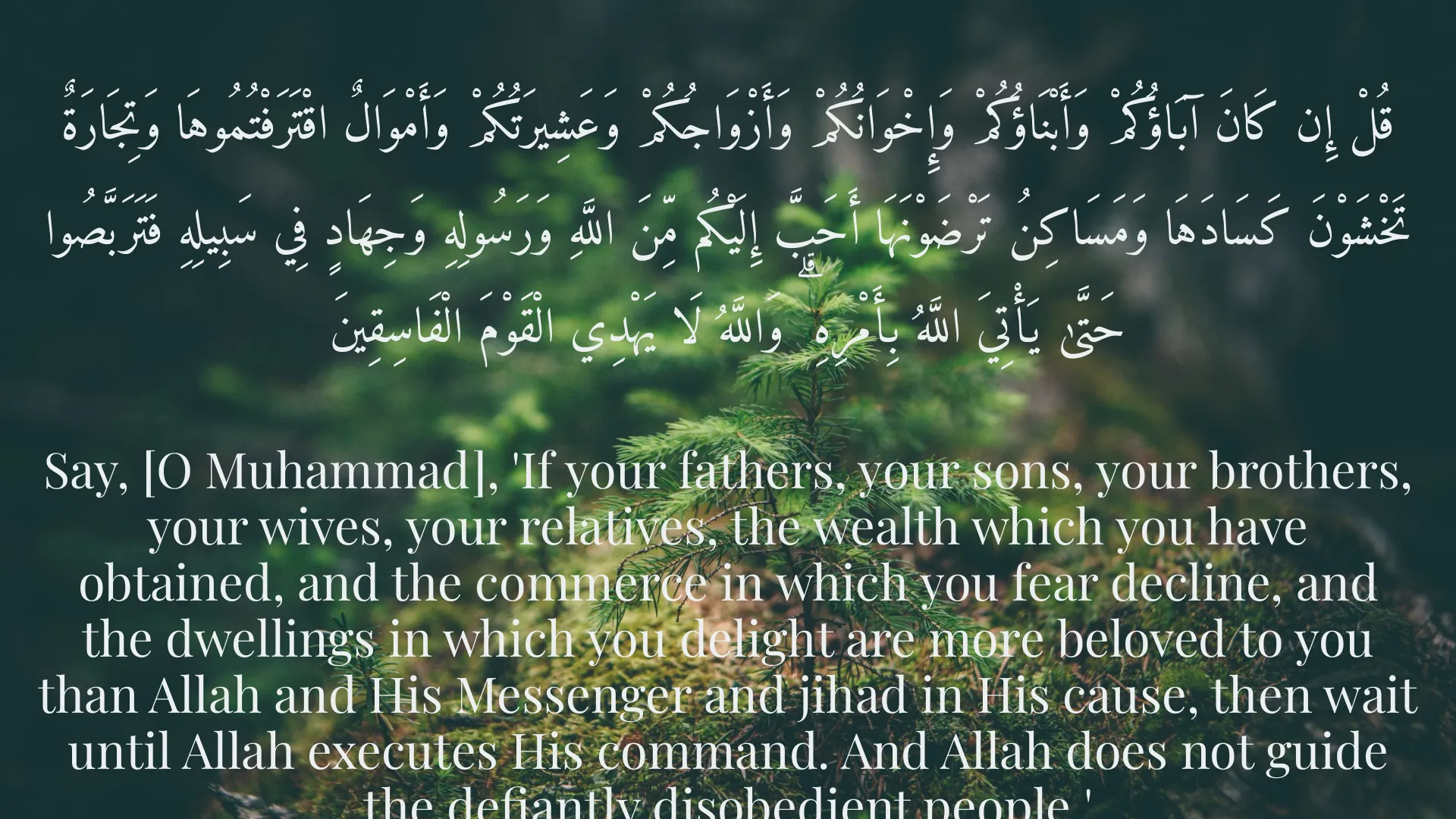
قُلْ إِن كَانَ آبَاؤُكُمْ وَأَبْنَاؤُكُمْ وَإِخْوَانُكُمْ وَأَزْوَاجُكُمْ وَعَشِيرَتُكُمْ وَأَمْوَالٌ اقْتَرَفْتُمُوهَا وَتِجَارَةٌ تَخْشَوْنَ كَسَادَهَا وَمَسَاكِنُ تَرْضَوْنَهَا أَحَبَّ إِلَيْكُم مِّنَ اللَّهِ وَرَسُولِهِ وَجِهَادٍ فِي سَبِيلِهِ فَتَرَبَّصُوا حَتَّىٰ يَأْتِيَ اللَّهُ بِأَمْرِهِ ۗ وَاللَّهُ لَا يَهْدِي الْقَوْمَ الْفَاسِقِينَ
Say, [O Muhammad], 'If your fathers, your sons, your brothers, your wives, your relatives, the wealth which you have obtained, and the commerce in which you fear decline, and the dwellings in which you delight are more beloved to you than Allah and His Messenger and jihad in His cause, then wait until Allah executes His command. And Allah does not guide the defiantly disobedient people.'
At-Tawbah : 24
وَمِنْ آيَاتِهِ أَنْ خَلَقَ لَكُم مِّنْ أَنفُسِكُمْ أَزْوَاجًا لِّتَسْكُنُوا إِلَيْهَا وَجَعَلَ بَيْنَكُم مَّوَدَّةً وَرَحْمَةً ۚ إِنَّ فِي ذَٰلِكَ لَآيَاتٍ لِّقَوْمٍ يَتَفَكَّرُونَ
And of His signs is that He created for you from yourselves mates that you may find tranquility in them; and He placed between you affection and mercy. Indeed in that are signs for a people who give thought.
Ar-Rum : 21
قُلْ إِن كُنتُمْ تُحِبُّونَ اللَّهَ فَاتَّبِعُونِي يُحْبِبْكُمُ اللَّهُ وَيَغْفِرْ لَكُمْ ذُنُوبَكُمْ ۗ وَاللَّهُ غَفُورٌ رَّحِيمٌ
Say, [O Muhammad], 'If you should love Allah, then follow me, [so] Allah will love you and forgive you your sins. And Allah is Forgiving and Merciful.'
Aal-Imran : 31
Short Story
It is said that a man of noble character was deeply enamored with the beauty of his garden, dedicating his entire life and wealth to it. He cherished every flower and every tree as if it were a part of his very soul. One day, a dervish passed by the garden. He saw the man engrossed in gazing at the flowers, smiled, and said: 'O owner of this earthly paradise! If you were to occupy your heart with the Creator of all paradises, as you are occupied with this soil and and water, what gardens would blossom within your soul, and what tranquility would take root in your heart!' The man heard and pondered. From then on, every time he looked at his garden, he contemplated not his ownership, but the grandeur of its Creator. His love for the garden did not diminish, but deepened; for from an earthly manifestation, he reached the Eternal Beloved, realizing that every earthly beauty is a sign of His boundless perfection. Thus, his love for the garden led him towards divine love, and his heart drank from both springs.