Quranic Answer
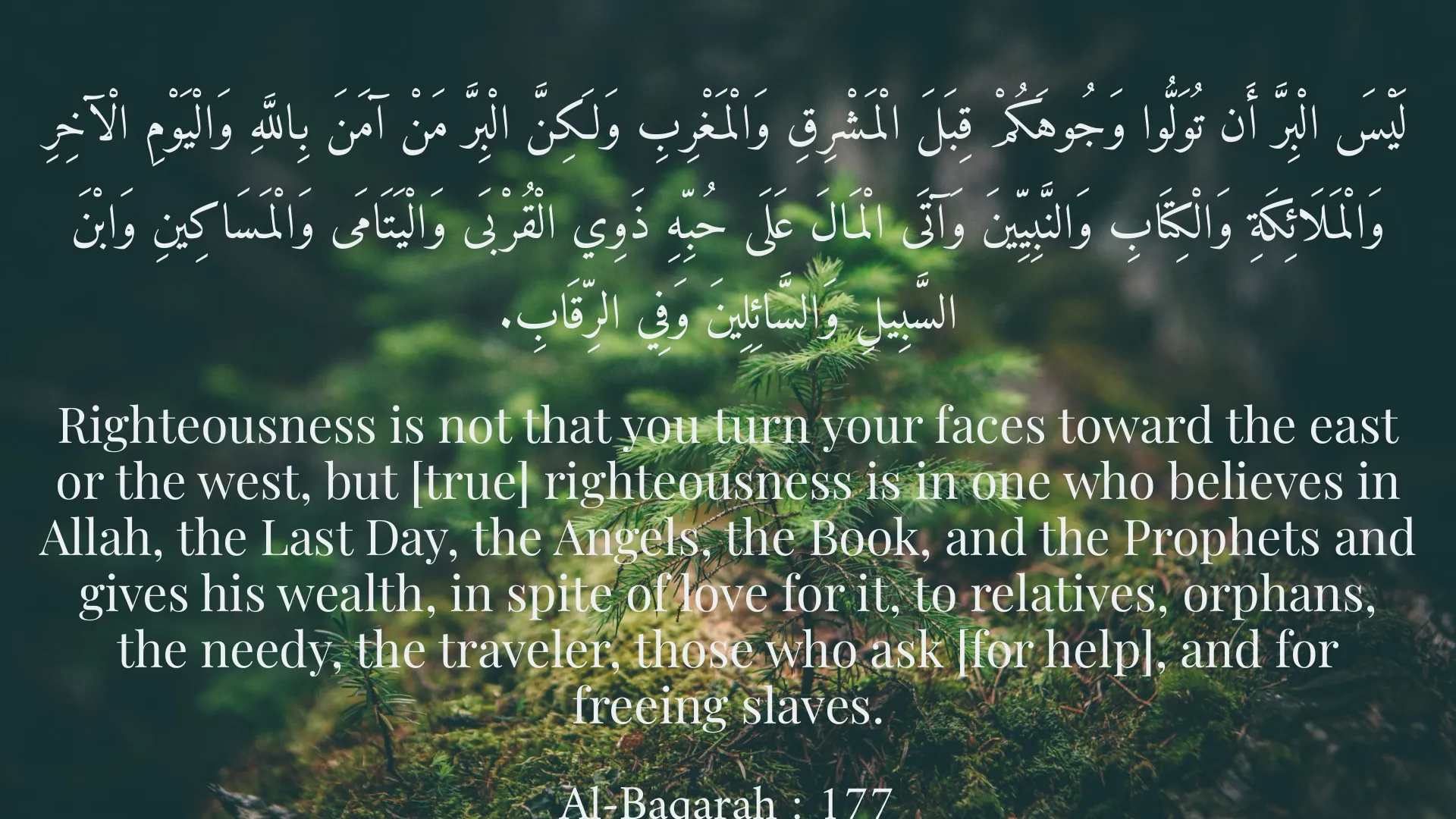
In the Holy Quran, the concept of pure intention occupies a vital and essential place in the teachings of Islam. One of the most emblematic verses highlighting this principle is found in Surah Al-Baqarah, verse 177. Here, Allah states: 'Righteousness is not that you turn your faces toward the east or the west, but [true] righteousness is in one who believes in Allah, the Last Day, the Angels, the Book, and the Prophets and gives his wealth, in spite of love for it, to relatives, orphans, the needy, the traveler, those who ask [for help], and for freeing slaves.' The profound wisdom encapsulated in this verse underscores the idea that the essence of righteousness is not merely about external rituals or gestures; it is deeply rooted in the internal state of the believer and their genuine intentions behind every action. At the heart of the matter lies the necessity for pure intention, which demands a firm belief in Allah and a commitment to sincere actions that stem from that belief. In the Islamic tradition, it is emphasized that one must first harbor faith within their heart before embarking on the path of righteous deeds. This journey towards righteousness involves giving generously to those in need, irrespective of one’s affection for wealth. The act of charitable giving is not just a transaction of material goods; it is a manifestation of a pure heart that desires to serve others for the sake of Allah alone. Moreover, the Quran reinforces the significance of a pure intention in Surah Al-Mu'minun, verses 1 and 2, where Allah proclaims: 'Certainly will the believers have succeeded: They who are during their prayer humbly submissive.' These verses clarify that success in this life and the hereafter is intricately linked to the attitude and devotion exhibited during worship. To achieve pure intention, one must be fully present in their prayers, humbling themselves before their Creator. This humility is a testament to their sincerity and commitment to attaining nearness to Allah, thereby reinforcing the importance of the inner state over outward appearances. To foster pure intention, it is beneficial for individuals to engage in regular self-reflection and self-talk. Constantly assessing one’s motivations behind actions helps in discerning whether they align with the pursuit of divine pleasure. This daily practice encourages believers to purify their hearts, ensuring that every deed they perform is intended solely for Allah's satisfaction. In a world filled with distractions and societal pressures, maintaining a focus on pure intentions can be particularly challenging yet immensely rewarding. Furthermore, steering clear of sins and contrived behaviors enhances one’s inner state, making it conducive for Allah's satisfaction. Repentance and seeking forgiveness not only cleanse the heart but also reaffirm the commitment to align one’s actions with a higher moral standard. The love for Allah, when kindled in the heart, acts as a catalyst for performing good deeds, as it nurtures an innate desire to please the Creator. It is through this love that believers are motivated to engage with their communities, uplift those in distress, and contribute positively to the fabric of society. In addition to individual commitment, the role of community and collective support cannot be understated in the pursuit of pure intention. Muslims are encouraged to hold each other accountable and help cultivate an environment where intentions can be nurtured and sustained. Within congregations and circles of knowledge, believers can discuss the importance of intention, share personal experiences, and remind each other of the necessity to remain steadfast on the path of righteousness. Such a supportive atmosphere fosters a communal consciousness focused on piety and moral integrity. The teachings on pure intention extend beyond simply doing good deeds—they serve as a comprehensive guide to living a life aligned with divine principles. In every act, whether it be in worship, charity, or everyday interactions, believers are encouraged to remain conscious of their intentions. Doing so not only enriches their spiritual lives but also reinforces the foundational principles that underlie the practice of Islam. In conclusion, the notion of pure intention, as beautifully articulated in the Surah Al-Baqarah and Surah Al-Mu'minun, outlines a profound roadmap for Muslims seeking to align their lives with divine will. By internalizing faith, performing sincere actions, humbling oneself in prayer, reflecting on personal motives, and relying on communal support, believers can aspire to attain a purer form of intention that is ultimately pleasing to Allah. In a continuously evolving world, the significance of a pure intention remains timeless, reminding us to re-evaluate our actions and their underlying motives, ensuring they remain anchored in a sincere quest for the grace and mercy of the Almighty. Thus, in the journey of life, let pure intention be our guiding star, illuminating our path towards righteousness and fulfilling our obligations as stewards of goodness in this world.
Related Verses
لَيْسَ الْبِرَّ أَن تُوَلُّوا وَجُوهَكُمْ قِبَلَ الْمَشْرِقِ وَالْمَغْرِبِ وَلَكِنَّ الْبِرَّ مَنْ آمَنَ بِاللَّهِ وَالْيَوْمِ الْآخِرِ وَالْمَلَائِكَةِ وَالْكِتَابِ وَالنَّبِيِّينَ وَآتَى الْمَالَ عَلَى حُبِّهِ ذَوِي الْقُرْبَى وَالْيَتَامَى وَالْمَسَاكِينِ وَابْنَ السَّبِيلِ وَالسَّائِلِينَ وَفِي الرِّقَابِ.
Righteousness is not that you turn your faces toward the east or the west, but [true] righteousness is in one who believes in Allah, the Last Day, the Angels, the Book, and the Prophets and gives his wealth, in spite of love for it, to relatives, orphans, the needy, the traveler, those who ask [for help], and for freeing slaves.
Al-Baqarah : 177
قَد أَفْلَحَ المؤمنون
Certainly will the believers have succeeded.
Al-Mu'minun : 1
الَّذِينَ هُم فِي صَلَاتِهِم خَاشِعُونَ
They who are during their prayer humbly submissive.
Al-Mu'minun : 2
Short Story
Once upon a time in a small neighborhood, there lived a man named Said. He was always in search of a pure intention to perform his deeds. One day, he decided to go to the mosque to pray for his needs. There, he encountered an elderly man who said to him, 'Said, intentions should be purely for God.' Said reflected on this advice, and from that day on, he performed all his deeds with a pure intention, and his life became filled with blessings and peace.