Quranic Answer
The essence of benevolence and altruism is a fundamental tenet in numerous cultures and religions, none more prominently than in the teachings of the Holy Quran. The Quran elaborates on various virtues that include kindness, generosity, and selfless service to others. Among these, the concept of assisting those in need without expecting anything in return resonates profoundly. This article delves into the concept of benevolence as articulated in select verses of the Quran, emphasizing its spiritual significance and moral implications. To begin with, Surah Al-Baqarah, verse 273, succinctly captures the essence of altruism. This verse states: ‘[Charity is] for the poor who have been restricted for the cause of Allah, unable to travel in the land. The unaware person would regard them as self-sufficient due to their restraint. You will know them by their mark. They do not advocate persistently with people. And whatever good you spend, indeed, Allah is Knowing of it.’ This verse profoundly illustrates that acts of charity should stem from genuine compassion and selflessness. Moreover, it accentuates the importance of acknowledging the silent struggles of those in need. Many individuals may appear self-sufficient; however, their circumstances may silently trap them in dire need. This awareness encourages us to look beyond surface appearances and act generously toward those we may not see as deserving. In today’s fast-paced world, where individuals are often preoccupied with their own lives, the Quran reminds us of the inherent value in recognizing and assisting the less fortunate. The phrase ‘whatever good you spend, indeed, Allah is Knowing of it’ signifies that altruistic acts do not go unnoticed, and the true reward lies not in the acknowledgment of others but in the divine recognition of our sincere acts. The idea of giving without expecting gratitude or reward fosters a culture of selflessness, where individuals can engage in generous acts motivated purely by the desire to help. Furthermore, the Quran reiterates the principle of giving selflessly in Surah Al-Insan, verses 8 and 9. These verses state: ‘And they give food in spite of [their] desire for it to the needy, the orphan, and the captive, [saying], ‘Indeed, we feed you only for the countenance of Allah. We wish not from you reward or gratitude.’ This profound statement sheds light on the essence of generosity. It portrays a scenario where individuals offer food and resources, even when they may have personal desires and needs for those same resources. The motivation for their kindness emanates from a desire to seek the pleasure of Allah rather than from a longing for recognition or repayment. This ideal form of benevolence illustrates the highest form of character and self-discipline, teaching us that true altruism involves making sacrifices for the benefit of others. Moreover, this principle of selfless assistance extends beyond mere financial contributions or food provisions. It encompasses all forms of support, including emotional, spiritual, and physical assistance. Individuals who dedicate their time and energy to uplifting others, without any expectation of reciprocation, embody the spirit of the teachings of the Quran. Therefore, these verses encourage us to cultivate a mindset of generosity in all aspects of life, motivating us to be actively involved in our communities and to extend a helping hand, regardless of our own circumstances. Additionally, the Quran reinforces this principle of self-sacrifice in Surah Aal-e-Imran, verse 92, saying: ‘Never will you attain the good reward until you spend [in the way of Allah] from that which you love. And whatever you spend, indeed, Allah is Knowing of it.’ This verse emphasizes that true benevolence is not merely about the act of giving; rather, it is about the intent and the sacrifice involved in that giving. It urges believers to give from their cherished belongings, extending the notion of charity to a deeper level, where the value of generosity is assessed not by the quantity of the gift but by the quality of the sacrifice made. It goes further to signify that a significant act of charity becomes more rewarding when it involves giving something that bears personal value. The emotional and psychological aspects of benevolence are deeply intertwined with these teachings. Engaging in acts of altruism not only aids those in need, but it also has the potential to uplift the giver. Studies in psychology have shown that helping others can lead to increased feelings of happiness and fulfillment in one’s life. The Quran acknowledges this connection by reinforcing that Allah knows and appreciates every act of kindness, further encouraging individuals to engage in benevolent actions. Moreover, this spirit of benevolence plays a pivotal role in fostering a sense of community and solidarity among individuals. When people help one another selflessly, it creates a cycle of kindness that contributes to a supportive atmosphere within society. This is especially important during times of crisis, as communities that embody these values are often better equipped to navigate challenges collectively. The Quran’s emphasis on helping others without expectation acts as a foundation for creating resilient and nurturing societies. In conclusion, the teachings of the Holy Quran profoundly articulate the principles of benevolence and altruism, encouraging us to aid those in need selflessly. The verses of Surah Al-Baqarah, Al-Insan, and Aal-e-Imran collectively highlight that true charity stems from sincere intention and a willingness to sacrifice what we hold dear. The emphasis on giving without expecting anything in return not only enriches our faith but also strengthens the bonds within our communities. It serves as a timeless reminder that every act of kindness, no matter how small, contributes to the larger fabric of humanity. As we internalize these values from the Quran, we are inspired not just to act generously but to do so wholeheartedly, seeking the pleasure of Allah while simultaneously uplifting those around us.
Related Verses
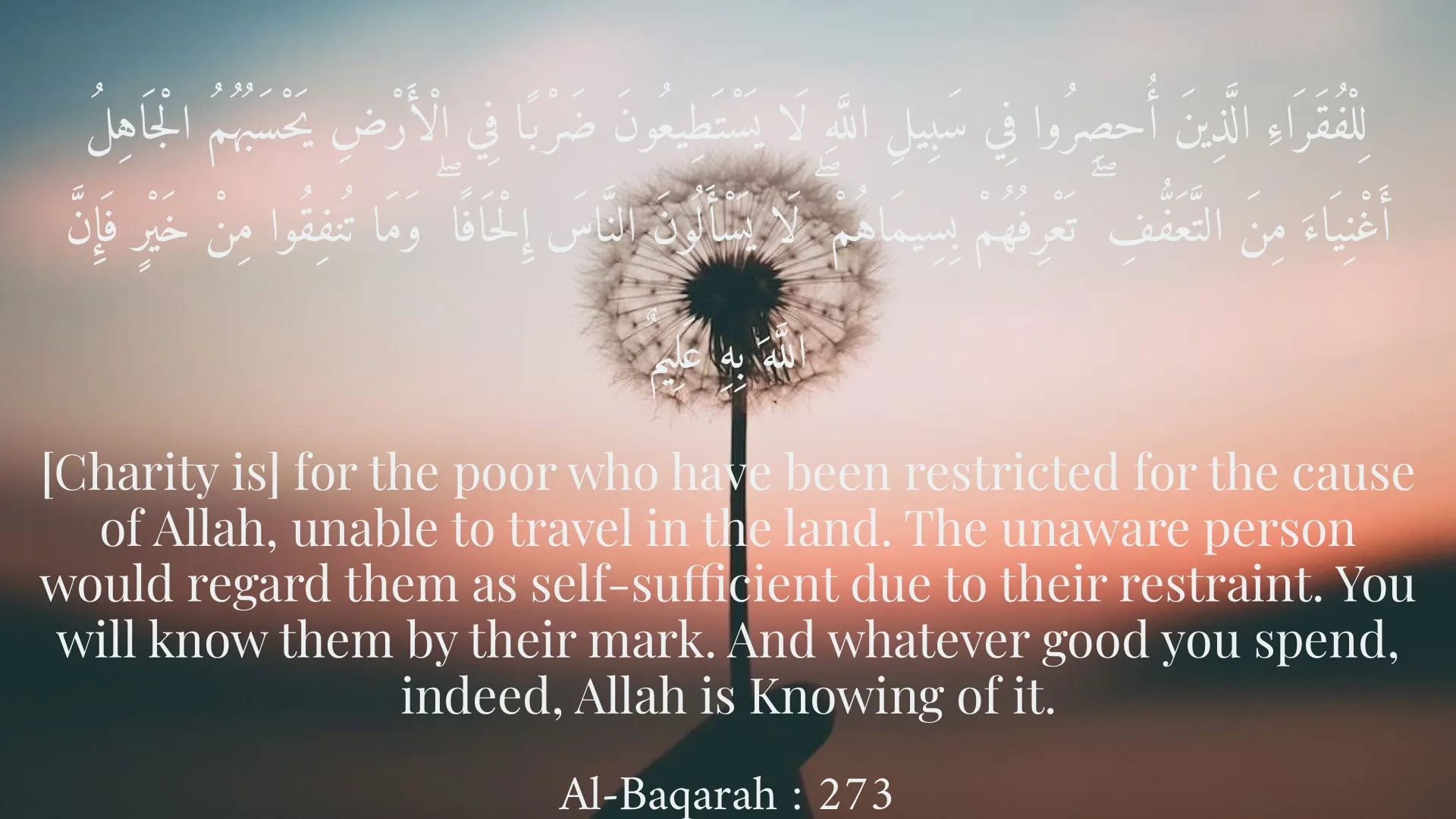
لِلْفُقَرَاءِ الَّذِينَ أُحصِرُوا فِي سَبِيلِ اللَّهِ لَا يَسْتَطِيعُونَ ضَرْبًا فِي الْأَرْضِ يَحْسَبُهُمُ الْجَاهِلُ أَغْنِيَاءَ مِنَ التَّعَفُّفِ ۖ تَعْرِفُهُمْ بِسِيمَاهُمْ ۖ لَا يَسْأَلُونَ النَّاسَ إِلْحَافًا ۖ وَمَا تُنفِقُوا مِنْ خَيْرٍ فَإِنَّ اللَّهَ بِهِ عَلِيمٌ
[Charity is] for the poor who have been restricted for the cause of Allah, unable to travel in the land. The unaware person would regard them as self-sufficient due to their restraint. You will know them by their mark. And whatever good you spend, indeed, Allah is Knowing of it.
Al-Baqarah : 273
وَيُطْعِمُونَ الطَّعَامَ عَلَى حُبِّهِ مِسْكِينًا وَيَتِيمًا وَأَسِيرًا
And they give food in spite of [their] desire for it to the needy, the orphan, and the captive.
Al-Insan : 8
لَن تَنَالُوا الْبِرَّ حَتَّى تُنفِقُوا مِمَّا تُحِبُّونَ ۖ وَمَا تُنفِقُوا مِن شَيْءٍ فَإِنَّ اللَّهَ بِهِ عَلِيمٌ
Never will you attain the good reward until you spend [in the way of Allah] from that which you love. And whatever you spend, indeed, Allah is Knowing of it.
Aal-e-Imran : 92
Short Story
In the middle of a village, a gathering was underway, and the people were united. One of the villagers, named Hasan, had a big heart and was known for his philanthropy. He decided one day to help the needy without expecting any gratitude. Hasan went to the homes of the needy, prepared good food, and delivered it to them. When they thanked him, he smiled and said, 'I did this solely for the pleasure of Allah, and I pray that He is always with you.' This spirit spread in the village, encouraging others to follow in Hasan's footsteps, and together they rushed to help those in need.