Quranic Answer
When addressing the question of how to identify hidden despair, it's crucial to first examine the Holy Quran's approach to the concepts of despair and hope. The Quran, as a book of divine guidance, does not offer a psychological checklist for identifying internal states. Instead, it emphasizes spiritual and ethical frameworks that guide individuals toward a righteous life, away from despair and towards strengthening hope. Despair (ya's or qunut) is strongly condemned in the Quran and is often linked with disbelief or misguidance (dalal), because despairing of Allah's mercy signifies a lack of recognition of His infinite power, wisdom, and boundless compassion. The Quran unequivocally states that no one should ever despair of Allah's mercy. In Surah Yusuf, verse 87, Prophet Ya'qub (AS) tells his sons: “O my sons, go and find out about Joseph and his brother and do not despair of the relief of Allah. Indeed, no one despairs of the relief of Allah except the disbelieving people.” This verse clearly links despair of Allah's mercy with disbelief. Furthermore, in Surah Az-Zumar, verse 53, Allah says: “Say, 'O My servants who have transgressed against themselves [by sinning], do not despair of the mercy of Allah. Indeed, Allah forgives all sins. Indeed, it is He who is the Forgiving, the Merciful.'” This verse also emphasizes the vastness of divine mercy and the sinfulness of despair. Therefore, the Quran considers despair not merely a fleeting emotion but a spiritual ailment deeply rooted in weakness of faith and insufficient understanding of Allah's attributes. To identify 'hidden despair' from a Quranic perspective, one must pay attention to signs indicating a weakening in beliefs and practices that the Quran recommends for fostering hope and reliance on Allah. These signs may not be overt expressions of hopelessness but might manifest in an individual's behavior, thoughts, and even their spiritual state: 1. Decreased Tawakkul (Reliance) and Increased Anxiety: One of the most prominent characteristics of a believer in the Quran is complete reliance on Allah. In Surah Aal-Imran, verse 160, it states: “And upon Allah let the believers rely.” If an individual, instead of relying on Allah in their affairs, experiences severe anxiety about the future, endless worries, and a sense of isolation when facing problems, this could be a sign of weakened tawakkul and a breeding ground for hidden despair. They might try to shoulder all burdens alone and neglect seeking divine assistance, even if they don't voice their distress. 2. Distance from Dhikr (Remembrance) and Worship: The Quran states in Surah Ar-Ra'd, verse 28: “Unquestionably, by the remembrance of Allah hearts are assured.” If someone who previously engaged in prayer, Quran recitation, and remembrance gradually distances themselves from these acts or no longer finds the same spiritual pleasure in them, they might be experiencing a spiritual languor that leads to despair. This distancing can drain an individual's spiritual energy, making them more vulnerable to the whispers of hopelessness. 3. Lack of Sabr (Patience) in the Face of Adversity: The Quran repeatedly advises believers to seek help through patience and prayer (Al-Baqarah, verse 153). If an individual quickly becomes restless when facing difficulties, is unable to endure trying circumstances, and constantly focuses on the negative aspects of situations—even if they outwardly don't express despair—they are likely struggling internally with this emotion. This restlessness and eagerness for immediate relief can be a sign of hidden despair concerning Allah's eventual relief. 4. Negative Outlook and Constant Criticism: While the Quran encourages reflection on Allah's signs and gratitude for blessings, a person experiencing hidden despair might unconsciously adopt a negative view of life, engage in self-criticism and criticism of others, and focus excessively on shortcomings. They may express less gratitude for blessings and dwell more on what they lack or have lost. This negative perspective can be an indicator of a heart gripped by the darkness of despair. 5. Isolation and Withdrawal from Community: Although the Quran advises believers to help one another and cooperate in righteousness and piety (Al-Ma'idah, verse 2), an individual struggling with hidden despair might gradually withdraw from social activities and the company of believers. They may feel misunderstood or unable to share their burdens with others, and this isolation itself can fuel feelings of loneliness and despair. Quranic Solutions for Combating Despair (which also aid in its identification): To combat and, consequently, identify hidden despair, the Quran offers fundamental spiritual strategies. Returning to these principles can eradicate this feeling and reveal its presence: 1. Strengthening Iman (Faith) and Knowledge of Allah: The primary cure for despair is a deeper understanding of Allah and His attributes (His boundless mercy, absolute power, wisdom, and infinite knowledge). When one knows that Allah is capable of all things and His mercy and grace are limitless, there is no room for despair. Studying and reflecting upon the Quran, especially verses that highlight Allah's power and mercy, can strengthen faith. 2. Adherence to Prayer and Constant Dhikr: As mentioned, the remembrance of Allah brings peace to hearts. Regular performance of prayers, especially night prayers (Tahajjud), and consistent remembrance (like Istighfar, Salawat, La hawla wa la quwwata illa billah) strengthen one's connection with the Creator and provide spiritual energy. A feeling of distance from these acts can be a warning sign. 3. Patience and Gratitude (Shukr): Practicing patience in the face of calamities and expressing gratitude for existing blessings, even the smallest ones, shifts one's perspective from deficiencies to blessings, preventing despair from taking root. Gratitude for blessings makes one aware of continuous divine grace and plants the seed of hope in the heart. 4. Repentance (Tawbah) and Seeking Forgiveness (Istighfar): Feelings of guilt can lead to despair of Allah's forgiveness. The Quran strongly emphasizes repentance and seeking forgiveness, promising the remission of sins. Sincere repentance lifts the burden of sin from an individual and opens the way for hope in Allah's mercy. 5. Viewing This World as a Temporary Passage: The Quran reminds us of the fleeting and temporal nature of this world. If one views this world as the ultimate goal and becomes overly attached to it, every setback and loss can lead to deep despair and sorrow. However, by understanding that this world is a test and a temporary passage, worldly adversities become lighter, and hope in the afterlife and divine reward is strengthened. Ultimately, identifying hidden despair is an internal, spiritual journey that begins with self-awareness and an honest assessment of one's relationship with Allah. If you find signs of weakness in your reliance (tawakkul), remembrance (dhikr), patience (sabr), gratitude (shukr), or a tendency towards isolation and negativity, these could be warnings of hidden despair. Returning to Quranic teachings and strengthening your connection with Allah is the key to escaping this state and replacing it with true peace and hope.
Related Verses
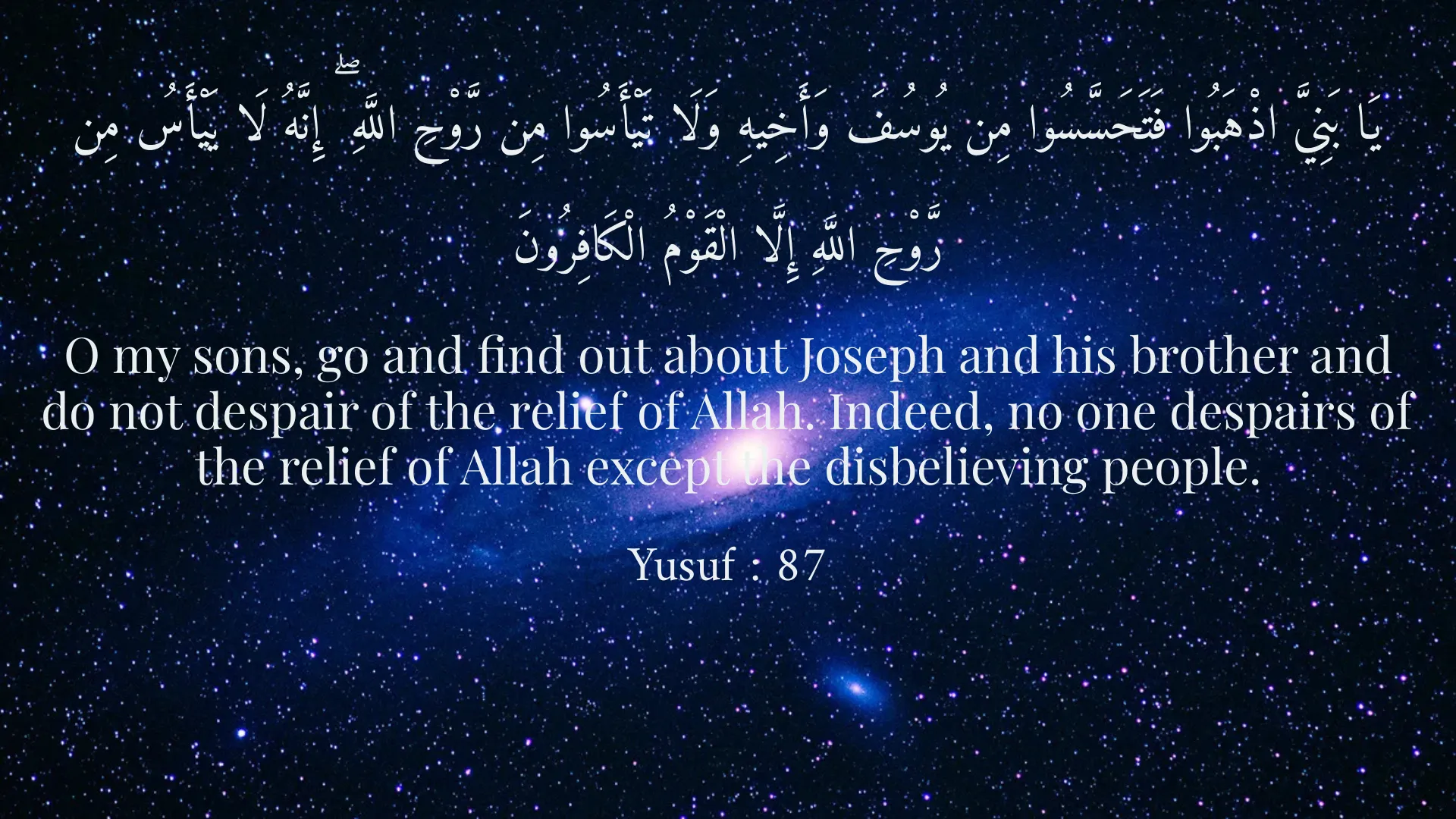
يَا بَنِيَّ اذْهَبُوا فَتَحَسَّسُوا مِن يُوسُفَ وَأَخِيهِ وَلَا تَيْأَسُوا مِن رَّوْحِ اللَّهِ ۖ إِنَّهُ لَا يَيْأَسُ مِن رَّوْحِ اللَّهِ إِلَّا الْقَوْمُ الْكَافِرُونَ
O my sons, go and find out about Joseph and his brother and do not despair of the relief of Allah. Indeed, no one despairs of the relief of Allah except the disbelieving people.
Yusuf : 87
قُلْ يَا عِبَادِيَ الَّذِينَ أَسْرَفُوا عَلَىٰ أَنفُسِهِمْ لَا تَقْنَطُوا مِن رَّحْمَةِ اللَّهِ ۚ إِنَّ اللَّهَ يَغْفِرُ الذُّنُوبَ جَمِيعًا ۚ إِنَّهُ هُوَ الْغَفُورُ الرَّحِيمُ
Say, 'O My servants who have transgressed against themselves [by sinning], do not despair of the mercy of Allah. Indeed, Allah forgives all sins. Indeed, it is He who is the Forgiving, the Merciful.'
Az-Zumar : 53
الَّذِينَ آمَنُوا وَتَطْمَئِنُّ قُلُوبُهُم بِذِكْرِ اللَّهِ ۗ أَلَا بِذِكْرِ اللَّهِ تَطْمَئِنُّ الْقُلُوبُ
Those who have believed and whose hearts are assured by the remembrance of Allah. Unquestionably, by the remembrance of Allah hearts are assured.
Ar-Ra'd : 28
يَاأَيُّهَا الَّذِينَ آمَنُوا اسْتَعِينُوا بِالصَّبْرِ وَالصَّلَاةِ ۚ إِنَّ اللَّهَ مَعَ الصَّابِرِينَ
O you who have believed, seek help through patience and prayer. Indeed, Allah is with the patient.
Al-Baqarah : 153
Short Story
In Saadi's Gulistan, it is narrated that a wealthy man lost all his possessions in a sea voyage. He returned home, and though financially ruined, he never openly spoke of his plight. He maintained his composure and continued to attend gatherings. However, a wise friend who knew him intimately noticed subtle changes: his smiles had faded, his gaze occasionally wandered distantly, and he no longer possessed the old enthusiasm for future plans. The wise friend did not directly inquire about his sorrow. Instead, he began to tell stories of the prophets' patience in adversity, the transient nature of this world, and the boundless mercy and sustenance of Allah. He spoke warmly and kindly of contentment and reliance on God, and how true peace resides in the hearts of those who are content with His decree. The wealthy man, touched by these wise words, eventually opened his heart and confessed the heavy burden of his hidden despair. Hearing his friend's words and being reminded of Allah's power and kindness, he found deep tranquility and the seed of hope in divine grace began to sprout in his heart, for he realized that true treasure lies in contentment and faith, not in worldly possessions.