Quranic Answer
Hope is a driving force that illuminates darkness and carves a path towards relief even in the depths of despair. In today's challenging world, many individuals may find themselves caught in the grip of pessimism and hopelessness, whether due to personal struggles, societal crises, or a general feeling of powerlessness. The crucial question then becomes: How can we keep this flame of hope ignited in the hearts of others, in a way that contributes to their resilience and steadfastness in the face of adversity? The Holy Quran, the book of guidance and light, is replete with teachings that not only invite us to be hopeful and to shun despair but also lay out practical pathways for maintaining hope within ourselves and instilling it in others. This answer, grounded in Quranic teachings, addresses this vital question, offering strategies to become a source of hope for those around us, with an emphasis on how to apply these profound concepts in our daily interactions. 1. Reliance on Allah (Tawakkul) and Reminding Others of His Endless Mercy: The core of hope in Islam lies in complete reliance on Almighty Allah (Tawakkul). The Quran repeatedly emphasizes Allah's greatness, absolute power, infinite wisdom, and vast mercy. Surah Yusuf, verse 87, reminds us: "O my sons, go and find out about Joseph and his brother and do not despair of the relief of Allah. Indeed, no one despairs of relief from Allah except the disbelieving people." This verse not only prohibits despair but categorizes it as a trait of disbelievers, underscoring the critical importance of hope from a Quranic perspective. To keep hope alive in the hearts of others, we must first deeply internalize this truth ourselves. Then, when someone is in despair, instead of judging or blaming, we should use gentle and compassionate words to remind them of Allah's boundless mercy and power. We can share Quranic stories of prophets and righteous servants who, amidst extreme hardships, attained salvation through their reliance on Allah. Remind them that Allah is always near to His servants and no problem is greater than His power. Emphasize that the doors of repentance and return are always open, and Allah forgives all sins. By actively listening to their problems, we can foster empathy and then, gently and wisely, guide their perspective towards reliance on Allah's divine plan. Even if there seems to be no worldly solution to their problem, assure them that relief from Allah is certain, and perhaps within these very difficulties lies immense good that is not yet visible. We can use examples from our own lives or others' to show how ease follows every hardship, and Allah never abandons His servants. 2. Patience (Sabr) and Prayer (Salah) as Pillars of Support and Tranquility: The Holy Quran introduces patience (Sabr) and prayer (Salah) as two powerful tools for confronting difficulties and maintaining inner peace. In Surah Al-Baqarah, verse 153, it states: "O you who have believed, seek help through patience and prayer. Indeed, Allah is with the patient." Patience signifies steadfastness and resilience in the face of adversity, while prayer means a direct and profound connection with the Creator, which brings tranquility, spiritual strength, and solace to the heart. Surah Al-Inshirah, verses 5-6, further emphasizes: "For indeed, with hardship [will be] ease. Indeed, with hardship [will be] ease." This repetition is a firm promise from Allah that should not be overlooked and must be reminded to others. When someone is hopeless, they often feel isolated and weak. We can help them find their inner strength through patience and connection with Allah. Encouraging them to perform Salah, not as a dry obligation but as a safe haven and a place for intimate conversation with the Most Merciful Being, can be profoundly effective. Tell them that patience is a sign of strength, not weakness, and Allah loves the patient, never abandoning them and reserving immense rewards for them. We can suggest that in moments of despair, they perform a few cycles of prayer and pour out their hearts to Allah, sharing all their sorrows with Him. Remind them that every problem has an end, and this difficult period too shall pass by Allah's grace, and Allah always provides ease after every hardship. Practically, we can accompany them, support them in their journey of patience, and show them that they are not alone in facing their problems. If they are not regular in prayer, we can invite them to reflect on the verses of the Quran and engage in the remembrance of Allah (Dhikr), as the Quran states in Surah Ar-Ra'd, verse 28: "Unquestionably, by the remembrance of Allah hearts are assured." This tranquility is a fundamental prerequisite for hope to sprout and flourish. 3. Gratitude (Shukr) and Seeing Hidden and Apparent Blessings: Gratitude (Shukr) is one of the essential keys to increasing blessings and contentment in life, directly linked to hope. In Surah Ibrahim, verse 7, it is stated: "And [remember] when your Lord proclaimed, 'If you are grateful, I will surely increase you [in favor]; but if you deny, indeed, My punishment is severe.'" Even at the peak of difficulties and despair, there are hidden and apparent blessings in every individual's life. By focusing on these, one can shift perspective from negativity and loss to positivity and abundance, paving the way for hope to emerge. Someone who has fallen into despair often only sees deficiencies and what they lack, losing the ability to see what they possess. It is our duty to guide them towards recognizing the existing blessings and bounties. We can ask them to make a list of things they have in their lives for which they are grateful—even the smallest and most obvious things like health, family, good friends, a roof over their heads, the ability to breathe, or even the daily sunrise. Remind them that merely being alive and having the opportunity for rectification, change, and growth is a great blessing that many are deprived of. Sometimes, a simple example of someone who faced greater difficulties but remained grateful can be a powerful wake-up call. Encouraging them to see the 'half-full glass' helps them find the necessary energy and motivation to emerge from their current situation and realize that, despite challenges, there are still reasons for joy and hope. Gratitude makes a person feel less like a victim and more focused on their own capabilities and Allah's boundless grace, and this shift in perspective is the very beginning of hope. 4. Help and Mutual Support (Ta'awun) and Practical Compassion: The Holy Quran places great emphasis on mutual assistance and benevolence. In Surah Al-Ma'idah, verse 2, it states: "And cooperate in righteousness and piety, but do not cooperate in sin and aggression." And in other verses, the importance of caring for the needy and helping fellow human beings is stressed. When someone is in despair, they sometimes need a helping hand, a listening ear, or simply a compassionate presence more than anything else. Offering practical help, emotional support, and showing empathy is the best and most effective way to ignite the flame of hope in the hearts of others. This help can include actively listening to their words without judgment or offering hasty solutions, providing constructive and expert advice (if we possess the knowledge), financial aid (if necessary and possible), or simply being by their side and showing them that they are not alone. Tell them that you are fully with them and will spare no effort to support them. This sense of support and solidarity empowers them to feel their problems less intensely and to know that others share their burden. Sometimes, just a smile, a sincere hug, or a kind word spoken from the heart can change the entire world of a despairing individual and pull them out of the depths of hopelessness. Let us remember that the Prophet Muhammad (peace be upon him) said: "Whoever relieves a believer of a worldly grief, Allah will relieve him of a grief from the Day of Judgment." This Hadith encourages us to act with compassion and help others, which is itself a source of hope. When someone feels that others care for them, are sympathetic, and are ready to help, hope gradually blossoms within them, and they are motivated to strive again to solve their problems. 5. Lessons from Quranic Narratives and Positive Future Vision: The Quran is rich with stories of prophets and past nations, filled with lessons of patience, resilience, and hope. These stories are not merely accounts of past events but serve as guiding lights for future generations and sources of inspiration for facing life's challenges. The story of Prophet Yusuf (Joseph), despite the well, imprisonment, false accusations, and long separation from his family, exemplifies the peak of hope and reliance on Allah, eventually leading to honor and high status in Egypt. The story of Prophet Ayyub (Job) and his unparalleled patience in the face of severe illness and the loss of wealth and children is a clear example of resilience and submission to Allah's will, which resulted in the return of everything and even more, by Allah's grace. We can recount these inspiring stories to the despairing individual, emphasizing how Allah, after numerous hardships, provided unexpected relief for His patient and grateful servants. Remind them that the same Allah who brought Yusuf out of the well and made him the governor of Egypt, and who healed Ayyub and restored all his possessions, is the same Allah who is capable of all things today and can change any person's life for the better. These stories are a symbol of life's dynamism and Allah's promise to aid believers, and one should never despair of His mercy and power. Furthermore, invite them to a positive future outlook. Instead of dwelling on the current problem and ruminating over the past, encourage them to imagine a better tomorrow and brighter days. However, this imagination must be based on reliance on Allah and the individual's own effort and perseverance. Tell them that every bitter end can be the beginning of a new path full of opportunities and blessings, and Allah always desires the best for His servants, even if it appears difficult on the surface. This perspective helps them invest their energy in building a better future rather than remaining trapped in the past and present. Conclusion: Keeping hope alive in the hearts of others is a human, ethical, and Islamic duty rooted in compassion, empathy, and a deep faith in Allah. This task requires not only words and advice but, more importantly, action, patience, active listening, and, above all, living as a vibrant example of hope and reliance. By relying on Allah, persevering through challenges, being grateful in all circumstances, offering practical help and compassion to others, and learning from Quranic narratives, we can ignite a light of hope in weary and despairing hearts and guide them towards a brighter horizon. Let us remember that sometimes, our mere presence, coupled with love and faith, will be the greatest source of hope for another, making a significant difference in their life's journey. This is a great mission that Allah has entrusted to the believers.
Related Verses
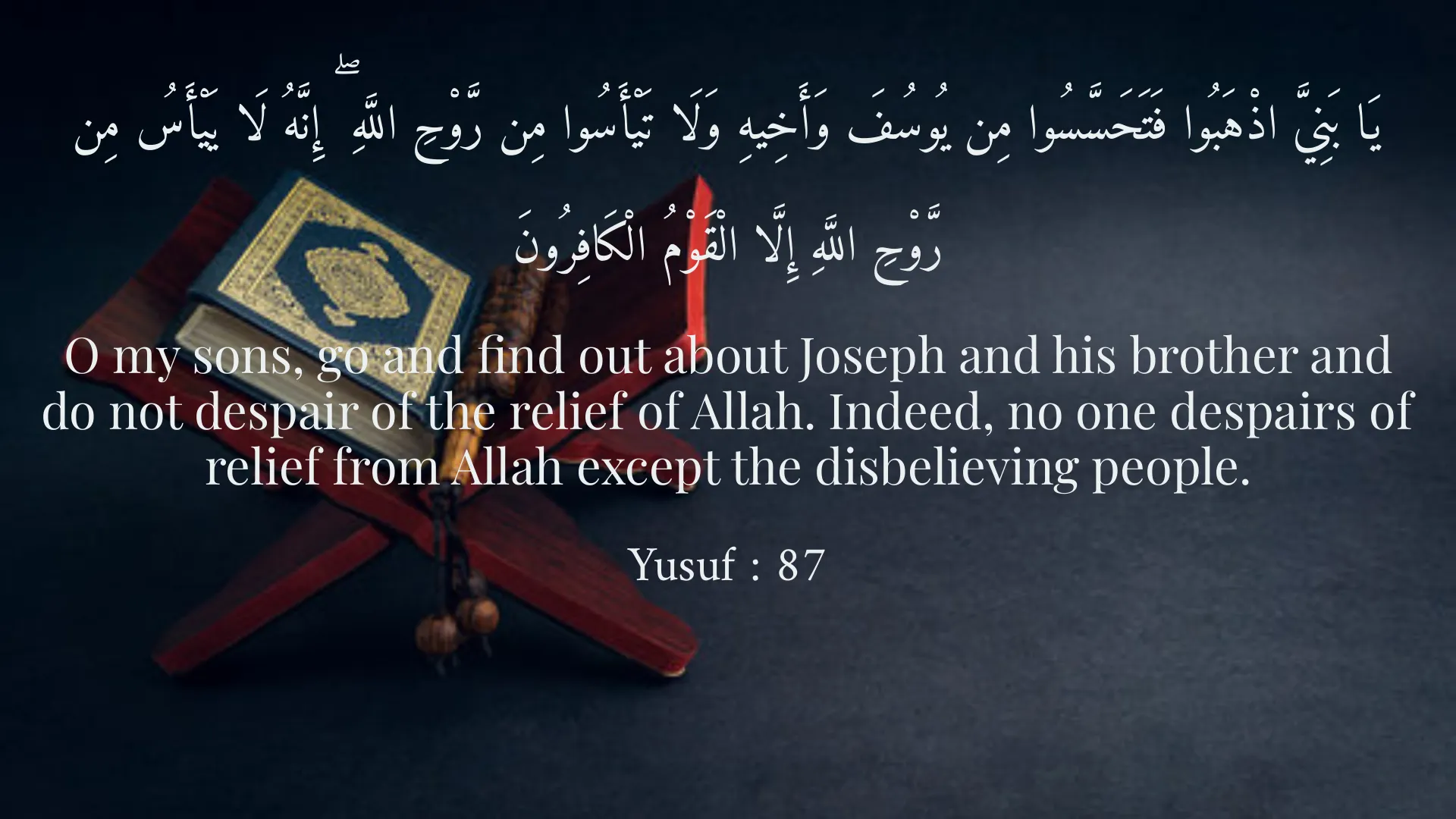
يَا بَنِيَّ اذْهَبُوا فَتَحَسَّسُوا مِن يُوسُفَ وَأَخِيهِ وَلَا تَيْأَسُوا مِن رَّوْحِ اللَّهِ ۖ إِنَّهُ لَا يَيْأَسُ مِن رَّوْحِ اللَّهِ إِلَّا الْقَوْمُ الْكَافِرُونَ
O my sons, go and find out about Joseph and his brother and do not despair of the relief of Allah. Indeed, no one despairs of relief from Allah except the disbelieving people.
Yusuf : 87
فَإِنَّ مَعَ الْعُسْرِ يُسْرًا
For indeed, with hardship [will be] ease.
Ash-Sharh : 5
إِنَّ مَعَ الْعُسْرِ يُسْرًا
Indeed, with hardship [will be] ease.
Ash-Sharh : 6
الَّذِينَ آمَنُوا وَتَطْمَئِنُّ قُلُوبُهُم بِذِكْرِ اللَّهِ ۗ أَلَا بِذِكْرِ اللَّهِ تَطْمَئِنُّ الْقُلُوبُ
Those who have believed and whose hearts are assured by the remembrance of Allah. Unquestionably, by the remembrance of Allah hearts are assured.
Ar-Ra'd : 28
Short Story
Once upon a time, a poor and weary dervish, overwhelmed by hunger and despair, sought refuge in a desolate ruin. In that darkness, amidst the crumbling walls, hopelessness consumed him. He muttered to himself, "When will the day come when hope returns to my heart and this sorrow leaves my chest?" Just then, his eyes fell upon an ant tirelessly carrying a grain towards its nest. Time and again, the grain would slip from its grasp and roll down, yet the tiny ant never gave up, returning repeatedly to retrieve it. Witnessing this, the dervish pondered, "If this small ant, with such persistence and hope, does not cease its efforts in seeking its sustenance, how can I, the noblest of creations, whose Lord is more merciful than a mother, succumb to despair and abandon my pursuit?" From that moment, the dervish's heart was enlightened, as if a spark of hope ignited within him. With reliance on God, he left the ruin, and soon, a breakthrough appeared in his affairs, and his life improved. Thus, even from a tiny ant, one can learn lessons of hope, perseverance, and reliance on God, keeping it alive not only in one's own heart but also in the weary hearts of others.