Quranic Answer
The path of faith and spiritual growth is a profound and often challenging journey, where every step is taken towards the Divine. In this journey, one of the greatest challenges is confronting one's own self and human weaknesses. Many of us, on this path, expect instant perfection from ourselves, and when we stumble or fall short, we become disheartened and lose patience. However, the Holy Quran offers wise guidance for this challenge, teaching us how to be patient and compassionate with ourselves on the path of faith. This patience is not merely about enduring hardships, but also includes steadfastness in performing good deeds, refraining from sins, and most importantly, forgiving oneself after making mistakes and returning to God. The Concept of Patience (Sabr) in the Quran: The Foundation of Steadfastness The Quran uses the word 'Sabr' with an extraordinary breadth of meaning. Patience in the Quran is not only about endurance in the face of calamities and difficulties but also encompasses steadfastness and perseverance in performing acts of worship and abstaining from forbidden acts. Allah repeatedly calls believers to patience in numerous verses. For example, in Surah Al-Baqarah, verse 153, He states: “O you who have believed, seek help through patience and prayer. Indeed, Allah is with the patient.” This pivotal verse identifies patience and prayer as two main pillars for seeking aid in all life matters, including internal and spiritual struggles. Patience with oneself on this path means understanding that internal change and transformation is a gradual process that requires continuous perseverance, without despair or hopelessness. Patience with Oneself (Jihad al-Nafs) The human soul (Nafs) has various dimensions: 'Nafs al-Ammarah bis-Sou'' (the soul commanding evil), 'Nafs al-Lawwamah' (the self-reproaching soul), and 'Nafs al-Mutma'innah' (the tranquil soul). The path of faith is a journey from the 'Nafs al-Ammarah' to the 'Nafs al-Mutma'innah', which necessitates an internal struggle (jihad). Patience with oneself in this jihad means accepting the reality that humans are prone to error, and no one reaches perfection at the beginning of their journey. The Quran acknowledges human weaknesses while always keeping the doors of repentance and return open. This divine approach teaches the believer that even after stumbling, they should not lose hope but should rise again, relying on Divine mercy and patience, and continue their path. Despairing of oneself is, in fact, despairing of Divine mercy, which is strictly forbidden in the Quran. Quranic Strategies for Patience with Oneself on the Path of Faith: 1. Seeking Help Through Prayer and Patience (As-Salat wa As-Sabr): As stated in Al-Baqarah, verse 153, prayer and patience are aids to humanity in all difficulties. Prayer is a direct connection with the Creator, providing moments of silence, contemplation, and repentance. Through prayer, one can lighten the heavy burden of self-reproach and seek Allah's help for steadfastness and self-improvement. Patience here means consistently performing prayer, even when you don't feel humility or believe your sins prevent your prayer from being accepted. Know that every effort to draw closer to God, even if imperfect, is accepted. 2. Remembrance of Allah (Dhikrullah): The Quran states: “Unquestionably, by the remembrance of Allah hearts are assured.” (Ar-Ra'd, verse 28). Constant remembrance of Allah, whether verbally (like tasbih) or spiritually (mindful presence of Allah), brings peace to the heart and reduces anxiety and self-blame. When facing your weaknesses, instead of drowning in despair, engage your tongue and heart in the remembrance of Allah. This gradually increases your strength and resolve to overcome temptations and slips. 3. Repentance and Seeking Forgiveness (At-Tawbah wal Istighfar): This is perhaps the most crucial aspect of patience with oneself. Allah explicitly states in the Quran that He forgives all sins, provided that His servants repent. In Surah Az-Zumar, verse 53, we read: “Say, 'O My servants who have transgressed against themselves [by sinning], do not despair of the mercy of Allah. Indeed, Allah forgives all sins. Indeed, it is He who is the Forgiving, the Merciful.'” This verse is a beacon of hope for anyone who falters on the path of faith. Patience with oneself means not allowing past sins to deter us from continuing the path. Each time we stumble, we should quickly return to Allah through seeking forgiveness and repentance, and learn from it. 4. Reliance on Allah (At-Tawakkul 'ala Allah): When a person encounters their weaknesses on the path of faith, they might feel that they are bearing this heavy burden alone. However, the Quran teaches us to rely on Allah. “And whoever relies upon Allah – then He is sufficient for him.” (At-Talaq, verse 3). Reliance does not mean ceasing effort, but rather making all efforts and then entrusting the outcome to Allah, confident in His support. This approach removes the psychological burden of excessive perfectionism and brings peace, allowing one to continue striving with greater patience. 5. Gradual Progress: The Quran itself was revealed gradually over 23 years, and Islamic law was established step by step. This is a lesson for us that spiritual growth is a slow and continuous process. Do not expect sudden transformations from yourself. Small, consistent steps are more valuable than large, intermittent leaps. Patience with oneself means appreciating every small progress, every sincere repentance, and every renewed effort, and treating one's soul with gentleness and kindness. Conclusion: Patience with oneself on the path of faith is a spiritual art rooted in Quranic teachings. It means understanding human nature, accepting its weaknesses alongside striving for perfection, and most importantly, relying on Allah's boundless mercy. By taking refuge in prayer, persevering in remembrance, repeatedly returning with repentance and seeking forgiveness, and relying on Allah, we can complete this journey with peace, steadfastness, and hope. Remember that Allah not only loves the patient but is with them, and every effort to draw closer to Him, even if accompanied by slips, will never go unrewarded.
Related Verses
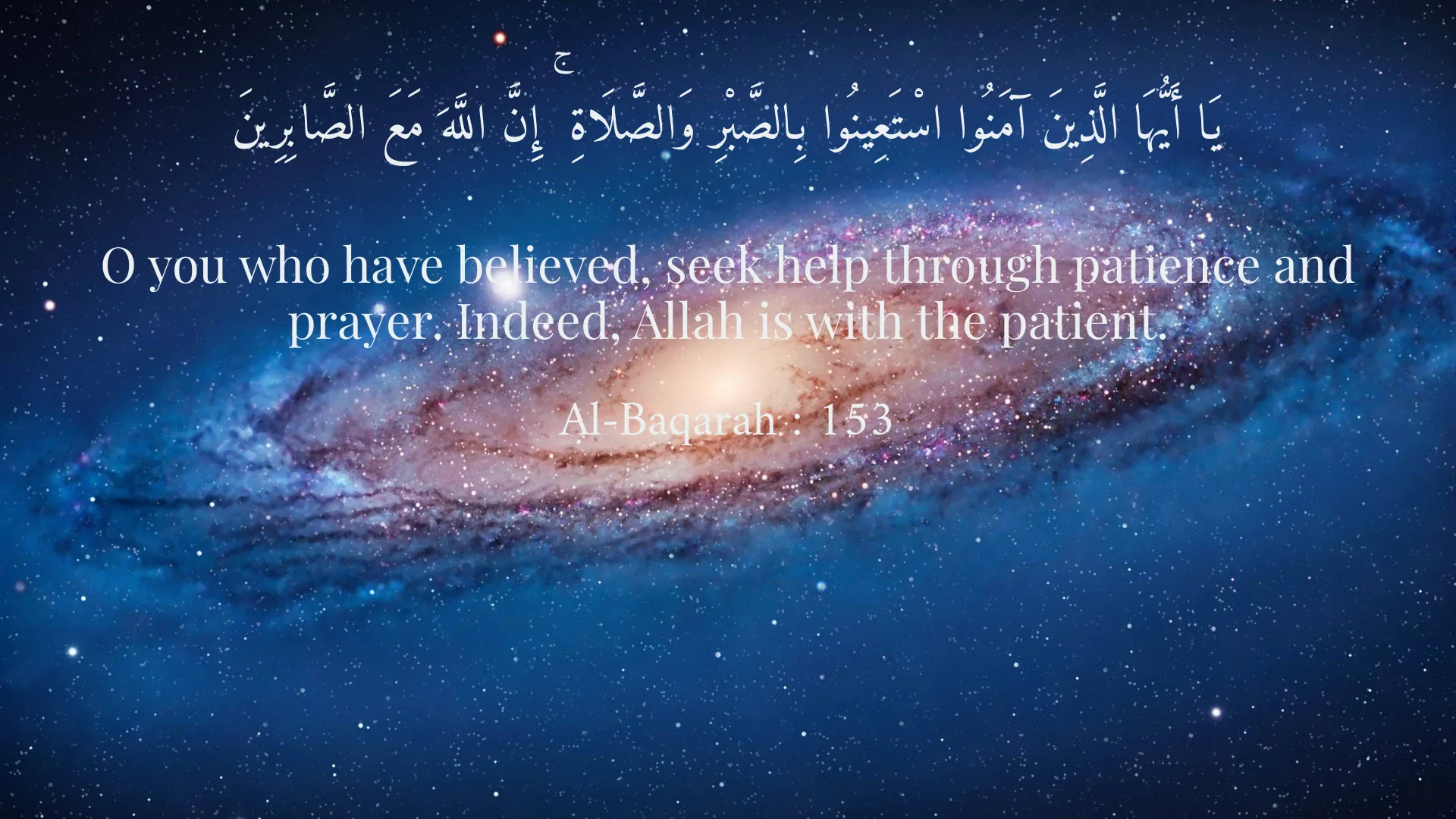
يَا أَيُّهَا الَّذِينَ آمَنُوا اسْتَعِينُوا بِالصَّبْرِ وَالصَّلَاةِ ۚ إِنَّ اللَّهَ مَعَ الصَّابِرِينَ
O you who have believed, seek help through patience and prayer. Indeed, Allah is with the patient.
Al-Baqarah : 153
قُلْ يَا عِبَادِيَ الَّذِينَ أَسْرَفُوا عَلَىٰ أَنفُسِهِمْ لَا تَقْنَطُوا مِن رَّحْمَةِ اللَّهِ ۚ إِنَّ اللَّهَ يَغْفِرُ الذُّنُوبَ جَمِيعًا ۚ إِنَّهُ هُوَ الْغَفُورُ الرَّحِيمُ
Say, 'O My servants who have transgressed against themselves [by sinning], do not despair of the mercy of Allah. Indeed, Allah forgives all sins. Indeed, it is He who is the Forgiving, the Merciful.'
Az-Zumar : 53
وَالْعَصْرِ
By time,
Al-Asr : 1
إِنَّ الْإِنسَانَ لَفِي خُسْرٍ
Indeed, mankind is in loss,
Al-Asr : 2
إِلَّا الَّذِينَ آمَنُوا وَعَمِلُوا الصَّالِحَاتِ وَتَوَاصَوْا بِالْحَقِّ وَتَوَاصَوْا بِالصَّبْرِ
Except for those who have believed and done righteous deeds and advised each other to truth and advised each other to patience.
Al-Asr : 3
Short Story
In ancient times, a pure-hearted youth named Salim embarked on the path of spiritual seeking and faith. He devoted himself to worship with great zeal, but it wasn't long before he grew disheartened by the whisperings of his own soul and his occasional lapses. Whenever his mind wandered during prayer or a worldly thought crossed his mind, he would severely reproach himself, believing he would never attain the status of the truly faithful, and he would despair of his own self. One day, distressed, he approached a wise old dervish, a man of the spiritual path, and complained about his impatience with himself and his discouragement over his weaknesses. The wise elder looked at him kindly and said, 'My son, I have heard of a gardener who planted a good seed but expected it to become a mighty tree overnight. He constantly dug at the soil, pulled at its branches, watered it excessively, and even tried to force the leaves open. The poor seed withered from all this restlessness and never bore fruit. But another gardener also planted a seed and, with patience and perseverance, watered it gently, understanding that the growth of every flower and fruit requires time and gentle care. He knew that sometimes storms would come and go, but the roots must become strong.' The elder continued: 'Salim, your soul is like that seed. Never despair if a thorn appears before a rose, or if a sprout has not yet become a forest. Be patient with the soil of your heart, water it with the remembrance of God, keep it free from the weeds of despair, and trust in the wisdom of the Divine Gardener. Every falling leaf is not the death of the tree, but a part of its cycle of life and growth. Sometimes, to take root deeply, some leaves must fall.' Salim learned a profound lesson from the wise elder's words. With a calmer heart and a more patient spirit, he returned to his path of faith, having learned that love and kindness towards oneself are an important part of the journey. Gradually, the blossoms of faith began to bear fruit within him.