Quranic Answer
Performing good deeds without succumbing to the feeling of hypocrisy (Riya) is one of the most significant and profound spiritual challenges on the path of drawing closer to Allah. Riya, in essence, means performing an action to be seen by others, to gain their praise and admiration, whereas sincerity (Ikhlas) means performing an action solely for the pleasure and satisfaction of the Almighty Lord. The Holy Quran and the Sunnah of the Prophet Muhammad (peace be upon him) strongly emphasize the supreme importance of sincerity in all acts of worship and good deeds. The primary goal of every believer should be that their actions, whether small or large, carry a divine essence and are free from any hint of showing off or seeking the attention of others. To better understand this concept, one must delve into the roots of Riya. Riya stems from weaknesses of the self, love for status and fame, and fear of people's judgment. In contrast, Ikhlas originates from the strength of faith, reliance on Allah, and the desire for eternal reward. The Quran explicitly states that deeds performed without a pure intention will be worthless and fruitless, even if they appear grand and significant on the surface. This is a key lesson: the quality of intention takes precedence over the quantity or outward appearance of the deed. One of the pivotal verses in this regard is Surah Al-Bayyinah, verse 5: "And they were not commanded except to worship Allah, [being] sincere to Him in religion, inclining to truth, and to establish prayer and to give zakat. And that is the correct religion." This verse clearly articulates that the foundation of religion is sincerity in worship and actions. Not only specific acts of worship like prayer and zakat, but all aspects of a believer's life must be accompanied by a pure, divine intention. Every good deed, from helping the needy to smiling at others, if done for Allah's pleasure, is invaluable. Another verse that profoundly addresses this concept is Surah Al-Kahf, verse 110: "So whoever would hope for the meeting with his Lord - let him do righteous work and not associate in the worship of his Lord anyone." This verse serves as a serious warning that even in performing righteous deeds, one should not associate partners; meaning, our intention should not be directed towards anyone other than Allah. Association here does not only mean worshipping idols but also includes minor polytheism (Shirk Asghar), of which Riya is a prominent manifestation. This subtle polytheism can nullify our good deeds and render them valueless. For this reason, the Prophet (PBUH) referred to Riya as "Shirk Asghar" or minor polytheism, because it is a form of involving others in the intention behind a divine act. Practical Strategies for Overcoming Riya and Cultivating Ikhlas: 1. Deep Reflection on Intention Before Every Action: Before embarking on any task, pause for a moment and ask yourself: "Why am I doing this?" Is my primary intention to please Allah, or to gain the attention of people? This continuous self-awareness is the cornerstone of sincerity. The Prophet Muhammad (PBUH) said: "Indeed, actions are by intentions." This fundamental prophetic tradition is the most basic principle in Islam for evaluating deeds. Without pure intention, even the greatest deeds become hollow. 2. Concealing Good Deeds as Much as Possible: Especially concerning voluntary acts, try to perform them discreetly. Charity given in secret, night prayers performed away from others' eyes, and assistance rendered without boasting or publicizing, are far removed from Riya. This concealment not only ensures sincerity but also increases its reward. However, this does not mean refraining from performing good deeds publicly; sometimes, performing good deeds in front of others can encourage and motivate them to do good, which itself carries immense reward. But even in such cases, the intention must be solely for Allah, and the goal should be to inspire others, not to show off personally. The key difference lies in the intention. If the aim is to be an example for others in the path of Allah, rather than gaining personal admiration, then it is permissible. 3. Constant Remembrance of Allah's Greatness and Majesty: When a person realizes the boundless greatness of Allah and their own insignificance before Him, the opinion of people will no longer matter. All focus will be on how to attain the pleasure of that One and Only Creator. This perspective helps a person to be freed from dependence on worldly approvals and to only seek divine approval. This remembrance cultivates a state of humility and submissiveness within a person, which is the best antidote to hypocrisy. 4. Supplication and Seeking Allah's Help: Ask Allah Almighty to keep you steadfast on the path of sincerity and protect you from the evil of Riya. The Prophet's (PBUH) supplication: "O Allah, I seek refuge in You from associating anything with You knowingly, and I seek Your forgiveness for what I do unknowingly." This prayer highlights the danger of Riya and the constant need for Allah's help to overcome it. Seeking refuge in Allah from both known and unknown forms of polytheism underscores the insidious nature of Riya, which can creep into our intentions without us even realizing it. 5. Practicing Humility and Modesty: Riya originates from arrogance and the desire for superiority. The more humble a person is and the more they perceive themselves as small before Allah and others, the less their inclination to show off. Knowing that every good deed that originates from us is by divine success and not merely from our personal abilities fosters humility. This understanding shifts the credit from oneself to Allah, thus purifying the intention. 6. Accepting Criticism and Not Being Upset by Lack of Appreciation: If you do something for Allah, the lack of thanks or even criticism from people should not discourage you. Your reward is with Allah, and He is the Best of rewarders. This indifference to people's praise or blame is a sign of sincerity and steadfastness in the path of truth. A sincere person cares only for Allah's gaze and pleasure, and does not use the opinions of others as a criterion for evaluating their deeds. This detachment from worldly validation is a true mark of spiritual maturity. 7. Reflecting on the Consequences of Riya in This World and the Hereafter: Hypocrisy not only yields no reward in the hereafter but can also lead to humiliation and disgrace in this world. One who acts to gain people's attention constantly lives in fear of their true intentions being exposed. This inner anxiety robs a person of peace. In contrast, sincerity brings inner peace and contentment. On the Day of Judgment, hypocritical deeds will be like scattered dust, holding no value. "And We will approach what they did of deeds and make them as scattered dust." (Al-Furqan: 23). This powerful imagery emphasizes the ultimate futility of actions done without sincerity. Ultimately, achieving complete sincerity is a continuous journey that requires constant spiritual struggle. Every moment, we must monitor our intentions and prevent them from deviating towards seeking people's attention. The ultimate goal is that all our actions, from breathing to the greatest acts of worship, are solely and purely for Allah. This is the true meaning of servitude, which leads a person to perfection and brings happiness in both this world and the hereafter. With sincerity, not only are our deeds accepted, but our hearts are also cleansed of spiritual ailments and transformed into a source of light and tranquility. This itself is the greatest worldly reward, attained even before the eternal rewards of the afterlife.
Related Verses
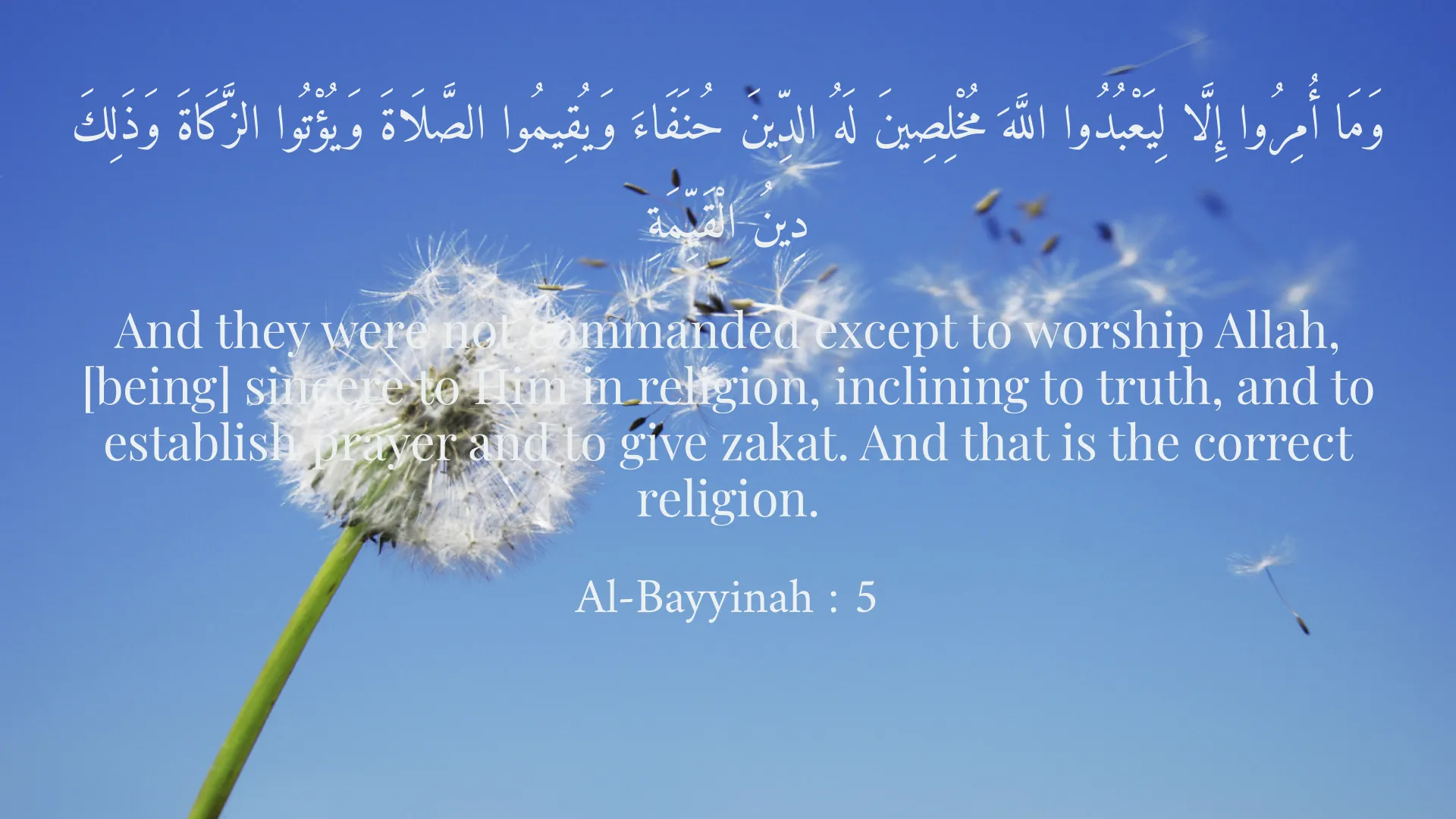
وَمَا أُمِرُوا إِلَّا لِيَعْبُدُوا اللَّهَ مُخْلِصِينَ لَهُ الدِّينَ حُنَفَاءَ وَيُقِيمُوا الصَّلَاةَ وَيُؤْتُوا الزَّكَاةَ وَذَلِكَ دِينُ الْقَيِّمَةِ
And they were not commanded except to worship Allah, [being] sincere to Him in religion, inclining to truth, and to establish prayer and to give zakat. And that is the correct religion.
Al-Bayyinah : 5
فَمَن كَانَ يَرْجُو لِقَاءَ رَبِّهِ فَلْيَعْمَلْ عَمَلًا صَالِحًا وَلَا يُشْرِكْ بِعِبَادَةِ رَبِّهِ أَحَدًا
So whoever would hope for the meeting with his Lord - let him do righteous work and not associate in the worship of his Lord anyone.
Al-Kahf : 110
يَا أَيُّهَا الَّذِينَ آمَنُوا لَا تُبْطِلُوا صَدَقَاتِكُم بِالْمَنِّ وَالْأَذَىٰ كَالَّذِي يُنفِقُ مَالَهُ رِئَاءَ النَّاسِ وَلَا يُؤْمِنُ بِاللَّهِ وَالْيَوْمِ الْآخِرِ ۖ فَمَثَلُهُ كَمَثَلِ صَفْوَانٍ عَلَيْهِ تُرَابٌ فَأَصَابَهُ وَابِلٌ فَتَرَكَهُ صَلْدًا ۖ لَّا يَقْدِرُونَ عَلَىٰ شَيْءٍ مِّمَّا كَسَبُوا ۗ وَاللَّهُ لَا يَهْدِي الْقَوْمَ الْكَافِرِينَ
O you who have believed, do not invalidate your charities with reminders [of it] or [other] injury, like one who spends his wealth [only] to be seen by the people and does not believe in Allah and the Last Day. His example is like that of a smooth rock with [a layer of] dust on it; then a downpour strikes it and leaves it bare. They are unable [to retain] anything of what they earned. And Allah does not guide the disbelieving people.
Al-Baqarah : 264
Short Story
In ancient times, there lived a pious and benevolent man named Sheikh Khalil. Every night, in the darkest hours, he would carry sacks of wheat and barley on his shoulders and secretly place them at the doors of the poor. No one but God knew of his deeds. The people of the city considered him an ordinary man, seeing no special signs of his benevolence beyond some apparent prayers and worship. One day, one of his disciples asked him, "O Master, why do you conceal the good deeds you perform? If people knew, they would praise you, and perhaps others would be encouraged." Sheikh Khalil smiled and said, "My son, if I perform these actions for the praise of people, what difference is there between that and mere showmanship? Is it not true that our Creator is more aware of hidden intentions? I seek my reward only from Him, not from the fleeting tongues of mortals. It is as if I hear the sweet-spoken Saadi say: 'The men of God tore the veil of illusion / Meaning, everywhere they saw nothing but God.' Let people know what they wish of me; what matters is that my Lord is pleased with my state and intention. For if an action is performed with a pure intention, it radiates light even in concealment, and if it is for show, it remains dark and worthless even in public. My goal is to attain a satisfaction that no human eye has seen, nor any human ear has heard." These words guided the disciple to the profound meaning of sincerity, and from then on, he too sought divine pleasure rather than popular acclaim.