Quranic Answer
Tawakkul, or complete reliance upon Allah, is one of the most beautiful and profound concepts in Islam, bringing immense peace to the heart and soul of a believer. However, Tawakkul is not merely a theoretical concept; it is a way of life, a continuous practice that permeates every moment of our existence. It signifies absolute and boundless trust in Allah, on the condition that an individual puts forth all their effort and then entrusts the outcome to Him. This understanding distinguishes Tawakkul from laziness and inaction, transforming it into a driving force for striving and hard work. To practice Tawakkul effectively, there are several steps we must consciously integrate into our daily lives. The first and most fundamental step is a deep and correct understanding of Allah and His absolute power. When a person truly comprehends the majesty, wisdom, infinite knowledge, and endless mercy of the Almighty, their trust in Him naturally escalates. If we truly believe that not a single leaf falls without His permission, and that He is the sole orchestrator of all affairs in the universe, then there is no room left for unnecessary worries or anxieties. This profound understanding forms the bedrock of any true Tawakkul, reassuring us that the best outcome will unfold for us, even if we initially face difficulties and challenges. The Holy Quran repeatedly emphasizes Allah’s absolute power and infinite knowledge, and these verses help us to gain a deeper appreciation of Allah’s position and His role in our lives. The second, and one of the most crucial practical aspects of Tawakkul, is exerting every possible effort. Many mistakenly believe Tawakkul means abandoning work and expecting miracles, a notion completely contrary to Quranic teachings and the Sunnah of Prophet Muhammad (PBUH). Allah states in the Holy Quran, "And whoever relies upon Allah – then He is sufficient for him" (Surah At-Talaq: 3). However, this verse immediately follows an emphasis on fulfilling duties and piety. The Prophet Muhammad (PBUH) also said, "Tie your camel and then put your trust in Allah." This hadith clearly illustrates that Tawakkul without effort is meaningless. We must utilize all our resources and capabilities, plan diligently, seek counsel, and pursue our goals with seriousness and perseverance. True Tawakkul begins when, after exerting all possible efforts, we entrust the results to Allah, knowing that His divine will and wisdom prevail beyond our endeavors. In other words, we are responsible for effort and action, not for the ultimate outcome. This approach frees us from the anxiety of an uncertain future and allows us to continue our path with peace of mind and hope. The third step is supplication (Dua) and seeking Allah's help. Dua is not merely a means of asking for divine assistance; it is also a testament to the servant’s weakness before His absolute power and an admission of constant need for Him. When we turn to Allah with all our heart and seek His aid, we not only feel a closer connection to our Creator but also find solace in our hearts. In difficult moments and crucial decisions, praying and entrusting matters to Him forms the cornerstone of practical Tawakkul. Furthermore, patience (Sabr) and contentment with Divine decree (Qada and Qadar) play a vital role in Tawakkul. After making efforts and praying, whatever the outcome, we must accept it with patience and contentment. This does not mean we cease striving for improvement, but rather that we accept the divine wisdom in what has transpired. Whether the outcome is desirable or not, a true believer knows that Allah wills what is best for them, and every event holds a wisdom that may not be immediately discernible. This contentment prevents despair and enables individuals to learn and grow from any circumstance. This inner peace, born from acceptance, is one of the greatest fruits of Tawakkul. The fourth aspect is managing and controlling expectations. Tawakkul does not mean that everything we wish for or strive towards will materialize exactly as we envision. Rather, Tawakkul implies trust in Divine wisdom, which might bring about paths and outcomes that are better or different from what we imagine. Sometimes, Allah does not give us what we want, but what is best for us. This difference in outcome may appear undesirable to us superficially, but deep down, it contains our welfare and good. Therefore, letting go of the need for complete control over results and accepting that the Divine will transcends our limited desires is a crucial part of practical Tawakkul. The fifth point is releasing anxiety and fears about the future. When we practice Tawakkul, we come to believe that Allah holds the reins of all affairs and is not oblivious to us. This belief alleviates many fears and worries stemming from an unknown future. A person who practices Tawakkul continues life with greater peace of mind, knowing that whatever happens is within the sphere of Divine wisdom and will ultimately be for their benefit. This mental state not only improves an individual's psychological well-being but also enables them to approach their life’s duties and missions with greater focus and energy. Tawakkul is a form of liberation from the bonds of worry and the entrapment of the future. In conclusion, implementing Tawakkul in practice is an ongoing journey and a spiritual path. This concept manifests in every moment of life, from major decisions to daily affairs. With every step we take, every effort we make, and every outcome we accept, we strengthen our Tawakkul. This continuous practice not only deepens our faith but also grants us unparalleled peace and makes our lives full of meaning and blessings. Tawakkul is not just an act of the heart; it is a continuous endeavor that requires self-awareness and willingness to align with the Divine will. This trust in Allah empowers us to walk through life with courage and certainty, knowing that He is our Sustainer and Helper.
Related Verses
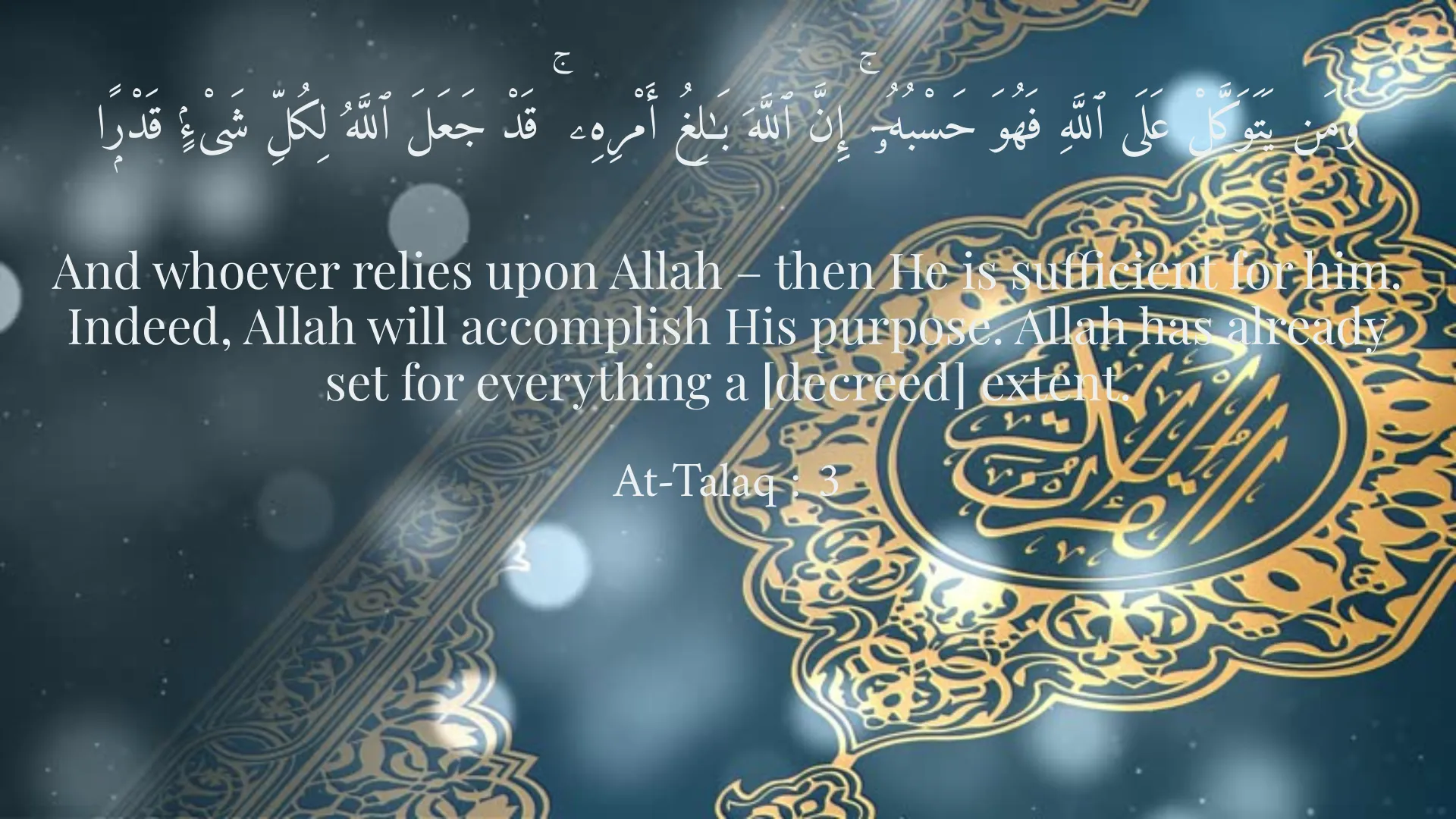
وَمَن يَتَوَكَّلْ عَلَى ٱللَّهِ فَهُوَ حَسْبُهُۥٓ ۚ إِنَّ ٱللَّهَ بَٰلِغُ أَمْرِهِۦ ۚ قَدْ جَعَلَ ٱللَّهُ لِكُلِّ شَىْءٍۢ قَدْرًۭا
And whoever relies upon Allah – then He is sufficient for him. Indeed, Allah will accomplish His purpose. Allah has already set for everything a [decreed] extent.
At-Talaq : 3
فَبِمَا رَحْمَةٍۢ مِّنَ ٱللَّهِ لِنتَ لَهُمْ ۖ وَلَوْ كُنتَ فَظًّا غَلِيظَ ٱلْقَلْبِ لَٱنفَضُّوا۟ مِنْ حَوْلِكَ ۖ فَٱعْفُ عَنْهُمْ وَٱسْتَغْفِرْ لَهُمْ وَشَاوِرْهُمْ فِى ٱلْأَمْرِ ۖ فَإِذَا عَزَمْتَ فَتَوَكَّلْ عَلَى ٱللَّهِ ۚ إِنَّ ٱللَّهَ يُحِبُّ ٱلْمُتَوَكِّلِينَ
So by mercy from Allah, [O Muhammad], you were lenient with them. And if you had been rude [in speech] and harsh in heart, they would have disbanded from about you. So pardon them and ask forgiveness for them and consult them in the matter. And when you have decided, then rely upon Allah. Indeed, Allah loves those who rely [upon Him].
Al-Imran : 159
وَلِلَّهِ غَيْبُ ٱلسَّمَٰوَٰتِ وَٱلْأَرْضِ وَإِلَيْهِ يُرْجَعُ ٱلْأَمْرُ كُلُّهُۥ فَٱعْبُدْهُ وَتَوَكَّلْ عَلَيْهِ ۚ وَمَا رَبُّكَ بِغَٰفِلٍ عَمَّا تَعْمَلُونَ
And to Allah belongs the unseen [aspects] of the heavens and the earth and to Him will be returned the matter, all of it. So worship Him and rely upon Him. And your Lord is not unaware of what you do.
Hud : 123
Short Story
It is narrated in Saadi's Golestan that a king asked his minister, "How is it that whenever I undertake a task, despite all my efforts, the outcome is sometimes not what I desire, yet you are always calm and composed?" The wise minister replied, "O King! The difference lies in this: you rely on means and outcomes, while I rely on the Creator of means. Whenever I begin a task, I first apply all my intelligence and ability and do what is within my power. Then, I release my heart from the outcome and entrust it to the Almighty Creator. For I know that He is more capable than anything we can imagine and knows what is best for us better than we do ourselves. That is why if the outcome is not as I wished, I do not grieve, for I know there is a hidden wisdom in it; and if it is as I wished, I am grateful. This tranquility stems from true reliance on God (Tawakkul)." The king took heed of this advice, and thereafter, through effort and Tawakkul, found deeper peace in his life.