Quranic Answer
Reconciling with oneself is a crucial step towards inner peace and well-being in life, and the Holy Quran offers profound and comprehensive guidance for this internal journey. From the Quranic perspective, self-reconciliation is not merely a psychological concept but a spiritual process that begins with understanding one's place in existence, accepting one's weaknesses, and striving for closeness to God. This reconciliation occurs when a person makes peace with their past, their mistakes, and their imperfections, and, relying on divine mercy and forgiveness, embarks on a path of growth and perfection. The Quran emphasizes that human beings are inherently prone to error and mistakes, yet the door of repentance and return is always open to them. One of the central Quranic concepts for self-reconciliation is 'Tawbah' (repentance). Tawbah means a sincere return to God after committing a sin or mistake. The Holy Quran repeatedly invites people to repent and promises forgiveness. In Surah Az-Zumar, verse 53, Allah says: "Say, 'O My servants who have transgressed against themselves [by sinning], do not despair of the mercy of Allah. Indeed, Allah forgives all sins. Indeed, it is He who is the Forgiving, the Merciful.'" This verse shines a light of hope into hearts, clearly demonstrating that even after committing major errors, one should not despair of divine forgiveness. This powerful message forms the basis for self-forgiveness. How can we expect ourselves not to make mistakes when Allah, the Most Merciful, introduces Himself as Al-Ghafoor (the Oft-Forgiving) and Ar-Rahim (the Most Merciful)? Accepting the truth that humans are fallible and that Allah is always ready to accept repentance is the first step towards freeing oneself from the heavy burden of sin and self-blame. Along with Tawbah, 'Istighfar' (seeking forgiveness) also plays a key role. Istighfar is a continuous process that purifies the heart and refines the soul. Prophet Muhammad (peace be upon him), despite being infallible, would seek forgiveness many times a day to teach us that Istighfar is not only for cleansing from sins but also for drawing closer to Allah and maintaining the purity of the soul. When we regularly seek forgiveness from Allah, we are essentially telling ourselves that every mistake can be rectified and every new beginning is possible. This sense of renewal and regeneration significantly helps in inner reconciliation. Another factor that the Quran presents for achieving inner peace and self-reconciliation is 'Dhikr Allah' (remembrance of God). In Surah Ar-Ra'd, verse 28, Allah says: "Those who have believed and whose hearts are assured by the remembrance of Allah. Unquestionably, by the remembrance of Allah hearts are assured." Self-blame, regret, and feelings of guilt can all cause turmoil and distress in the heart. But when a person remembers Allah, they take refuge in His infinite power, boundless mercy, and absolute wisdom. This remembrance assures a person that they are not alone and that they have a Supporter and Guide who can relieve them of any difficulty. Dhikr, or remembrance of God, not only includes verbal recitations but also contemplating divine verses, praying with presence of mind, and observing God's signs in the universe. This spiritual connection helps a person to see themselves not as a solitary, vulnerable being, but as part of a grand divine plan where every mistake is rectifiable and every dark spot can be illuminated. 'Sabr' (patience) and 'Tawakkul' (reliance on God) are also two other essential pillars in the process of self-reconciliation. Reconciling with oneself is a time-consuming process and requires patience. One must resist the temptations of despair and self-reproach. Patience means steadfastness on the path of truth and enduring difficulties. Tawakkul in Allah means that a person puts forth their best effort and then entrusts the outcome to Allah. This reliance removes the heavy burden of complete control over results from a person's shoulders and gives them peace, knowing that even if desired outcomes are not achieved due to past shortcomings, divine wisdom and expediency are at play. The Quran also refers to the 'Nafs al-Lawwamah' or 'self-reproaching soul' (Surah Al-Qiyamah, verse 2). This soul is the awakened conscience of a person that reproaches them for their mistakes. This reproach is beneficial as long as it is constructive and leads to repentance and reform. However, if this reproach turns into self-destruction and despair, it must be managed with the help of divine mercy and remembrance of God. It is important for a person to distinguish between constructive self-awareness and excessive self-blame. Self-awareness helps an individual learn from past mistakes and strive for a better future, while excessive self-blame traps them in a cycle of pain and despair. Finally, for self-reconciliation, 'Amal Saleh' (righteous deeds) is also very important. In Surah Hud, verse 114, it is stated: "Indeed, good deeds do away with ill deeds. That is a reminder for those who remember." Performing good deeds not only atones for past sins but also restores a sense of self-worth and efficacy to a person. When a person sees themselves on the path of serving creation and earning the Creator's pleasure, feelings of guilt and worthlessness are replaced by hope and inner contentment. These righteous deeds can include helping the needy, establishing justice, seeking knowledge, or even offering a kind smile. Every good deed performed with pure intention can be a bridge to rebuilding one's relationship with oneself. In summary, reconciling with oneself in light of Quranic teachings is a journey of repentance and seeking forgiveness, taking refuge in the remembrance of God, patience and reliance on Him, and practical action in performing good deeds. This path requires the individual to avoid despair, accept themselves, and, by relying on God, move towards a better and calmer version of themselves. This process not only leads to spiritual tranquility but also deepens one's connection with God.
Related Verses
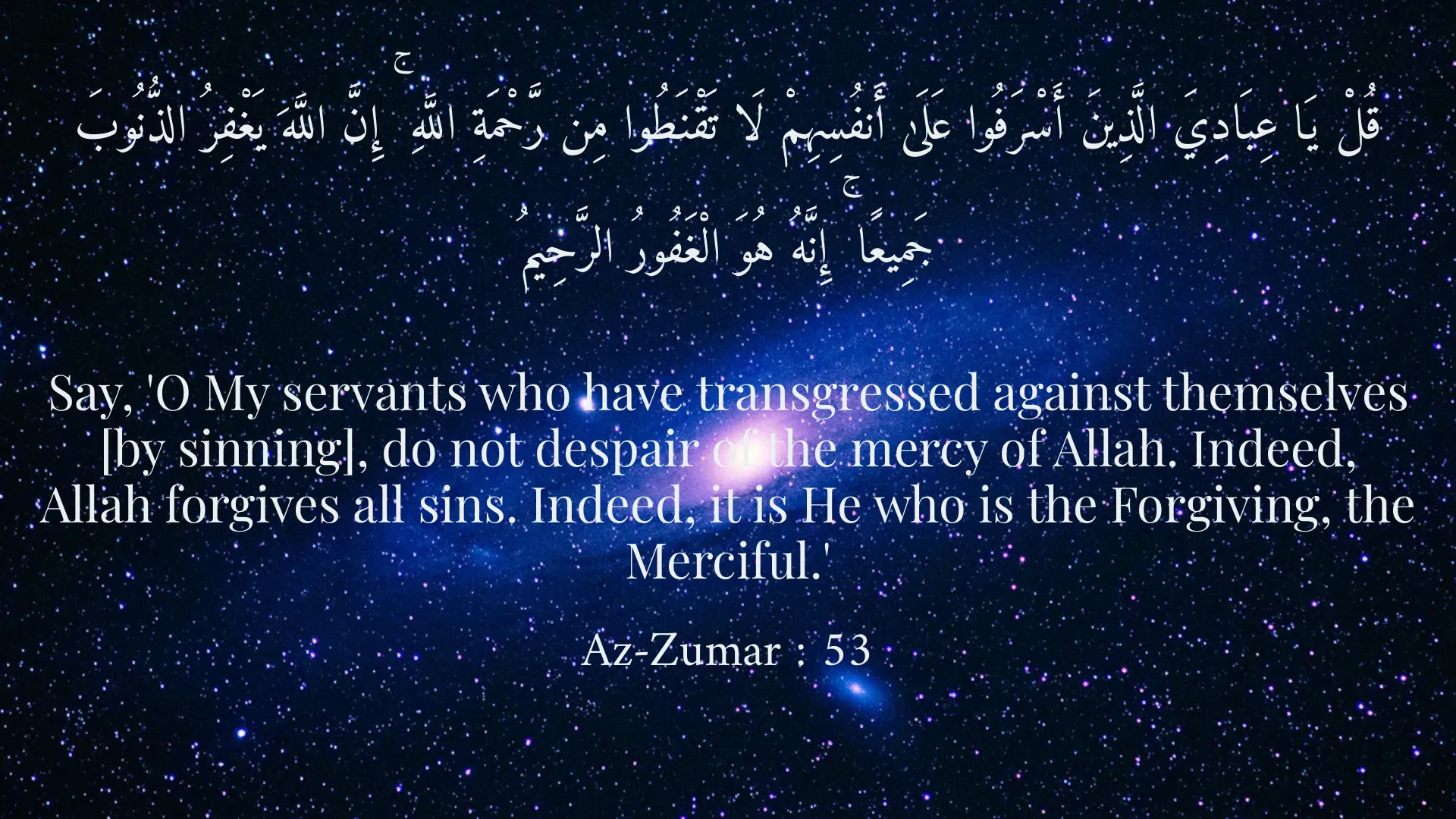
قُلْ يَا عِبَادِيَ الَّذِينَ أَسْرَفُوا عَلَىٰ أَنفُسِهِمْ لَا تَقْنَطُوا مِن رَّحْمَةِ اللَّهِ ۚ إِنَّ اللَّهَ يَغْفِرُ الذُّنُوبَ جَمِيعًا ۚ إِنَّهُ هُوَ الْغَفُورُ الرَّحِيمُ
Say, 'O My servants who have transgressed against themselves [by sinning], do not despair of the mercy of Allah. Indeed, Allah forgives all sins. Indeed, it is He who is the Forgiving, the Merciful.'
Az-Zumar : 53
الَّذِينَ آمَنُوا وَتَطْمَئِنُّ قُلُوبُهُم بِذِكْرِ اللَّهِ ۗ أَلَا بِذِكْرِ اللَّهِ تَطْمَئِنُّ الْقُلُوبُ
Those who have believed and whose hearts are assured by the remembrance of Allah. Unquestionably, by the remembrance of Allah hearts are assured.
Ar-Ra'd : 28
وَأَقِمِ الصَّلَاةَ طَرَفَيِ النَّهَارِ وَزُلَفًا مِّنَ اللَّيْلِ ۚ إِنَّ الْحَسَنَاتِ يُذْهِبْنَ السَّيِّئَاتِ ۚ ذَٰلِكَ ذِكْرَىٰ لِلذَّاكِرِينَ
And establish prayer at the two ends of the day and at the approach of night. Indeed, good deeds do away with ill deeds. That is a reminder for those who remember.
Hud : 114
Short Story
A man in a parched desert was on the verge of perishing from thirst. Suddenly, he saw a small sparrow with its delicate beak bringing a drop of water to its thirsty chicks. Witnessing this scene, the man admonished himself: "O soul! Learn from this tiny sparrow. You who show no such kindness to others and are solely preoccupied with yourself, how can you expect to be content with yourself and reconcile with your inner being? If you wish to reclaim your inner peace, you must quench your heart with love and forgiveness." From that moment, the man resolved to be benevolent and, through serving others and being kind to himself, to attain true peace, for he understood that reconciliation with oneself passes through reconciliation with the world and its Creator.