Quranic Answer
To effectively reduce worldly concerns and achieve true peace of heart, the Holy Quran offers profound and insightful guidance that transcends superficial advice, leading to a transformative shift in one's perception of life and existence. These solutions are rooted in a proper understanding of humanity's place, the purpose of creation, and the transient and ephemeral nature of this world. When an individual becomes aware of these fundamental truths, many of the anxieties and pressures stemming from the relentless pursuit of worldly affairs dissipate, giving way to tranquility and contentment. One of the most fundamental Quranic teachings in this regard is the elucidation of the temporary and transient nature of worldly life. The Quran repeatedly emphasizes that this world, with all its glitter, pleasures, wealth, and status, is merely a passage, a test, and a bridge to the eternal and everlasting abode of the Hereafter. This world is neither the final destination nor the source of lasting peace. In Surah Al-Hadid, verse 20, Allah Almighty provides a vivid and impactful illustration of this world, stating: “Know that the life of this world is only play and amusement, pomp and mutual boasting among you, and rivalry in respect of wealth and children. It is like a rain whose vegetation delights the tillers; then it withers, and you see it become yellow; then it becomes scattered dust. And in the Hereafter is a severe punishment or forgiveness from Allah and [His] approval. And what is the life of this world except the enjoyment of delusion.” This verse likens the world to childlike play and amusement, fleeting adornments, mutual boasting among people, and competition in accumulating wealth and offspring. It then compares it to vegetation that, after rain, grows green and flourishes, astonishing the farmers, but soon withers, turns yellow, and ultimately crumbles into dust. A deep understanding of this parable, that the world is merely “mata’ al-ghurur” (the enjoyment of delusion), is the first step towards freeing oneself from the grip of worldly concerns. When we realize that what we cling to today, like dew on a leaf, will vanish with the rising sun, detaching from it becomes easier. Following the comprehension of the world's nature, the second step is to focus on the Hereafter and to make it the ultimate goal in all our actions and intentions. The Quran explicitly states that true and lasting life is in the Hereafter, and the full reward or punishment for our deeds will be given there. In Surah Al-A'la, verses 16 and 17, Allah says: “But you prefer the worldly life, while the Hereafter is better and more lasting.” This verse beautifully demonstrates that although humans naturally incline towards this world, wisdom and divine guidance necessitate prioritizing the Hereafter, which is both superior in goodness and more enduring. When a person knows that every effort made in this world, if done with a divine intention, becomes an investment for their eternity, concerns related to worldly outcomes become less significant. This perspective imbues life with greater meaning and depth, replacing short-term, fleeting worldly goals with long-term, eternal objectives. One of the most effective remedies for achieving tranquility and reducing worldly preoccupations is the constant remembrance of Allah (Dhikr). In Surah Ar-Ra'd, verse 28, Allah Almighty says: “Those who have believed and whose hearts are assured by the remembrance of Allah. Unquestionably, by the remembrance of Allah hearts are assured.” Dhikr is not merely repeating words; it is a state of continuous awareness of God's presence, His power, His mercy, and His planning in all matters. When a person constantly remembers the Creator and Administrator of existence, they realize that everything is under His will, and not a single leaf falls without His permission. This continuous remembrance instills a sense of trust and complete reliance on Allah (Tawakkul) in the heart. Attachment to material things and the outcomes of worldly endeavors often stems from fear of the future, fear of loss, or the inability to achieve aspirations. But when we truly believe that Allah is our Sustainer and Protector, anxieties and worries significantly diminish. Dhikr and prayer serve as a secure refuge against the onslaught of worldly temptations and pressures, purifying the heart from impurities and connecting it to the wellspring of peace. Moreover, the Quran emphasizes moderation and balance in life. Islam never advocates monasticism or absolute renunciation of the world. Instead, it promotes the wise and proper use of worldly blessings to attain the Hereafter. In Surah Al-Qasas, verse 77, Allah says: “But seek, through that which Allah has given you, the home of the Hereafter; and [yet], do not forget your share of the world. And do good as Allah has done good to you. And desire not corruption in the land. Indeed, Allah does not like corrupters.” This verse provides a golden guideline for balance in life: use what Allah has given you to seek the abode of the Hereafter, but do not forget your share in this world. And do good as Allah has done good to you. And do not seek to cause corruption in the land. This verse teaches us not to lean towards excessive materialism nor to deprive ourselves of lawful pleasures. Possessing wealth, having a family, a job, and enjoying the beauties of this world are not blameworthy; in fact, they can be means to attain closeness to Allah, provided they remain means and not the ultimate goal, and do not blind us with attachment. Another Quranic teaching that helps reduce worldly concerns and increase inner contentment is the concept of gratitude (Shukr) and satisfaction (Qana’ah). In Surah Ibrahim, verse 7, Allah says: “If you are grateful, I will surely increase you [in favor]; but if you deny, indeed, My punishment is severe.” Being grateful for our possessions, blessings, and even the opportunities Allah has granted us, frees us from regretting what we lack and from the endless competition to acquire more. When we truly see and appreciate the blessings around us, desires, greed, and envy, which are among the biggest sources of anxiety and preoccupation, diminish. Contentment, which means being satisfied with what Allah has provided and accepting one’s destiny, brings peace to the heart and liberates it from the chains of greed and covetousness. This approach frees an individual from the never-ending race to gain more, a race that never leads to complete satisfaction, and allows them to enjoy the present moment and focus on the spiritual aspects of life. In conclusion, to reduce worldly concerns, we must change our perspective towards them. Let us view the world as a bridge, not a destination; as a farm for planting seeds of righteous deeds, not a market for endlessly accumulating goods. Faith in divine decree, complete reliance on Allah in all matters, fulfilling religious obligations, avoiding sins, helping those in need, and remembering death and the Hereafter are all tools the Quran provides for this purpose. With this comprehensive and elevated perspective, the world transforms from a source of anxiety and distress into a means for achieving eternal peace and felicity, freeing our hearts from the heavy burden of unnecessary preoccupations. This path leads to true tranquility and liberation from the cage of worldly concerns, a path illuminated by divine guidance, leading us towards a meaningful life free from endless worries.
Related Verses
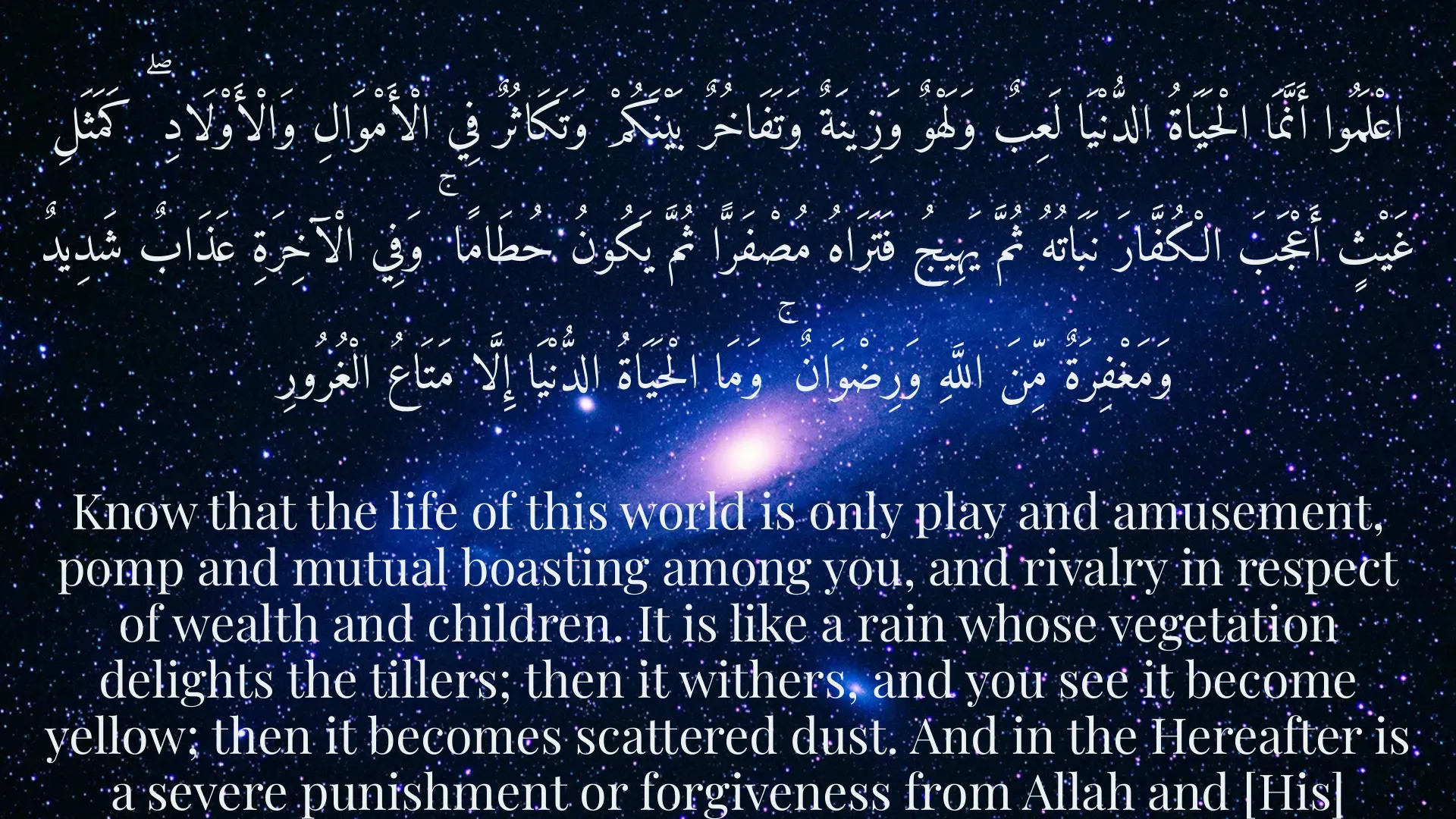
اعْلَمُوا أَنَّمَا الْحَيَاةُ الدُّنْيَا لَعِبٌ وَلَهْوٌ وَزِينَةٌ وَتَفَاخُرٌ بَيْنَكُمْ وَتَكَاثُرٌ فِي الْأَمْوَالِ وَالْأَوْلَادِ ۖ كَمَثَلِ غَيْثٍ أَعْجَبَ الْكُفَّارَ نَبَاتُهُ ثُمَّ يَهِيجُ فَتَرَاهُ مُصْفَرًّا ثُمَّ يَكُونُ حُطَامًا ۚ وَفِي الْآخِرَةِ عَذَابٌ شَدِيدٌ وَمَغْفِرَةٌ مِّنَ اللَّهِ وَرِضْوَانٌ ۚ وَمَا الْحَيَاةُ الدُّنْيَا إِلَّا مَتَاعُ الْغُرُورِ
Know that the life of this world is only play and amusement, pomp and mutual boasting among you, and rivalry in respect of wealth and children. It is like a rain whose vegetation delights the tillers; then it withers, and you see it become yellow; then it becomes scattered dust. And in the Hereafter is a severe punishment or forgiveness from Allah and [His] approval. And what is the life of this world except the enjoyment of delusion.
Al-Hadid : 20
الَّذِينَ آمَنُوا وَتَطْمَئِنُّ قُلُوبُهُم بِذِكْرِ اللَّهِ ۗ أَلَا بِذِكْرِ اللَّهِ تَطْمَئِنُّ الْقُلُوبُ
Those who have believed and whose hearts are assured by the remembrance of Allah. Unquestionably, by the remembrance of Allah hearts are assured.
Ar-Ra'd : 28
وَابْتَغِ فِيمَا آتَاكَ اللَّهُ الدَّارَ الْآخِرَةَ ۖ وَلَا تَنسَ نَصِيبَكَ مِنَ الدُّنْيَا ۖ وَأَحْسِن كَمَا أَحْسَنَ اللَّهُ إِلَيْكَ ۖ وَلَا تَبْغِ الْفَسَادَ فِي الْأَرْضِ ۖ إِنَّ اللَّهَ لَا يُحِبُّ الْمُفْسِدِينَ
But seek, through that which Allah has given you, the home of the Hereafter; and [yet], do not forget your share of the world. And do good as Allah has done good to you. And desire not corruption in the land. Indeed, Allah does not like corrupters.
Al-Qasas : 77
Short Story
Long ago, in the city of Shiraz, there lived a very wealthy merchant. He possessed numerous houses, many caravanserais, and countless treasures of gold and jewels. Yet, the more his wealth grew, the more his worldly concerns multiplied. He was perpetually chasing a better deal, greater profit, and a larger accumulation of assets. Peace had abandoned his life, and he slept restlessly, constantly fearing the loss of his fortune. One day, he passed by an ascetic and free-spirited dervish who sat in a corner of a mosque, with a serene heart and a cheerful countenance. The merchant, in astonishment, asked, "O Dervish, you have nothing, yet how can you sit so calmly and without sorrow, while I, with all my wealth, am never at ease?" The dervish smiled and replied, "O Master, the heavy burden of the world rests upon your shoulders, and this burden will never lighten unless you free your heart from it. You possess your wealth, but your wealth has enslaved you. I possess nothing, and therefore I fear nothing. My liberation from attachments is what has made me the wealthiest person, not your treasures." The merchant pondered for a moment and realized that true peace lies in freedom from greed and attachment to the world, not in the pursuit of more.