Quranic Answer
Anxiety about the future is a deeply human experience, a natural response to uncertainty. Whether these concerns relate to financial stability, health, relationships, or the state of the world, these worries can often feel overwhelming, consuming our thoughts and robbing us of peace. However, the Holy Quran, as a complete guide for humanity, offers profound and practical wisdom that can transform our relationship with the future, helping us to navigate its ambiguities with tranquility and resilience. It provides a spiritual anchor in turbulent times, shifting our focus from uncontrollable outcomes to controllable actions and, most importantly, to an unshakable trust in the Divine. This Quranic approach not only helps to alleviate anxiety but also provides us with a deeper insight into the purpose of life and our place in the divine plan, which itself leads to more sustained peace. Perhaps the most central Quranic teaching for alleviating future anxiety is the concept of 'Tawakkul', absolute reliance and trust in Allah. It's not a passive surrender but an active trust that comes after one has exerted their best effort. The Quran repeatedly emphasizes that Allah is the ultimate Disposer of affairs and the best Protector. When a believer internalizes that their sustenance, health, and destiny are ultimately in Allah's hands, a tremendous burden is lifted. This doesn't mean neglecting planning or hard work; rather, it means doing your utmost, then entrusting the outcome to Allah, knowing that whatever transpires is ultimately for your good, even if you don't immediately perceive it. Allah says in Surah At-Talaq (65:3), "And whoever relies upon Allah - He is sufficient for him. Indeed, Allah will accomplish His purpose. Allah has already set for everything a [decreed] extent." This verse is a powerful antidote to anxiety, assuring us that Allah's plan is perfect and His provision is limitless for those who place their faith in Him. The anxious mind often fixates on "what if" scenarios, but Tawakkul helps replace these with "Allah is sufficient for me." It cultivates a sense of inner security, knowing that you are never truly alone and that your Creator is your strongest ally. This deep conviction provides a strong pillar for our soul in facing the unknown, giving us the strength to face challenges with greater serenity. Another profound teaching for peace of mind is 'Dhikr', the remembrance of Allah. The Quran explicitly states in Surah Ar-Ra'd (13:28), "Those who have believed and whose hearts are assured by the remembrance of Allah. Unquestionably, by the remembrance of Allah hearts are assured." This verse is a direct promise. When we remember Allah through His names, through recitation of the Quran, or through prayer, our hearts find solace. The constant mental chatter of anxiety is silenced, replaced by a deep sense of connection and tranquility. Dhikr acts as a spiritual balm, calming the nervous system and reorienting our focus from worldly uncertainties to the eternal presence of the Divine. It reminds us of Allah's attributes – His mercy, His power, His wisdom – which naturally diminish fear and apprehension. Regular Dhikr practice, whether formal (like tasbeeh) or informal (like simply acknowledging Allah's presence throughout the day), creates a fortified inner sanctuary against the storms of worry. It brings a profound understanding that despite external chaos, there is an unchanging, all-encompassing reality – Allah. The Quran frequently enjoins 'Sabr' (patience) and 'Salat' (prayer) as key means of coping with life's challenges, including future anxiety. In Surah Al-Baqarah (2:153), Allah commands, "O you who have believed, seek help through patience and prayer. Indeed, Allah is with the patient." Patience in this context isn't just about passively waiting; it's about steadfastness, perseverance, and maintaining faith through difficulties. When facing an uncertain future, patience allows us to endure the present anxieties without being overwhelmed, trusting that ease will follow hardship. Prayer, on the other hand, is our direct line of communication with Allah. It is a moment of submission, humility, and profound connection where we lay bare our fears and hopes before our Creator. The ritual of prayer, with its structured movements and verses, offers a respite from worldly thoughts, a dedicated time to reconnect with the divine source of peace. Beyond the formal prayers, 'Du'a' (supplication) is also a powerful tool. Pouring out our hearts to Allah, asking for guidance, strength, and ease, reinforces our reliance on Him and provides immense psychological relief. It empowers us by reminding us that we have an all-powerful ally, while simultaneously humbling us to acknowledge our limitations and need for divine assistance. A fundamental Islamic belief is 'Qada wal-Qadar', the divine decree or predestination. Understanding and accepting this concept is crucial for overcoming future anxiety. It means believing that everything that happens, good or bad, is by Allah's knowledge and permission. This does not negate free will or human effort; rather, it emphasizes that the ultimate outcome is in Allah's hands. When we realize that certain aspects of our future are beyond our control and are part of a larger divine plan, it frees us from the burden of hyper-control and obsessive worrying. Our responsibility is to make the best choices and exert our efforts, and then accept the outcome with contentment, knowing that Allah's wisdom is perfect, even if His plan is not immediately clear to us. This acceptance fosters inner peace and resilience, transforming potential sources of dread into opportunities for spiritual growth and increased faith. It allows us to distinguish between what we can influence and what we cannot, freeing us from the paralysis of uncontrollable fears. Finally, the Quran imbues believers with an inherent sense of optimism and 'Raja'' (hope). Allah's mercy is expansive, and His promises are true. The Quran frequently reassures us that after hardship comes ease (Surah Al-Inshirah, 94:5-6) and that Allah does not burden a soul beyond its capacity (Surah Al-Baqarah, 2:286). This constant reminder of divine mercy and justice is a powerful antidote to despair and anxiety. Believers are encouraged to always have good expectations of Allah, trusting in His benevolence and wisdom. This hopeful outlook transforms potential anxieties into opportunities for patience, prayer, and growth, fostering an inner strength that makes one resilient against life's uncertainties. It's the belief that no matter how dark the clouds seem, Allah's light will eventually shine through, bringing comfort and clarity. This hope serves as a motivator for constructive action, pushing us to strive for what is within our power while leaving the outcomes to God. In essence, the Quran offers a comprehensive spiritual toolkit for confronting future anxiety. By cultivating unwavering 'Tawakkul' in Allah, seeking tranquility through constant 'Dhikr', finding strength in 'Sabr' and 'Salat', embracing the wisdom of 'Qada wal-Qadar', focusing on righteous actions in the present, and maintaining an optimistic 'Raja'' in Allah's boundless mercy, believers can transform their relationship with the unknown. They learn to live with a profound sense of peace, knowing that their affairs are in the hands of the All-Wise, All-Merciful Creator, and that whatever the future holds, it is ultimately part of a divine plan designed for their ultimate well-being. This profound spiritual framework empowers individuals not to eliminate uncertainty, but to face it with a heart full of faith and serenity. This means accepting that we cannot control everything, but we can master our reactions and our faith, which is an invaluable source of peace.
Related Verses
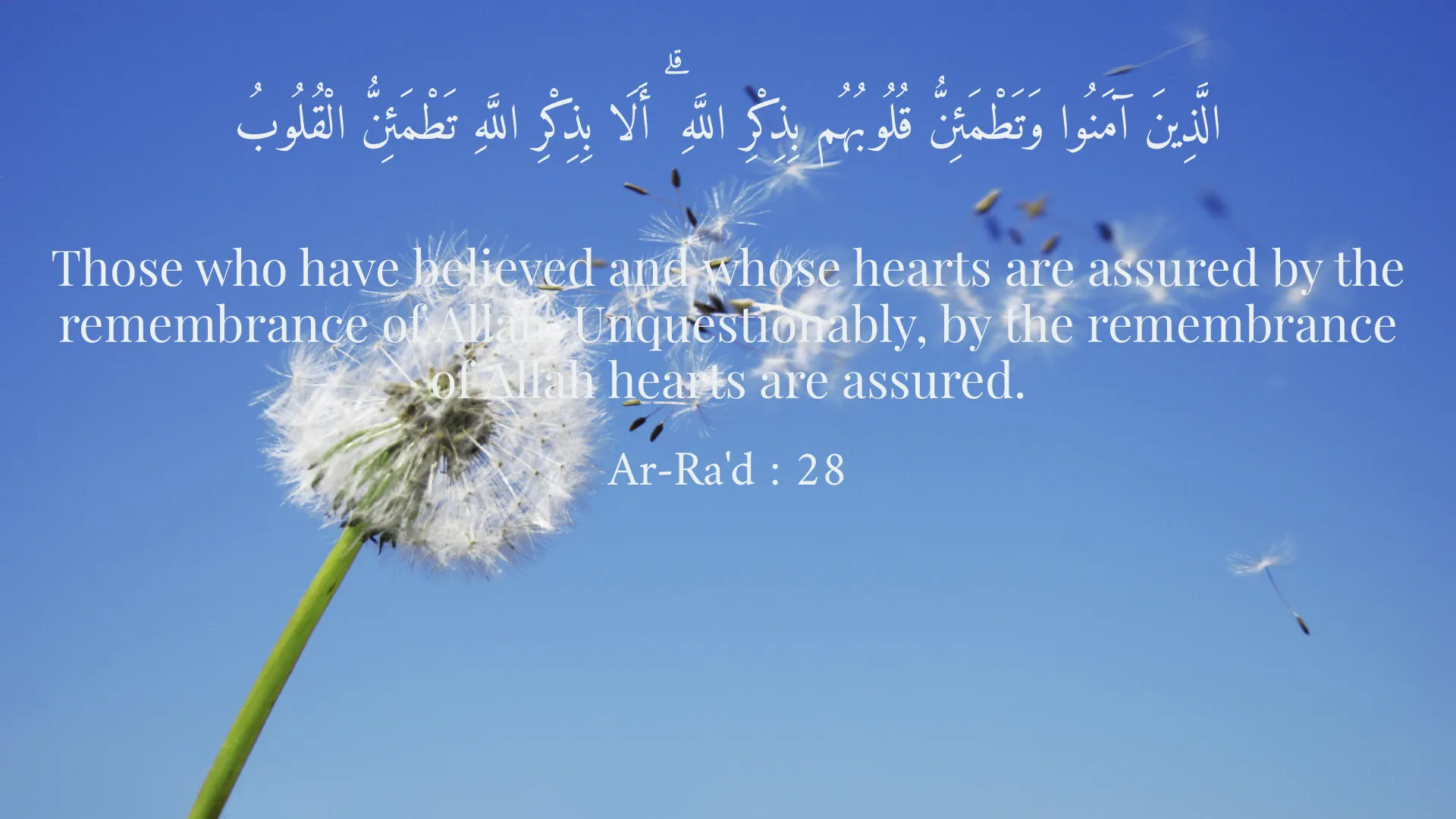
الَّذِينَ آمَنُوا وَتَطْمَئِنُّ قُلُوبُهُم بِذِكْرِ اللَّهِ ۗ أَلَا بِذِكْرِ اللَّهِ تَطْمَئِنُّ الْقُلُوبُ
Those who have believed and whose hearts are assured by the remembrance of Allah. Unquestionably, by the remembrance of Allah hearts are assured.
Ar-Ra'd : 28
وَمَن يَتَوَكَّلْ عَلَى اللَّهِ فَهُوَ حَسْبُهُ ۚ إِنَّ اللَّهَ بَالِغُ أَمْرِهِ ۚ قَدْ جَعَلَ اللَّهُ لِكُلِّ شَيْءٍ قَدْرًا
And whoever relies upon Allah - He is sufficient for him. Indeed, Allah will accomplish His purpose. Allah has already set for everything a [decreed] extent.
At-Talaq : 3
يَاأَيُّهَا الَّذِينَ آمَنُوا اسْتَعِينُوا بِالصَّبْرِ وَالصَّلَاةِ ۚ إِنَّ اللَّهَ مَعَ الصَّابِرِينَ
O you who have believed, seek help through patience and prayer. Indeed, Allah is with the patient.
Al-Baqarah : 153
Short Story
One day, a dervish with a serene mind and a joyful heart was sitting in a garden, listening to the birds sing. A king passed by and asked him, "How is it that I, with all this dominion and wealth, have no peace for a moment and am always worried about the future, while you, with your poverty, are so at ease?" The dervish smiled and said, "O King! You are a slave of treasure, and I am a slave of the Bestower of Treasure. You fear what will happen, but I know that my Lord is the Provider and will never abandon His servant. Whoever entrusts their heart to Him will be free from the worries of tomorrow."