Quranic Answer
In the Holy Quran, Allah commands the believers in various verses to always have hope in Him and to trust Him in times of difficulty. This divine directive serves as a foundation for the Islamic faith, reminding adherents that no matter how dark the circumstances may appear, there is always a light of hope illuminating the path forward. This article will explore the significance of hope as taught in the Quran, its relevance in the lives of believers, and the various verses that encapsulate the essence of hope in the face of adversity. Hope in life not only brings peace but can also lead people toward success and progress, both spiritually and materially. The concept of hope is deeply embedded in the teachings of Islam. It is a central tenet that encourages believers to look towards Allah for guidance, strength, and resilience. One of the most important verses that encapsulates this notion is found in verse 53 of Surah Az-Zumar. This verse reads: 'Say, O My servants who have believed, fear your Lord. For those who do good in this world is goodness, and the earth of Allah is spacious. Indeed, the patient will be given their reward without account.' In this verse, Allah promises the believers that by being pious and doing good deeds in this life, they will receive a great reward. This reward can help keep hope alive in the hearts of believers. Here, the correlation between piety, good deeds, and the vastness of Allah's mercy is established. It encourages individuals to maintain their efforts toward righteousness, regardless of their present circumstances, fostering a sense of hope that transcends immediate challenges. Moreover, the verse emphasizes the importance of patience. In life, trials and tribulations are inevitable. However, through patience, believers will find that the rewards are not only forthcoming but are also boundless. The phrase 'without account' highlights Allah's infinite generosity. This sense of assurance prompts believers to constantly trust in Allah’s plan and to stay focused on their aspirations of goodness. Hope is thereby interwoven with the concepts of faith and resilience, guiding believers to stay true to their values and to seek Allah’s mercy in every aspect of their lives. In addition to Surah Az-Zumar, Surah Ash-Shu'ara, verse 80 states: 'And mention My Servant Abraham. Indeed, he was a man of truth and a prophet.' This verse serves as a reminder that figures like Abraham (Ibrahim), who had unwavering faith and hope in times of hardship, can serve as inspiring role models for all believers. Abraham’s journey is replete with trials, from his early struggles against idolatry to the monumental test of sacrificing his son. Despite facing seemingly insurmountable odds, he remained steadfast in his belief and hopeful in Allah's wisdom and mercy. His life story epitomizes the essence of resilient hope that believers can emulate. The concept of hope as explained in the Quran is not merely passive optimism; it is an active faith that thrives even in the face of adversity. The lessons drawn from the lives of prophets like Abraham motivate believers to maintain their faith amidst trials. Each narrative emphasizes that challenges are a part of the divine plan and that through enduring faith, one can find salvation and reward. Hope transforms struggles into opportunities for spiritual growth and character development, urging believers to approach their difficulties with optimism and trust in Allah. Furthermore, another essential verse that reinforces the notion of hope is found in Surah Al-Baqarah, verse 286, which states: 'Allah does not burden a soul beyond that it can bear.' This verse can be a profound source of comfort and hope, as it reassures believers that every trial they face is tailored to their individual strengths and resilience. It implies that God, in His infinite wisdom, knows our capacities and that the hardships we endure are within our ability to manage. Therefore, by reflecting on this divine promise, believers can cultivate a heart full of hope. It instills a sense of courage, urging individuals to confront life’s challenges with the understanding that every trial comes with a way out. This assurance is particularly significant, as it lays the groundwork for a fulfilling life dedicated to service, compassion, and gratitude. Hope in Islam is intimately linked to trust in Allah and His plan. Believers are encouraged to develop a strong connection with Allah through prayer, supplication, and the remembrance of His countless blessings. Nurturing this relationship reinforces faith in His mercy and fosters an unwavering sense of hope. When believers engage in acts of worship and charity, they embody the spirit of hope, serving as vessels of positivity and support for those around them. In conclusion, the significance of hope as articulated in the Quran is multi-dimensional. It not only encourages believers to strive for goodness and maintain patience but also serves as a lifeline during times of despair. The verses of Surah Az-Zumar, Surah Ash-Shu'ara, and Surah Al-Baqarah collectively underscore the importance of remaining steadfast in faith, trusting Allah, and understanding that each challenge is a stepping stone towards greater rewards. By reflecting on these teachings, individuals can foster a heart full of hope, guiding them through the vicissitudes of life with faith and resilience. Thus, hope in the context of the Quran serves as a powerful motivator that propels believers towards progress, success, and ultimately a deeper connection with their Creator.
Related Verses
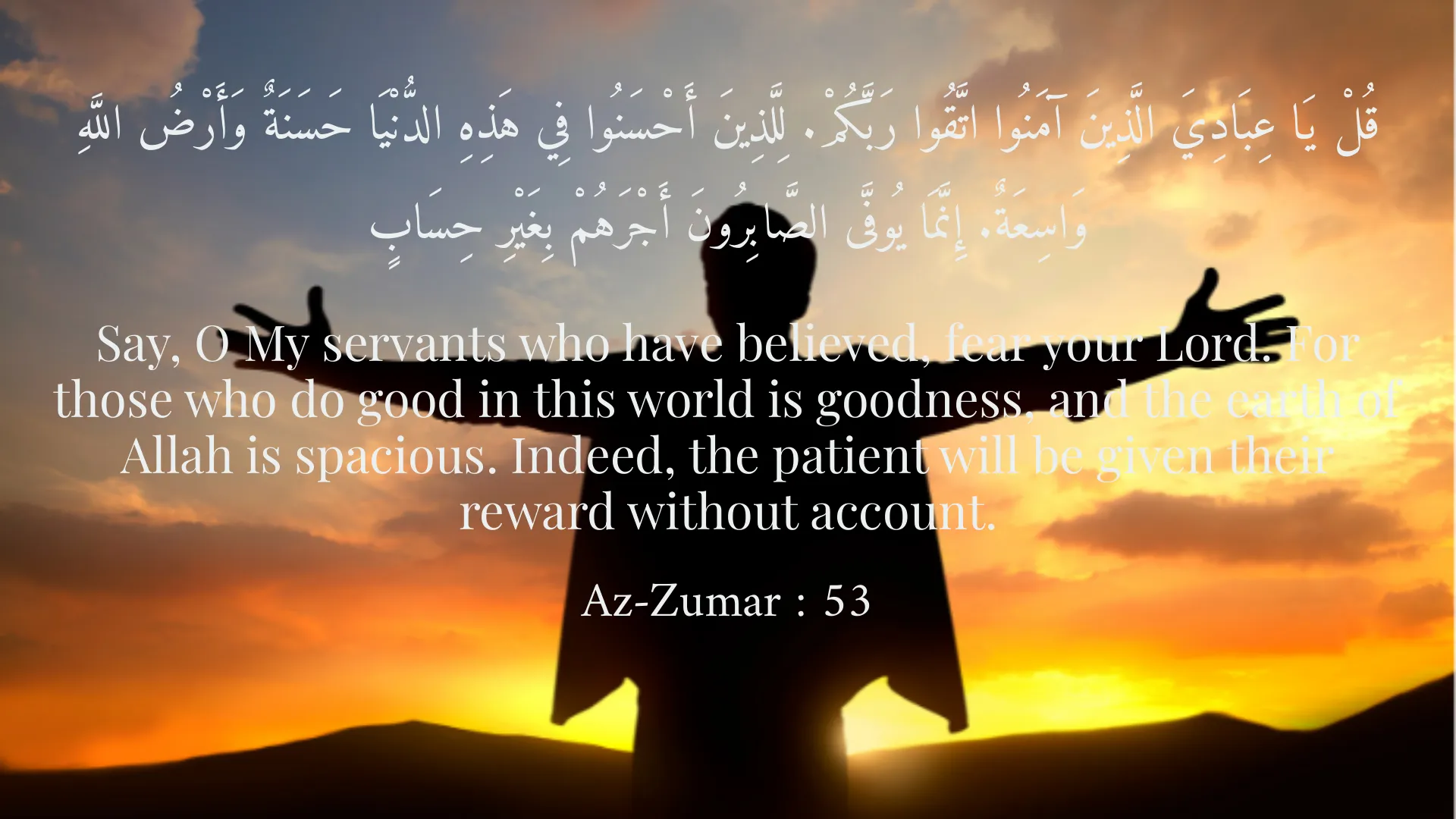
قُلْ يَا عِبَادِيَ الَّذِينَ آمَنُوا اتَّقُوا رَبَّكُمْ. لِلَّذِينَ أَحْسَنُوا فِي هَذِهِ الدُّنْيَا حَسَنَةٌ وَأَرْضُ اللَّهِ وَاسِعَةٌ. إِنَّمَا يُوفَّى الصَّابِرُونَ أَجْرَهُمْ بِغَيْرِ حِسَابٍ
Say, O My servants who have believed, fear your Lord. For those who do good in this world is goodness, and the earth of Allah is spacious. Indeed, the patient will be given their reward without account.
Az-Zumar : 53
وَأَذْكُرْ عَبْدِي إِبْرَاهِيمَ إِنَّهُ كَانَ صِدِّيقًا نَبِيًّا
And mention My Servant Abraham. Indeed, he was a man of truth and a prophet.
Ash-Shu'ara : 80
لَا يُكَلِّفُ اللَّهُ نَفْسًا إِلَّا وُسْعَهَا
Allah does not burden a soul beyond that it can bear.
Al-Baqarah : 286
Short Story
One day, a man named Adel was reflecting on his life and felt very unhappy. He recalled the verses of the Quran and decided to have hope in Allah. He started praying and reading the Quran every day, and gradually he felt a greater sense of hope and peace. From that day on, Adel always tried to remember Allah and trust Him during difficult times.