Quranic Answer
Living without judging others is not merely a strategy for personal tranquility; it is a fundamental pillar of Islamic ethics and a core tenet of Quranic teachings. The Holy Quran repeatedly emphasizes the importance of preserving the dignity, honor, and rights of others, explicitly forbidding Muslims from engaging in suspicion, backbiting, spying, and mockery. A deep understanding of these teachings and their practical application in daily life can help us foster a society built on empathy and mutual respect. The first and perhaps most crucial step on this path is acknowledging that only God possesses absolute knowledge of intentions and inner states. Humans, with their inherent cognitive limitations, can never fully grasp the hidden truths of others' beings. Therefore, any judgment based on outward appearances or hearsay is prone to error and injustice. Verse 12 of Surah Al-Hujurat explicitly warns believers against "much [negative] assumption," stating: "O you who have believed, avoid much [negative] assumption. Indeed, some assumption is sin. And do not spy or backbite each other. Would one of you like to eat the flesh of his brother when dead? You would detest it. And fear Allah; indeed, Allah is Accepting of repentance and Merciful." This verse sternly condemns the ominous trio of suspicion, spying, and backbiting, which are the primary roots of unjust judgment. Negative assumption opens the door to spying, which in turn leads to backbiting and the exposure of private matters. The vivid simile of backbiting to "eating the flesh of one's dead brother" powerfully illustrates the abhorrence of this act, instilling deep aversion in the human heart. Further in the same Surah, Verse 11 of Al-Hujurat addresses the issues of mockery and fault-finding, proclaiming: "O you who have believed, let not a people ridicule [another] people; perhaps they may be better than them; nor let women ridicule [other] women; perhaps they may be better than them. And do not insult one another and do not call each other by [offensive] nicknames. Wretched is the name [of] disobedience after [one's] faith. And whoever does not repent - then it is those who are the wrongdoers." This verse underscores the truth that every individual, regardless of their appearance, social status, or any other characteristic, might be superior in the sight of Allah. Mockery and fault-finding are signs of arrogance and ignorance, directly contradicting the spirit of humility and modesty that characterizes true believers. These verses teach us to focus on self-improvement rather than criticizing others. Whenever the temptation to judge or find fault arises, we should remember that the person we are judging might hold a higher status with God than we do. Moreover, the Quran emphasizes individual accountability. In Surah Al-An'am, Verse 164, we read: "And no bearer of burdens will bear the burden of another..." This verse reminds us that each person is responsible for their own actions, and we have no right to judge others for matters that do not concern us or to shoulder their sins. Our duty is to offer sincere advice (naseehah) gently and to invite others to the truth, not to condemn or ostracize them. This approach not only preserves human dignity but also provides an opportunity for individuals to repent and return to the right path. When we refrain from judging others, an atmosphere of trust and security is created, where people feel more comfortable expressing themselves and accepting constructive feedback. To live without judgment, we must shift our mindset. Instead of focusing on others' weaknesses, we should concentrate on their strengths and positive aspects. Instead of seeking faults, we should give others the benefit of the doubt and interpret their actions in a positive light. This practice not only brings inner peace to ourselves but also strengthens our relationships with others. Furthermore, adhering to the Quranic advice in Surah Al-Isra, Verse 36, which states: "And do not pursue that of which you have no knowledge. Indeed, the hearing, the sight and the heart - all of those will be questioned," serves as a vital guide against baseless judgments. This verse reminds us that our judgments must be based on knowledge and certainty, not on mere assumptions or guesses. If we lack sufficient knowledge about something, we should remain silent and refrain from expressing an opinion. Ultimately, practicing humility and modesty before God and His creation is the key to liberation from judgmental tendencies. When a person recognizes the grandeur of God and their own weaknesses, arrogance and superiority, which are the roots of judgment, dissipate. Living without judging others means accepting human diversity, respecting individual privacy, and focusing on our own path of growth and self-correction. This way of life not only helps us to live in a more peaceful and harmonious society but also opens a door to inner peace and a deeper connection with the Creator. This approach embodies the true spirit of mercy, empathy, and Islamic brotherhood that the Quran calls us to, safeguarding us from the afflictions of suspicion and backbiting, and ultimately leading to a healthy society filled with love and respect. This is not merely an ethical behavior, but an act of worship that brings divine pleasure and purifies the heart from worldly contaminations.
Related Verses
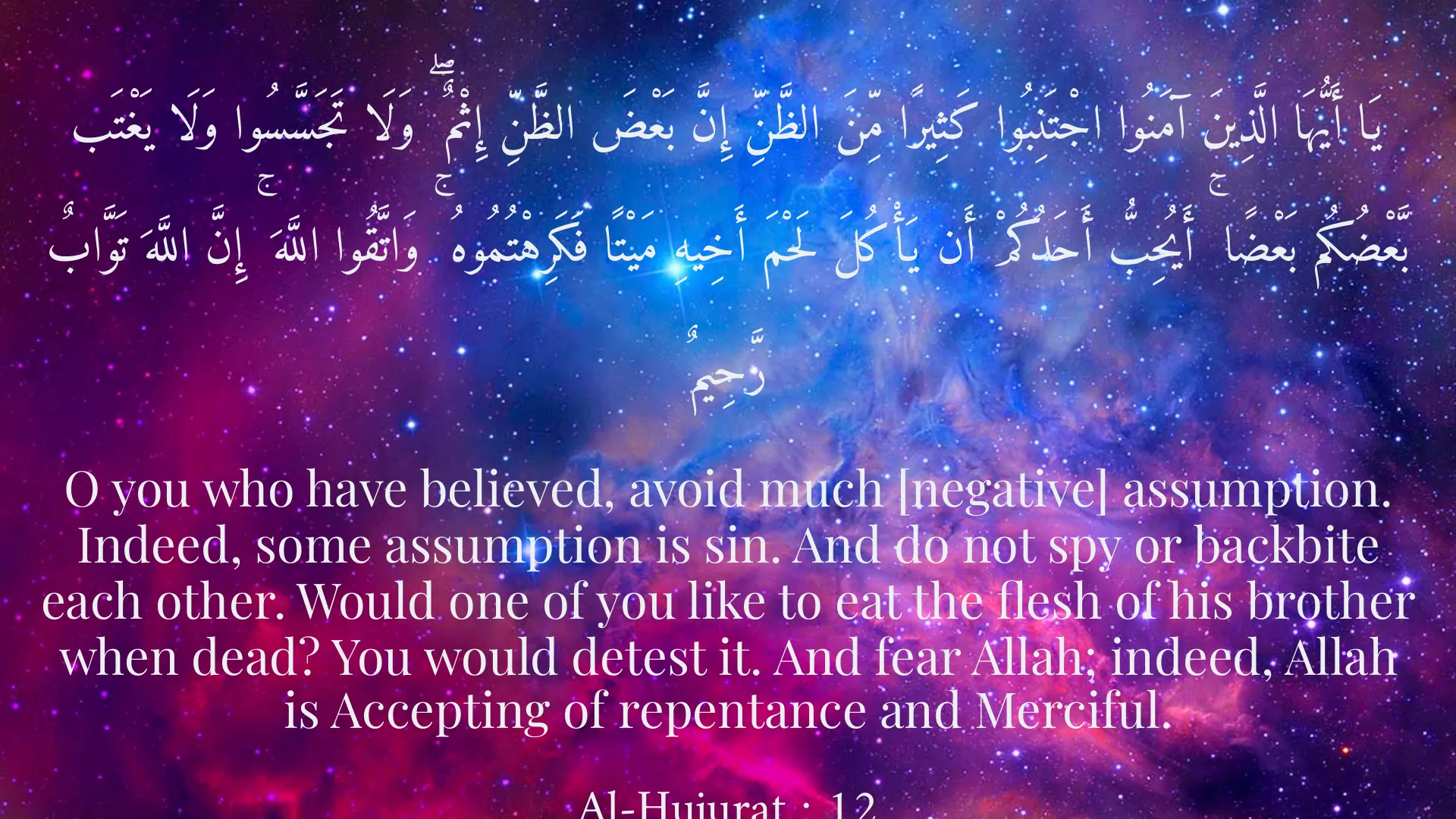
يَا أَيُّهَا الَّذِينَ آمَنُوا اجْتَنِبُوا كَثِيرًا مِّنَ الظَّنِّ إِنَّ بَعْضَ الظَّنِّ إِثْمٌ ۖ وَلَا تَجَسَّسُوا وَلَا يَغْتَب بَّعْضُكُم بَعْضًا ۚ أَيُحِبُّ أَحَدُكُمْ أَن يَأْكُلَ لَحْمَ أَخِيهِ مَيْتًا فَكَرِهْتُمُوهُ ۚ وَاتَّقُوا اللَّهَ ۚ إِنَّ اللَّهَ تَوَّابٌ رَّحِيمٌ
O you who have believed, avoid much [negative] assumption. Indeed, some assumption is sin. And do not spy or backbite each other. Would one of you like to eat the flesh of his brother when dead? You would detest it. And fear Allah; indeed, Allah is Accepting of repentance and Merciful.
Al-Hujurat : 12
يَا أَيُّهَا الَّذِينَ آمَنُوا لَا يَسْخَرْ قَوْمٌ مِّن قَوْمٍ عَسَىٰ أَن يَكُونُوا خَيْرًا مِّنْهُمْ وَلَا نِسَاءٌ مِّن نِّسَاءٍ عَسَىٰ أَن يَكُنَّ خَيْرًا مِّنْهُنَّ ۖ وَلَا تَلْمِزُوا أَنفُسَكُمْ وَلَا تَنَابَزُوا بِالْأَلْقَابِ ۖ بِئْسَ الِاسْمُ الْفُسُوقُ بَعْدَ الْإِيمَانِ ۚ وَمَن لَّمْ يَتُبْ فَأُولَٰئِكَ هُمُ الظَّالِمُونَ
O you who have believed, let not a people ridicule [another] people; perhaps they may be better than them; nor let women ridicule [other] women; perhaps they may be better than them. And do not insult one another and do not call each other by [offensive] nicknames. Wretched is the name [of] disobedience after [one's] faith. And whoever does not repent - then it is those who are the wrongdoers.
Al-Hujurat : 11
وَلَا تَقْفُ مَا لَيْسَ لَكَ بِهِ عِلْمٌ ۚ إِنَّ السَّمْعَ وَالْبَصَرَ وَالْفُؤَادَ كُلُّ أُولَٰئِكَ كَانَ عَنْهُ مَسْئُولًا
And do not pursue that of which you have no knowledge. Indeed, the hearing, the sight and the heart - all of those will be questioned.
Al-Isra : 36
Short Story
One day, a dervish was seen sitting by a well, washing his clothes. A man passed by and asked with surprise, "O Dervish, why are you sitting here wasting your time with this task? Why don't you go to the mosque and join the congregation to benefit from its rewards?" The dervish looked up and, with a calm smile and a bright heart, replied: "My friend, I am so engrossed in my own sins and so busy finding fault with myself that I have no time to see the faults of others or to judge them. The mosque is for the virtuous, and I am still in the process of cleansing my own soiled garments. May God make me worthy of being among the righteous." This heartwarming tale from Saadi's Golestan teaches us that before we sit in judgment of others, we should strive to reform ourselves and cleanse the mirror of our own being from the dust of sins. For self-criticism is a gateway to inner peace and harmonious coexistence with others.