Quranic Answer
The age of information, characterized by an unprecedented deluge of data, instant connectivity, and the rapid dissemination of news, presents both immense opportunities for acquiring knowledge and significant challenges in the pursuit of truth. Navigating this complex landscape requires a robust framework for discernment, a framework that the Holy Quran, with its timeless wisdom, profoundly offers. Far from being a relic of the past, the Quran provides universal principles that are acutely relevant to distinguishing truth from falsehood in our contemporary information-saturated world and attaining profound, lasting truths. At the heart of the Quranic approach to truth-seeking lies the principle of Tawhid, the absolute Oneness of God. This foundational belief establishes that ultimate truth originates solely from Allah, the All-Knowing, the All-Wise. When a Muslim seeks truth, their primary orientation is towards divine guidance, acknowledging that human intellect, while valuable, is limited. The Quran repeatedly asserts, “The truth is from your Lord, so do not be among the doubters” (Surah Al-Baqarah 2:147). This sets the compass for the truth-seeker: aligning oneself with divine revelation and seeking clarity from the ultimate source of knowledge. This Tawhid is not merely a creed but a cognitive framework that teaches us to weigh everything in the light of divine will and knowledge, rather than fluctuating human opinions. Crucially, the Quran mandates critical thinking and verification, a principle encapsulated in the concepts of “Tabayyun” (investigation or verification) and “Tahqeeq” (ascertainment). In an era rife with misinformation and “fake news,” Quran 49:6 provides a direct and powerful injunction: “O you who have believed, if there comes to you a disobedient one with information, investigate, lest you harm a people out of ignorance and become, over what you have done, regretful.” This verse is a cornerstone for media literacy and information discernment in Islam. It explicitly instructs believers not to blindly accept information, especially from questionable sources, but to actively verify its authenticity before acting upon it or spreading it. This means developing a healthy skepticism, cross-referencing information, evaluating the credibility of sources, and understanding potential biases. In the digital realm, this translates to scrutinizing URLs, checking for reputable citations, and being wary of sensationalist headlines or emotionally charged content. This Quranic command forms the basis of any informed and responsible activity in the online space, warning us against the dangers of hasty judgment and inadvertently spreading falsehoods. Furthermore, the Quran strongly cautions against blind following (“Taqleed”) and basing judgments on mere conjecture (“Zann”). Surah Al-Isra 17:36 states: “And do not pursue that of which you have no knowledge. Indeed, the hearing, the sight and the heart - all of them will be questioned.” This verse emphasizes the profound responsibility of individuals for the information they consume and disseminate. It is a call to seek certain knowledge (Ilm al-Yaqin) rather than relying on speculation or hearsay. In the age of social media echo chambers, where algorithms often reinforce existing beliefs (confirmation bias), this Quranic principle is vital. It encourages believers to step outside their comfort zones, engage with diverse perspectives (while maintaining critical filters), and base their convictions on sound evidence and rational thought, rather than popular opinion or emotional appeal. This means cultivating an open yet vigilant mind, ready to examine any information, but only accepting it after verification and certainty of its truth. Beyond mere intellectual vigilance, the Quran emphasizes the indispensable role of piety (Taqwa) in attaining truth. Surah Al-Anfal 8:29 states: “O you who have believed, if you fear Allah, He will grant you a criterion (Furqan) to distinguish [right from wrong].” “Furqan” refers to a special faculty of discernment, an inner light that enables one to differentiate between truth and falsehood, right and wrong. This spiritual insight is not achieved merely by intellectual acumen but by cultivating a deep consciousness of God, fearing His displeasure, and striving to live righteously. Taqwa purifies the heart and mind, removing veils of ego, prejudice, and worldly attachments that can distort one’s perception of truth. A heart attuned to God is less susceptible to manipulation and more capable of recognizing subtle nuances of truth that intellectual analysis alone might miss. This inner discernment is a powerful tool for filtering misleading information and accessing the core of truth. The Quran also encourages seeking knowledge and reflecting on the signs of Allah in the universe and within oneself. Verses like those in Surah Al-Imran 3:190-191, which speak of those who remember Allah standing, sitting, and lying on their sides and reflect on the creation of the heavens and the earth, highlight the importance of contemplation. This reflective process, combined with active learning, is crucial for building a comprehensive understanding of reality. In the information age, it means utilizing vast accessible knowledge resources responsibly and integrating them with a spiritual perspective. This approach helps us to see information not merely as raw data, but as signs of divine power and wisdom. Finally, the Quran stresses patience (Sabr) and steadfastness (Thabat) in the pursuit of truth. The path to true understanding is rarely instant or straightforward, especially when navigating complex and often contradictory information. It requires perseverance, humility, and a willingness to revise one's understanding when confronted with stronger evidence. Prayer and seeking divine guidance, such as through Istikhara (prayer for guidance), also play a critical role in illuminating the path when faced with choices or ambiguities. Patience here means not rushing to conclusions and enduring the difficulties of the investigative path. In conclusion, the Quran offers a holistic and practical methodology for reaching truth in the information age. It begins with grounding oneself in the ultimate truth of Tawhid, cultivating critical thinking and verification skills (“Tabayyun”), consciously avoiding blind acceptance and mere speculation (“Zann”), and most importantly, nurturing piety (“Taqwa”) to develop an inner discernment (“Furqan”). Coupled with continuous learning, reflection, and patience, these Quranic principles empower individuals to navigate the digital labyrinth, distinguish fact from fiction, and ultimately arrive at a profound and enduring understanding of reality, guided by divine wisdom. This divine guide is a light in the darkness of informational ambiguity, leading the believer towards the pure spring of truth.
Related Verses
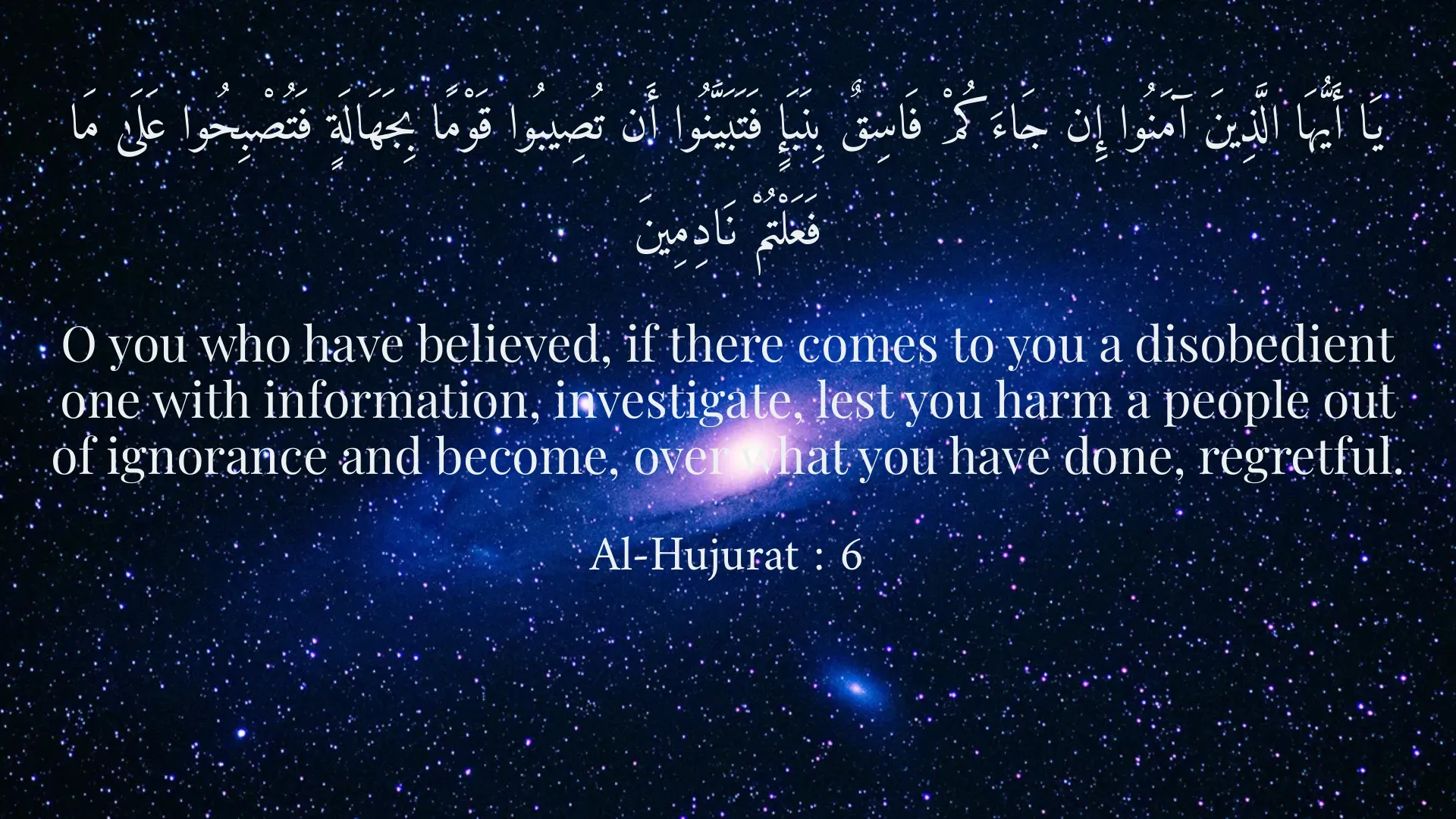
يَا أَيُّهَا الَّذِينَ آمَنُوا إِن جَاءَكُمْ فَاسِقٌ بِنَبَإٍ فَتَبَيَّنُوا أَن تُصِيبُوا قَوْمًا بِجَهَالَةٍ فَتُصْبِحُوا عَلَىٰ مَا فَعَلْتُمْ نَادِمِينَ
O you who have believed, if there comes to you a disobedient one with information, investigate, lest you harm a people out of ignorance and become, over what you have done, regretful.
Al-Hujurat : 6
وَلَا تَقْفُ مَا لَيْسَ لَكَ بِهِ عِلْمٌ ۚ إِنَّ السَّمْعَ وَالْبَصَرَ وَالْفُؤَادَ كُلُّ أُولَٰئِكَ كَانَ عَنْهُ مَسْئُولًا
And do not pursue that of which you have no knowledge. Indeed, the hearing, the sight and the heart - all of them will be questioned.
Al-Isra : 36
يَا أَيُّهَا الَّذِينَ آمَنُوا إِن تَتَّقُوا اللَّهَ يَجْعَل لَّكُمْ فُرْقَانًا وَيُكَفِّرْ عَنكُمْ سَيِّئَاتِكُمْ وَيَغْفِرْ لَكُمْ ۗ وَاللَّهُ ذُو الْفَضْلِ الْعَظِيمِ
O you who have believed, if you fear Allah, He will grant you a criterion (Furqan) to distinguish [right from wrong] and remove from you your evil deeds and forgive you; and Allah is the possessor of great bounty.
Al-Anfal : 29
Short Story
It is narrated that in a certain time, a renowned merchant, who had benefited greatly from wisdom and experience, was on a journey. In a city, he met a caravan and inquired about the city he intended to enter. One of the caravan members, with great enthusiasm, spoke ill of the city's ruler, calling him unjust and unfair. The merchant listened carefully, but said to himself, “A wise man does not judge based on a single word; perhaps the spreading of words is for a specific purpose.” When he arrived in the city, through investigation and observation, he realized that the ruler was a just and wise man, and that those words originated from the malice and envy of one of his enemies. The merchant, with a smile of understanding, said: “Truly, the wise is not he who believes every rumor, but he who, with a discerning eye and a vigilant mind, distinguishes truth from falsehood.”