Quranic Answer
In today's rapidly advancing world, where Artificial Intelligence (AI) is swiftly integrating into almost every aspect of our lives, the question arises: how can we manage and guide this powerful technology according to divine principles and values? Although the Holy Quran does not directly mention artificial intelligence, it is replete with ethical principles, values, and guidelines that can provide a comprehensive framework for our interaction with this novel phenomenon. These guidelines help us to utilize AI not merely as a tool for material progress, but as a means to achieve elevated human and divine objectives. One of the most crucial principles emphasized by the Quran is human accountability and stewardship (Khilafah). God has appointed humanity as His vicegerent and successor on Earth. This position places a heavy responsibility on humans, encompassing the cultivation of the Earth, upholding justice, and making proper use of blessings and capabilities. AI, as one of humanity's most advanced intellectual achievements, falls under this responsibility. Developers and users of AI must always bear in mind that their actions, both in designing and deploying AI, carry worldly and otherworldly accountability. Does the AI we build contribute to justice or foster discrimination? Does it lead to the welfare of society or pave the way for corruption? These are questions rooted in the Quranic concept of accountability. Surah Al-Baqarah, verse 30 explicitly refers to humanity's role as a vicegerent: "And [mention, O Muhammad], when your Lord said to the angels, 'Indeed, I will make upon the earth a successive authority...'" This verse forms the foundation for a responsible approach to any human achievement, including artificial intelligence. Secondly, the principle of justice and avoidance of oppression. The Holy Quran repeatedly emphasizes the establishment of justice and equity and severely condemns oppression. In interacting with AI, this principle gains paramount importance. AI algorithms must be designed to act justly and be free from any racial, gender, economic, or social discrimination. Using biased data or designing a system that benefits a specific group is an instance of oppression and corruption on Earth, which the Quran forbids. Verse 8 of Surah Al-Ma'idah states: "O you who have believed, be persistently [upholders of justice], witnesses for Allah, even if it be against yourselves or parents and relatives. Whether one is rich or poor, Allah is more worthy of both. So follow not [personal] inclination, lest you deviate. And if you distort [your testimony] or refuse [to give it], then indeed Allah is ever, with what you do, Acquainted." This verse clearly calls us to establish justice, even towards opponents, which extends to AI systems. Third, beneficence and serving humanity. The primary goal of any human endeavor, from a Quranic perspective, should be to bring good and benefit to people. AI should serve humanity and address problems such as disease, poverty, education, and environmental issues. This technology must not become a tool for extensive surveillance, societal control, or the creation of psychological and social harms. Any application of AI that harms human physical or mental well-being, or human dignity, contradicts this Quranic principle. In Surah Ar-Rahman, several verses refer to divine blessings and the importance of utilizing them for good and welfare, which can be extended to the proper use of technology. The Quran invites humans to goodness and righteous deeds, and certainly, using AI for the good and welfare of people would be an example of such righteous deeds. Fourth, observing divine limits and avoiding extremism or negligence. The Quran constantly invites humanity to observe limits and moderation in all matters. This principle must be considered in the development and use of AI. For example, AI should not be worshipped to the extent of giving it absolute power, leading it to go beyond human control or undermine the exalted status of humans as beings with free will and intellect. On the other hand, its unique positive potentials should not be ignored. Finding a balance between optimal use and not crossing ethical and human red lines is a key point emphasized by the Quran. Verse 77 of Surah Al-Qasas states: "But seek, through that which Allah has given you, the home of the Hereafter; and [yet], do not forget your share of the world. And do good as Allah has done good to you. And desire not corruption in the land. Indeed, Allah does not like corrupters." This verse guides us towards moderation in utilizing worldly blessings and avoiding corruption on Earth, which also applies to the use of AI. Finally, attention to knowledge and insight (Ilm and Hikmah). The Quran repeatedly emphasizes the importance of knowledge, reflection, and intellect. AI itself is a product of human knowledge. The Quran encourages us to seek knowledge and use it to understand the world and improve life, but it always reminds us that true knowledge must be accompanied by faith and wisdom. Knowledge without ethics and spirituality can lead to ruin. Therefore, the development of AI must be accompanied by a deep insight into its consequences, and AI scientists and engineers, alongside their technical expertise, must possess a deep ethical and spiritual understanding. Numerous verses, such as Surah Az-Zumar, verse 9: "Are those who know equal to those who do not know?" and Surah Fatir, verse 28: "Only those fear Allah, from among His servants, who have knowledge," emphasize the importance of knowledge, but knowledge that leads to the fear of Allah and piety. In summary, the Holy Quran, by emphasizing human accountability, the necessity of establishing justice, benefiting creation, observing moderation, and the importance of knowledge coupled with ethics, provides a stable and divine framework for our interaction with AI. These guidelines help us to transform AI into a tool for building a better, fairer, and more humane world, utilizing it for human perfection and prosperity, not for corruption and destruction. This Quranic approach guarantees that this technology will be used to enhance humanity's standing and draw closer to divine goals.
Related Verses
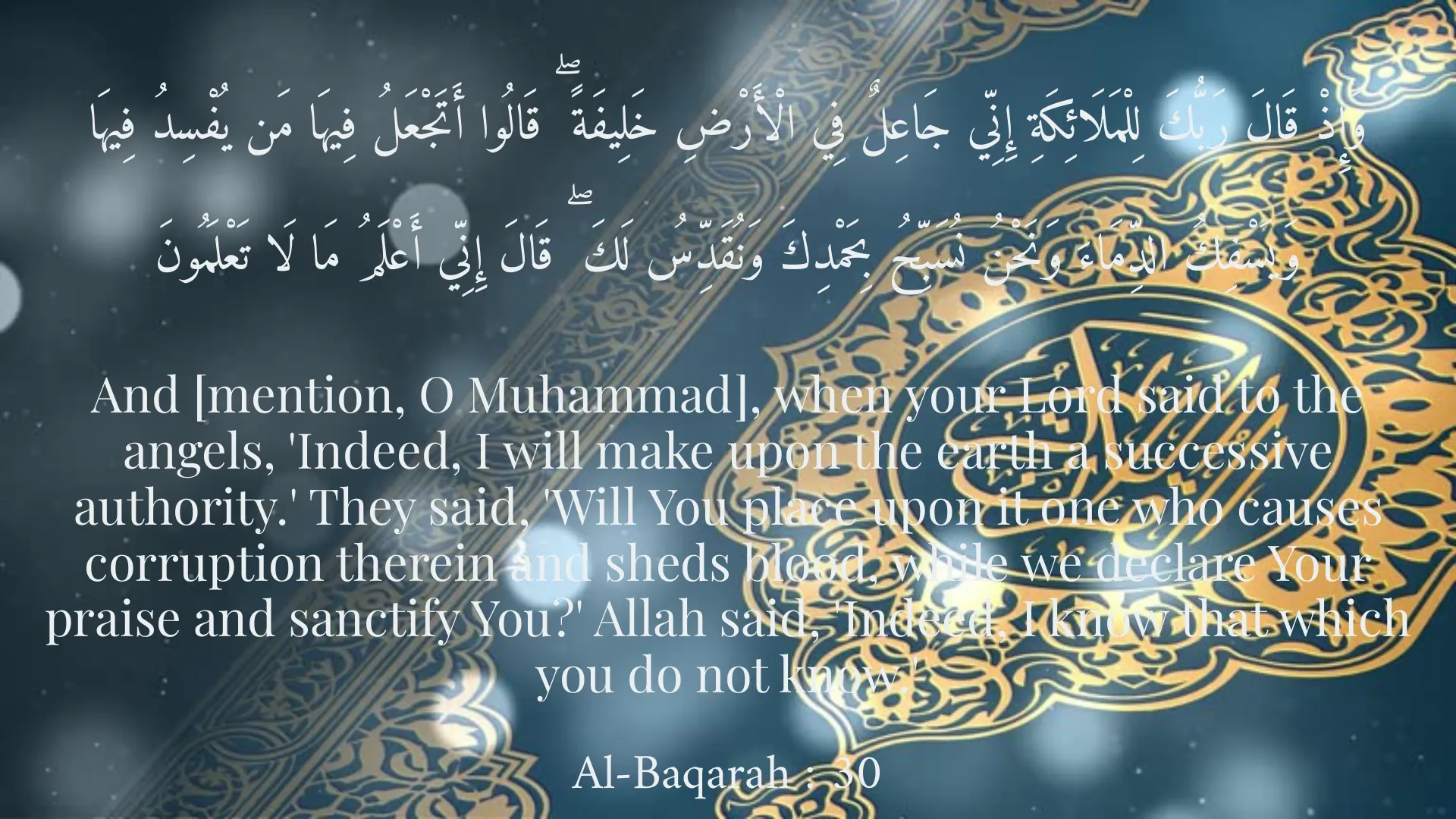
وَإِذْ قَالَ رَبُّكَ لِلْمَلَائِكَةِ إِنِّي جَاعِلٌ فِي الْأَرْضِ خَلِيفَةً ۖ قَالُوا أَتَجْعَلُ فِيهَا مَن يُفْسِدُ فِيهَا وَيَسْفِكُ الدِّمَاءَ وَنَحْنُ نُسَبِّحُ بِحَمْدِكَ وَنُقَدِّسُ لَكَ ۖ قَالَ إِنِّي أَعْلَمُ مَا لَا تَعْلَمُونَ
And [mention, O Muhammad], when your Lord said to the angels, 'Indeed, I will make upon the earth a successive authority.' They said, 'Will You place upon it one who causes corruption therein and sheds blood, while we declare Your praise and sanctify You?' Allah said, 'Indeed, I know that which you do not know.'
Al-Baqarah : 30
يَا أَيُّهَا الَّذِينَ آمَنُوا كُونُوا قَوَّامِينَ لِلَّهِ شُهَدَاءَ بِالْقِسْطِ ۖ وَلَا يَجْرِمَنَّكُمْ شَنَآنُ قَوْمٍ عَلَىٰ أَلَّا تَعْدِلُوا ۚ اعْدِلُوا هُوَ أَقْرَبُ لِلتَّقْوَىٰ ۖ وَاتَّقُوا اللَّهَ ۚ إِنَّ اللَّهَ خَبِيرٌ بِمَا تَعْمَلُونَ
O you who have believed, be persistently [upholders of justice], witnesses for Allah, even if it be against yourselves or parents and relatives. Whether one is rich or poor, Allah is more worthy of both. So follow not [personal] inclination, lest you deviate. And if you distort [your testimony] or refuse [to give it], then indeed Allah is ever, with what you do, Acquainted.
Al-Ma'idah : 8
وَابْتَغِ فِيمَا آتَاكَ اللَّهُ الدَّارَ الْآخِرَةَ وَلَا تَنسَ نَصِيبَكَ مِنَ الدُّنْيَا ۖ وَأَحْسِن كَمَا أَحْسَنَ اللَّهُ إِلَيْكَ ۖ وَلَا تَبْغِ الْفَسَادَ فِي الْأَرْضِ ۖ إِنَّ اللَّهَ لَا يُحِبُّ الْمُفْسِدِينَ
But seek, through that which Allah has given you, the home of the Hereafter; and [yet], do not forget your share of the world. And do good as Allah has done good to you. And desire not corruption in the land. Indeed, Allah does not like corrupters.
Al-Qasas : 77
أَمَّنْ هُوَ قَانِتٌ آنَاءَ اللَّيْلِ سَاجِدًا وَقَائِمًا يَحْذَرُ الْآخِرَةَ وَيَرْجُو رَحْمَةَ رَبِّهِ ۗ قُلْ هَلْ يَسْتَوِي الَّذِينَ يَعْلَمُونَ وَالَّذِينَ لَا يَعْلَمُونَ ۗ إِنَّمَا يَتَذَكَّرُ أُولُو الْأَلْبَابِ
Is one who is devoutly obedient during periods of the night, prostrating and standing [in prayer], fearing the Hereafter and hoping for the mercy of his Lord, [like one who is not]? Say, 'Are those who know equal to those who do not know?' Only those of understanding will remember.
Az-Zumar : 9
Short Story
In Saadi's Gulistan, it is narrated that a king commissioned a master architect to build an unparalleled palace. The architect, with utmost skill and precision, constructed a building that astonished every beholder. However, the king did not reward him, saying: "I see that your edifice is perfect, but look closely whether its foundations are built on justice and good intention or not. Were the materials acquired lawfully, and were the laborers paid fairly?" The architect lowered his head in shame, for in his haste to build the magnificent structure, he had overlooked some of these points. The king declared: "Any knowledge that is not put into practice, and any art that is not used for the good and welfare of people, is not only worthless but may also be harmful." This story reminds us that even at the peak of technological advancements like AI, true value lies in building it upon foundations of ethics, justice, and beneficence; otherwise, instead of leading to prosperity, it might lead to corruption and ruin.