Quranic Answer
The Holy Quran, as a divine revelation and a comprehensive guide for life, provides invaluable guidance not only for spiritual and devotional matters but also for all aspects of human existence, including economic and financial affairs. In today's world, where financial and investment complexities are constantly increasing, Quranic principles can serve as a compass, helping investors make ethical and responsible decisions. Ethical investment in Islam goes beyond mere profit-seeking; it is built upon the foundations of justice, benevolence, avoidance of oppression, and social responsibility. This approach helps investors achieve spiritual peace and divine reward in addition to material gain, and contribute to building a just and sustainable society. One of the most central Quranic directives concerning economics and investment is the prohibition of Riba (interest). The Quran explicitly forbids usury and equates it with waging war against Allah and His Messenger. In Surah Al-Baqarah, verse 275, it states: “Those who consume interest will not stand [on the Day of Resurrection] except as one stands who is being beaten by Satan into insanity. That is because they say, 'Trade is [just] like interest.' But Allah has permitted trade and forbidden interest.” This verse clearly distinguishes between lawful trade and unlawful interest. Riba, by generating wealth without real productive effort or risk-taking, leads to the unjust accumulation of wealth, deprives the needy, and concentrates wealth in the hands of a few. Therefore, ethical investors, inspired by the Quran, avoid any interest-based investment activities, such as usurious bonds, interest-bearing bank deposits, and interest-based loans. Instead, they turn towards investments based on profit-sharing (like Mudarabah and Musharakah) and genuine trade of goods and services, as these activities contribute to healthy and sustainable economic growth. Secondly, the Quran emphasizes avoiding investment in unlawful (Haram) industries and activities. The Quran encourages believers to cooperate in righteousness and piety and forbids cooperation in sin and aggression. In Surah Al-Ma'idah, verse 2, it states: “And cooperate in righteousness and piety, but do not cooperate in sin and aggression.” Based on this principle, a Muslim investor should not invest in companies whose activities contradict Islamic teachings, such as the production and distribution of alcohol, pork, gambling, pornography, conventional finance (due to riba), weapons for unjust wars, and any business that harms society or violates ethical principles. This necessitates thorough due diligence and transparency in selecting companies and sectors to ensure that capital is employed for the good and welfare of society. Thirdly, a crucial principle is justice, fairness, and transparency in transactions. The Quran heavily emphasizes the necessity of upholding justice in all human relations, including financial dealings. In Surah An-Nisa, verse 29, it says: “O you who have believed, do not consume one another's wealth unjustly but only [in lawful] business by mutual consent.” This verse underscores earning wealth through legitimate means and with the mutual consent of all parties involved. It prohibits any income derived from fraud, deception, bribery, hoarding, or transactions involving excessive uncertainty (Gharar) or speculation (Maysir), which are forbidden in Islamic jurisprudence. Quranic ethical investment means choosing opportunities that offer full transparency, are based on accurate information, and are free from any ambiguity or deceit. This helps protect the rights of all stakeholders and fosters a climate of trust in the market. Fourthly, the Quran highlights social responsibility and the role of wealth in societal development. The Quran views wealth as a trust (amanah) from God that should be spent in His way and for the benefit of His creation. The emphasis on charity (Infaq), Zakat, and Sadaqah reflects the view that wealth should not be concentrated in the hands of a few but should circulate, reach the needy, and be used for public welfare projects. In Surah Al-Baqarah, verse 277, Allah states: “Indeed, those who believe and do righteous deeds and establish prayer and give zakah will have their reward with their Lord, and there will be no fear concerning them, nor will they grieve.” These verses not only emphasize the obligatory payment of Zakat but also encourage investors to invest in areas that lead to the betterment of people's lives, job creation, sustainable development, and environmental protection. This can include investments in education, healthcare, renewable energy, sustainable agriculture, and infrastructure that benefits the general public. Finally, the Quran offers a comprehensive and balanced perspective on this world and the hereafter, encouraging investors to adopt a long-term outlook and responsibility towards resources. Worldly wealth and blessings are considered a trust in human hands, to be used wisely and responsibly, avoiding extravagance and waste. A Muslim investor, understanding this, does not merely focus on short-term gains but also considers the long-term consequences of their investments on society, the environment, and future generations. This approach signifies sustainable investment, which simultaneously creates economic value while preserving and strengthening social and environmental values. Therefore, the Quran provides a moral, comprehensive, and holistic framework for investment decisions that transcends individual interests, seeking the welfare of the entire society and human prosperity, thus providing a path for earning lawful and blessed sustenance.
Related Verses
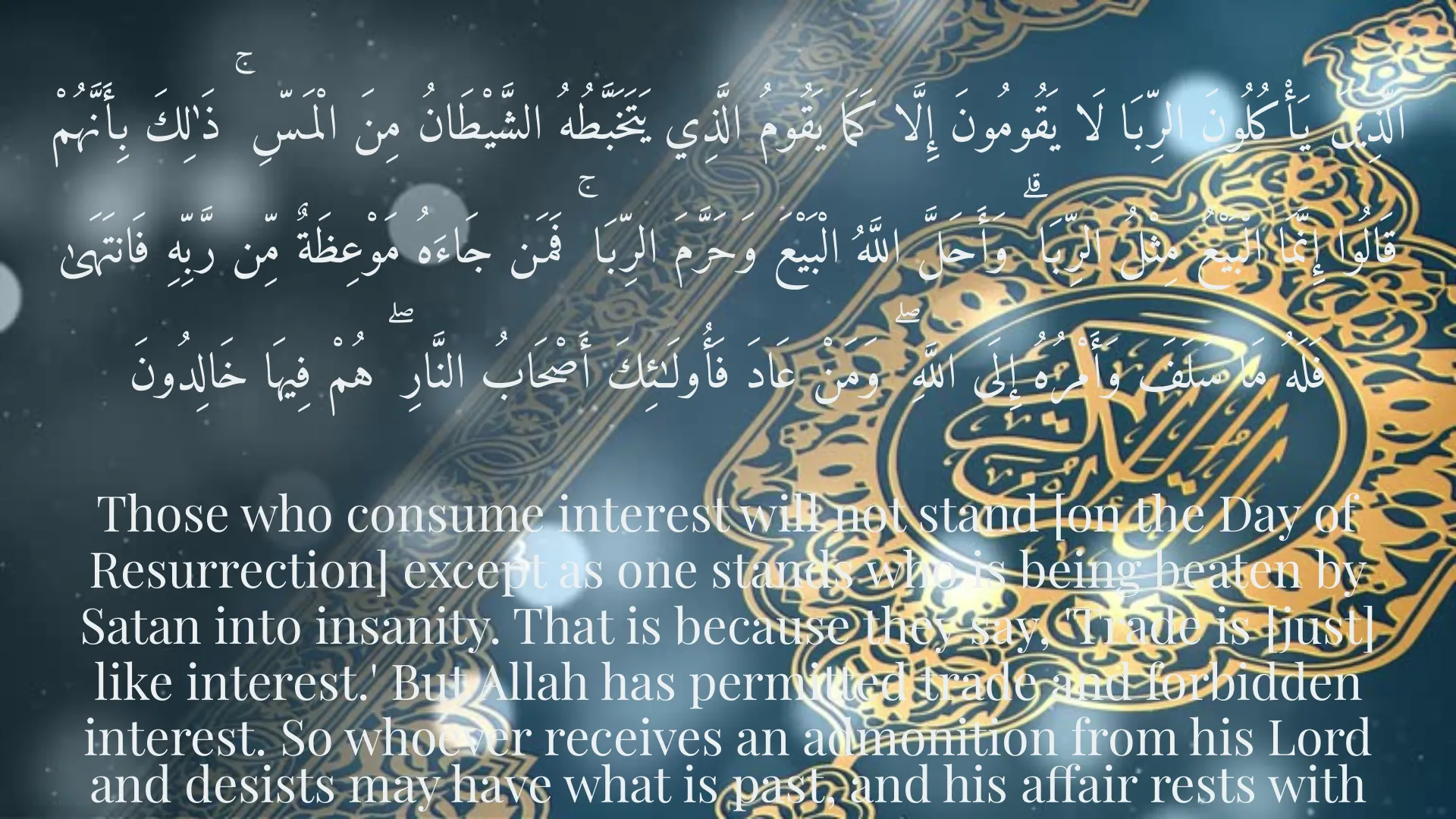
الَّذِينَ يَأْكُلُونَ الرِّبَا لَا يَقُومُونَ إِلَّا كَمَا يَقُومُ الَّذِي يَتَخَبَّطُهُ الشَّيْطَانُ مِنَ الْمَسِّ ۚ ذَٰلِكَ بِأَنَّهُمْ قَالُوا إِنَّمَا الْبَيْعُ مِثْلُ الرِّبَا ۗ وَأَحَلَّ اللَّهُ الْبَيْعَ وَحَرَّمَ الرِّبَا ۚ فَمَن جَاءَهُ مَوْعِظَةٌ مِّن رَّبِّهِ فَانتَهَىٰ فَلَهُ مَا سَلَفَ وَأَمْرُهُ إِلَى اللَّهِ ۖ وَمَنْ عَادَ فَأُولَٰئِكَ أَصْحَابُ النَّارِ ۖ هُمْ فِيهَا خَالِدُونَ
Those who consume interest will not stand [on the Day of Resurrection] except as one stands who is being beaten by Satan into insanity. That is because they say, 'Trade is [just] like interest.' But Allah has permitted trade and forbidden interest. So whoever receives an admonition from his Lord and desists may have what is past, and his affair rests with Allah. But whoever returns [to dealing in interest] - those are the companions of the Fire; they will abide eternally therein.
Al-Baqarah : 275
يَا أَيُّهَا الَّذِينَ آمَنُوا لَا تَأْكُلُوا أَمْوَالَكُم بَيْنَكُم بِالْبَاطِلِ إِلَّا أَن تَكُونَ تِجَارَةً عَن تَرَاضٍ مِّنكُمْ ۚ وَلَا تَقْتُلُوا أَنفُسَكُمْ ۚ إِنَّ اللَّهَ كَانَ بِكُمْ رَحِيمًا
O you who have believed, do not consume one another's wealth unjustly but only [in lawful] business by mutual consent. And do not kill yourselves. Indeed, Allah is ever Merciful to you.
An-Nisa : 29
يَا أَيُّهَا الَّذِينَ آمَنُوا لَا تُحِلُّوا شَعَائِرَ اللَّهِ وَلَا الشَّهْرَ الْحَرَامَ وَلَا الْهَدْيَ وَلَا الْقَلَائِدَ وَلَا آمِّينَ الْبَيْتَ الْحَرَامَ يَبْتَغُونَ فَضْلًا مِّن رَّبِّهِمْ وَرِضْوَانًا ۚ وَإِذَا حَلَلْتُمْ فَاصْطَادُوا ۚ وَلَا يَجْرِمَنَّكُمْ شَنَآنُ قَوْمٍ أَن صَدُّوكُمْ عَنِ الْمَسْجِدِ الْحَرَامِ أَن تَعْتَدُوا ۘ وَتَعَاوَنُوا عَلَى الْبِرِّ وَالتَّقْوَىٰ ۖ وَلَا تَعَاوَنُوا عَلَى الْإِثْمِ وَالْعُدْوَانِ ۚ وَاتَّقُوا اللَّهَ ۖ إِنَّ اللَّهَ شَدِيدُ الْعِقَابِ
O you who have believed, do not violate the sanctity of the symbols of Allah nor of the sacred month nor of the [sacrificial] animals [marked for sacrifice] nor the garlands [indicating their dedication] nor those intending [to visit] the Sacred House seeking bounty from their Lord and [His] approval. But when you come out of ihram, then [you may] hunt. And do not let the hatred of a people for having obstructed you from the Sacred Mosque lead you to transgress. And cooperate in righteousness and piety, but do not cooperate in sin and aggression. And fear Allah; indeed, Allah is severe in penalty.
Al-Ma'idah : 2
Short Story
In the era when Sa'di of Shiraz planted wisdom in his Gulistan, there were two renowned merchants in the city of Shiraz. One was named Hakeem (the Wise), who, despite his vast wealth, always adhered to principles of fairness and ethics. He began every transaction with honesty and considered not only his own profit but also the well-being of his customers and employees. He invested his wealth in ventures that benefited society, such as aiding farmers or constructing public water reservoirs. The other merchant, named Ghafil (the Heedless), thought only of accumulating wealth and spared no trick or dishonesty in pursuit of profit. Ghafil’s wealth grew daily, but whoever dealt with him experienced nothing but dissatisfaction and distrust. One day, the market suffered a recession, and many merchants fell into distress. Hakeem, who always thought of the people, rushed to their aid, using his capital to support his employees and the community. Ghafil, however, thought only of preserving his own wealth at this time, even trampling on the rights of those who worked for him. After a while, prosperity returned to the market. But this time, people flocked only to Hakeem, for they knew that dealing with him brought peace and blessing. Ghafil, despite his wealth, had lost his honor and credibility; no one would deal with him, and eventually, his wealth became worthless, and he was left alone. Sa'di said: 'Whatever wealth and fortune there may be, one day it shall perish, but a good name and good deeds remain forever.'