Quranic Answer
How do we feel that our prayers are heard? This is a profound question that resides in the hearts of many believers, often prompting moments of introspection and spiritual yearning. Sometimes, after making a heartfelt supplication, one might feel that their prayer has not reached anywhere, left adrift in an empty void, or that their pleas have simply echoed without response. However, the Holy Quran, the divine guiding scripture, provides unequivocal assurance that Allah Almighty is always listening to our prayers and is ever close to His servants. The feeling of a prayer being heard is more an internal sensation and a deep, heartfelt connection with the Lord than an external, immediately verifiable event. It fundamentally stems from faith (Iman), certainty (Yaqeen), and a correct, nuanced understanding of Quranic concepts regarding divine interaction and response. The Quran unequivocally promises to hear and respond to the supplications of His servants, setting a clear foundation for our belief in the efficacy of prayer. In Surah Al-Baqarah, verse 186, Allah declares: “And when My servants ask you, [O Muhammad], concerning Me - indeed I am near. I respond to the invocation of the supplicant when he calls upon Me. So let them respond to Me [by obedience] and believe in Me that they may be [rightly] guided.” This verse itself serves as a direct divine guarantee, a profound testament to Allah’s immediate accessibility. Allah introduces Himself as “near,” emphasizing His proximity and readiness to listen, and states explicitly that He responds to the invocation of every supplicant when they call upon Him. The powerful phrase “أُجِيبُ دَعْوَةَ الدَّاعِ إِذَا دَعَانِ” (I respond to the invocation of the supplicant when he calls upon Me) acts as an inherent seal of affirmation, ensuring us that our prayers are never futile or unheard. They reach the Divine Presence as soon as they are uttered, or even when they are merely contemplated in the heart, and are indeed heard. This profound sense of divine proximity and responsiveness forms the very first step in feeling that one's prayer has been heard. So, why do we sometimes feel that our prayers have not been answered in the way we expected? This perception often arises because our understanding of 'response' needs to be deepened and broadened beyond immediate material fulfillment. Allah is All-Wise (Al-Hakeem) and All-Knowing (Al-Aleem); He knows what is truly best for us and precisely when it is best, even if we are unaware of the bigger picture. Therefore, the answer to a prayer can manifest in various profound and beneficial forms, each a clear sign of divine attention and grace: 1. Direct Fulfillment of the Request: This is when the very thing we asked for is granted to us. This is undoubtedly the most straightforward and tangible form of an answer, immediately strengthening our feeling of being heard. 2. Substitution with a Greater Good: Allah may grant us something inherently better and more beneficial than what we initially sought. For instance, we might pray for immense worldly wealth, and instead, He bestows upon us robust health, profound inner peace, or insightful wisdom, which are often far more valuable and enduring than fleeting material possessions. This form of answer requires reflection and a deeper understanding of divine wisdom. 3. Aversion of Harm or Calamity: Sometimes, our fervent prayer acts as a protective shield, subtly warding off a disaster, misfortune, or harm that was destined to befall us. We may remain entirely unaware of this averted misfortune, yet through our earnest supplication, Allah has safeguarded us from potential peril. This divine protection can manifest in various aspects of our material or spiritual lives, preventing significant suffering. 4. Storage for the Hereafter: It is possible that the answer to a prayer is not realized in this worldly life, but Allah, in His boundless generosity, reserves its full reward for our Hereafter. This is indeed a supreme divine favor, as the reward in the Hereafter is eternal, everlasting, and incomparable to any worldly gain. This type of divine response necessitates strong faith and a long-term perspective. 5. Inner Peace and Submission: At times, the most profound answer is an immediate and deep sense of tranquility that descends upon us after prayer. This feeling of heartfelt assurance and serene submission to the Divine Will itself signifies that the prayer has been heard and answered. This inner peace indicates that the heavy burden of worry and anxiety has been lifted from our shoulders and entrusted entirely to the Lord. This spiritual calm often provides the very solace many seekers are looking for. To further cultivate the feeling that our prayers are heard, we must actively focus on enhancing the quality of our supplications and purifying our inner spiritual state. As stated in Surah Ghafir, verse 60: “And your Lord says, 'Call upon Me; I will respond to you.' Indeed, those who disdain My worship will enter Hell [rendered] contemptible.” This verse not only reiterates the promise of response but also emphasizes humility and sincere devotion in prayer. * Certainty and Trust in Allah (Yaqeen and Tawakkul): We must believe with absolute conviction that Allah hears our prayers and is capable of anything and everything. Doubt and skepticism can inadvertently create a barrier between us and the divine response. A Hadith Qudsi beautifully conveys this: “I am as My servant thinks of Me, so let him think of Me as he wishes.” This unwavering belief is crucial. * Sincerity of Intention (Ikhlas): Prayer must be offered with pure and sincere intentions, solely for the pleasure and recognition of Allah. When we pray, our primary aim should not merely be to acquire worldly benefits, but fundamentally to strengthen our intimate connection with the Creator and to express our gratitude and reliance upon Him. * Humility and Supplication (Tadarru' and Khushu'): Prayer should be accompanied by profound humility, earnest pleading, and a sense of awe and submissiveness before the grandeur of Allah. A broken heart and eyes moist with tears often form a stronger, more direct bridge to divine acceptance. Verse 55 of Surah Al-A'raf instructs: “Call upon your Lord in humility and in private. Indeed, He does not like transgressors.” This humble spiritual state fosters a deep sense of connection. * Lawful Earnings and Sustenance (Halal Rizq): Ensuring that one's earnings and sustenance are lawful (halal) has a direct and significant impact on the acceptance of prayers. The Prophet Muhammad (peace be upon him) reportedly said: “The prayer of one who eats unlawful morsels is not accepted.” Purity in one's daily life thus paves the way for prayers to be heard. * Perseverance and Consistency: One should never grow weary, despair, or give up on praying, even if immediate results are not apparent. Sometimes, the answer to a prayer requires patience, persistence, and waiting for the opportune moment. Many prophets and righteous individuals persevered in their supplications for years before their desires were fulfilled. Imam Ali (peace be upon him) advised: “Do not reject supplication, for supplication is a treasure from the treasures of Allah’s mercy.” This steadfastness itself reinforces the feeling of divine presence. * Gratitude (Shukr): Whether our prayer is answered exactly as we wished or in another form, cultivating an attitude of gratitude for all blessings and consciously acknowledging divine responses—even subtle ones—signifies a deeper understanding and strengthens the feeling that our prayers are heard. Gratitude truly opens more doors to divine mercy and understanding. Ultimately, the feeling of prayers being heard is a transformative spiritual journey during which our faith in Allah grows progressively stronger, and our personal connection with Him deepens profoundly. When we turn to Allah with a trusting heart and a truthful tongue, this very act of turning is itself a powerful sign of His continuous presence and closeness. The comforting realization that we are never alone, and that there is always an All-Hearing and All-Responding Lord beside us, brings the greatest and most enduring tranquility. Therefore, let us always pray with unwavering certainty and boundless hope, for Allah is indeed always listening and always responding, even if His answer comes in forms we initially did not anticipate. The mere ability to engage in prayer is, in itself, a profound sign of divine mercy and grace, an exclusive permission granted to us to speak to Him and ask of Him. This is a beautiful, reciprocal connection: He hears, and in turn, we feel heard, and this profound feeling emanates directly from the depths of our faith, granting us unparalleled inner peace and reassurance.
Related Verses
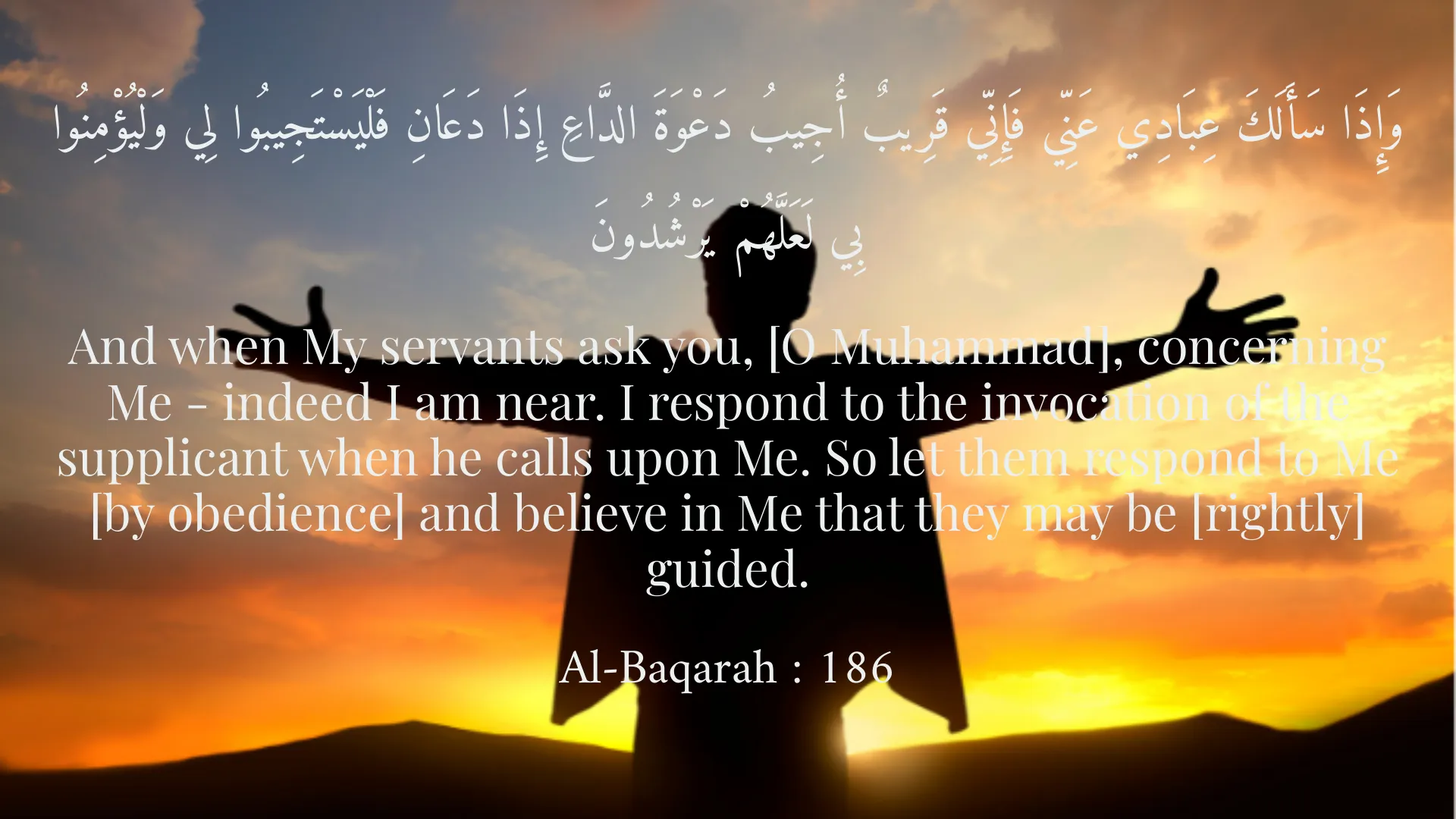
وَإِذَا سَأَلَكَ عِبَادِي عَنِّي فَإِنِّي قَرِيبٌ أُجِيبُ دَعْوَةَ الدَّاعِ إِذَا دَعَانِ فَلْيَسْتَجِيبُوا لِي وَلْيُؤْمِنُوا بِي لَعَلَّهُمْ يَرْشُدُونَ
And when My servants ask you, [O Muhammad], concerning Me - indeed I am near. I respond to the invocation of the supplicant when he calls upon Me. So let them respond to Me [by obedience] and believe in Me that they may be [rightly] guided.
Al-Baqarah : 186
وَقَالَ رَبُّكُمُ ادْعُونِي أَسْتَجِبْ لَكُمْ ۚ إِنَّ الَّذِينَ يَسْتَكْبِرُونَ عَنْ عِبَادَتِي سَيَدْخُلُونَ جَهَنَّمَ دَاخِرِينَ
And your Lord says, 'Call upon Me; I will respond to you.' Indeed, those who disdain My worship will enter Hell [rendered] contemptible.
Ghafir : 60
ادْعُوا رَبَّكُمْ تَضَرُّعًا وَخُفْيَةً ۚ إِنَّهُ لَا يُحِبُّ الْمُعْتَدِينَ
Call upon your Lord in humility and in private. Indeed, He does not like transgressors.
Al-A'raf : 55
Short Story
A dervish was sitting by a stream, complaining of his poverty to the Almighty and saying, “O God! Grant me abundant sustenance so that I may be relieved from the torment of hunger.” Years passed in this state, and poverty remained with him. Yet, amidst this, a heart full of reliance and a soul filled with certainty were bestowed upon him. One day, a disciple asked him, “O master, for years you have been praying and asking God for sustenance, why has your condition not changed?” The dervish smiled and said, “My son, God heard my prayer and granted me what was better for me. I asked for worldly provision, but He led me to richness of heart and independence from creation. Now, I fear nothing, and this inner peace is a testament that my prayer was heard and answered in the best possible way, for true wealth is the richness of character, not the abundance of possessions.” This tale illustrates that divine response sometimes occurs in a hidden and internal manner, transcending our expectations, and the feeling of peace and self-sufficiency itself is a clear sign that prayer has been heard.