Quranic Answer
The question, "How do I keep my intentions pure?", delves into one of the most profound and fundamental teachings of the Holy Quran and Islamic ethics: the concept of Ikhlas, or sincerity. Linguistically, Ikhlas means to purify or refine something, to remove impurities. In an Islamic context, it refers to purifying one's intention from any non-divine motive, performing actions solely for the pleasure and satisfaction of Allah (SWT). The Glorious Quran repeatedly emphasizes the paramount importance of Ikhlas, considering it the criterion for the acceptance of deeds in the sight of Allah. This principle is not confined to acts of worship but permeates all aspects of a believer's individual and social life. Without Ikhlas, even the greatest deeds may become worthless and fruitless, because Allah's criterion for accepting an action is the quality of the inner intention and motivation, not merely the quantity or outward appearance of the act. This point is the very essence and foundation of every spiritual and religious movement towards the Lord. Ikhlas is like a soul breathed into the body of actions, giving them life and meaning. An action performed without sincerity, even if it appears good and benevolent outwardly, is internally devoid of value and cannot provide the necessary stability and persistence for spiritual growth in the long run, because its roots do not lie in the Creator's pleasure. The purpose of life and worship is to attain proximity to Allah, and this significant goal cannot be achieved except through true Ikhlas. The Holy Quran unequivocally identifies Ikhlas as a prerequisite for true salvation and success. In Surah Al-Bayyinah, verse 5, Allah states: "And they were not commanded except to worship Allah, [being] sincerely obedient to Him, inclining to truth, and to establish prayer and to give zakah. And that is the correct religion." (وَمَا أُمِرُوا إِلَّا لِيَعْبُدُوا اللَّهَ مُخْلِصِينَ لَهُ الدِّينَ حُنَفَاءَ وَيُقِيمُوا الصَّلَاةَ وَيُؤْتُوا الزَّكَاةَ ۚ وَذَٰلِكَ دِينُ الْقَيِّمَةِ). This verse explicitly declares that the purpose of creation and divine commands is the sincere worship of Allah. The word "mukhliseen" (sincerely obedient) is key to understanding this concept. It implies worship that is free from any blemish, associating nothing with Allah in intention or deed. Furthermore, in Surah Az-Zumar, verse 2, it is mentioned: "Indeed, We sent down to you the Book for the people in truth. So worship Allah, [being] sincere to Him in religion." (إِنَّا أَنزَلْنَا إِلَيْكَ الْكِتَابَ بِالْحَقِّ فَاعْبُدِ اللَّهَ مُخْلِصًا لَّهُ الدِّينَ). This is a direct command to Prophet Muhammad (PBUH) and, consequently, to all Muslims, indicating that the foundation of religious practice is sincerity in worship and servitude. In fact, all dimensions of religiosity, from monotheism to establishing prayer and paying zakat, depend on a pure intention and exclusive attention to divine pleasure. Maintaining pure intentions in today's world, which is rife with temptations of seeking fame, showing off (Riya'), and seeking attention from others, is a continuous spiritual struggle (Jihad al-Nafs). How can we preserve this precious gem within ourselves and keep it free from impurities? The Holy Quran, through its guidance, offers practical solutions: 1. Deep Knowledge and Understanding of Allah (Ma'rifatullah): The more a person comes to know Allah – His power, His absolute knowledge, His self-sufficiency, and His boundless mercy – the weaker their non-divine motivations become. When we realize that only Allah holds ultimate power over benefit and harm, and that no one but Him can bestow or withhold anything from us, we cease to seek the approval of mere mortals. Surah Al-An'am, verse 162, beautifully articulates this: "Say, 'Indeed, my prayer, my rites of sacrifice, my living and my dying are for Allah, Lord of the worlds.'" (قُلْ إِنَّ صَلَاتِي وَنُسُكِي وَمَحْيَايَ وَمَمَاتِي لِلَّهِ رَبِّ الْعَالَمِينَ). This verse is a manifestation of complete Ikhlas in all dimensions of life, stemming from profound knowledge of the Lord of the Worlds. This knowledge is not merely intellectual; it permeates the depths of the heart, transforming into a deep conviction that influences all human actions and decisions. When Allah reigns supreme in the heart, there is no room for other motives, and a person truly surrenders to the divine will. 2. Constant Self-Accountability (Muhasabah) and Vigilance (Muraqabah): A believer must continuously scrutinize their intentions before, during, and after every action. Before an act, they should ask: "For whom am I doing this? Is my goal Allah's pleasure or people's praise?" During the act, they must ensure their initial pure intention does not waver and incline towards Riya' or showing off. After the act, they should reflect whether they felt satisfaction from human praise rather than divine pleasure. This continuous self-awareness acts as a strong shield against Riya' and subtle forms of polytheism (Shirk al-Khafi). This practice is akin to lighting a lamp in the heart that illuminates hidden darknesses, helping a person prevent falling into the trap of self-deception and ostentation. This process requires deep honesty with oneself and courage to face inner shortcomings. 3. Avoiding Ostentation and Seeking Fame (Riya' and Sum'ah): One of the greatest afflictions to Ikhlas is the desire to be seen and praised by others. The Quran and Islamic traditions strongly warn against Riya'. Even if we perform good deeds, we must be careful that our intention is not to gain human admiration, but solely Allah's pleasure. Sometimes, concealing certain good deeds can significantly strengthen Ikhlas. This does not mean avoiding public good works, but rather keeping the heart pure from the motivation of showing off even in public endeavors. The pursuit of fame and social status often contaminates intentions and strips actions of spiritual value. In contrast, one who thinks only of divine pleasure maintains a consistent intention, whether in private or public, and their actions are adorned with divine light. 4. Frequent Renewal of Intention: Throughout the day, and in carrying out various duties, it is advisable to renew our intentions. For example, when working to earn a lawful living, we should intend that this work is to support our family, avoid dependence on others, and fulfill Allah's command. Even in daily tasks like eating, sleeping, or dressing, one can transform them into acts of worship with pure intentions, e.g., by intending to strengthen the body for worship or to maintain modesty and covering. This renewal of intention adds a layer of sincerity to our actions and transforms daily life into a platform for spiritual growth. 5. Reliance upon Allah (Tawakkul): When intentions are purified, a person entrusts their actions to Allah and leaves the outcome to Him. This reliance frees them from worries about people's judgments and worldly results, bringing peace of heart. When we know that only Allah sees and rewards, concerns about what people say or think dissipate, and one performs their duties with peace of mind. This absolute trust in the Lord is the main pillar of Ikhlas and liberation from material and worldly bonds. One who relies on Allah no longer needs the approval and praise of humans, for they know that only divine approval holds true value. 6. Supplication and Seeking Allah's Help (Du'a and Isti'anah): Maintaining pure intentions is a challenging task that the soul cannot accomplish on its own, and Satan is always lurking to corrupt intentions. Therefore, we must constantly implore Allah (SWT) to purify our intentions and protect us from the evil of Riya' and self-conceit. Supplication is the weapon of the believer and a gateway to connect with the endless source of power and purity. Imploring Allah and asking for sincerity of intention is a sign of humility and an acknowledgment of one's own weakness in the face of temptations, and Allah aids those who sincerely seek His help. This continuous connection with the Creator keeps the heart free from impurities. In conclusion, Ikhlas is not a destination but a continuous journey. The human heart is constantly exposed to change and the infiltration of temptations. Therefore, one must consistently strive in self-purification and refining intentions. Keeping intentions pure helps a person remain steadfast in the face of difficulties, benefit from divine rewards, and attain true inner peace. It is an eternal investment whose fruit is closeness to Allah and inner contentment. This challenging path, though arduous, is made possible by divine grace and a person's firm will. Every step taken with a pure intention holds immeasurable value in the sight of Allah, and on the Day of Judgment, these pure intentions will make the believer's scale heavy. This path is not only for specific acts of worship but is vital for every word, every action, and every moment of silence in life. Therefore, let us examine our intentions at every moment and, with divine assistance, keep them pure for the sake of gaining the satisfaction of the Lord of the Worlds alone, knowing that this sincerity is the secret to the acceptance of deeds and the conquest of hearts.
Related Verses
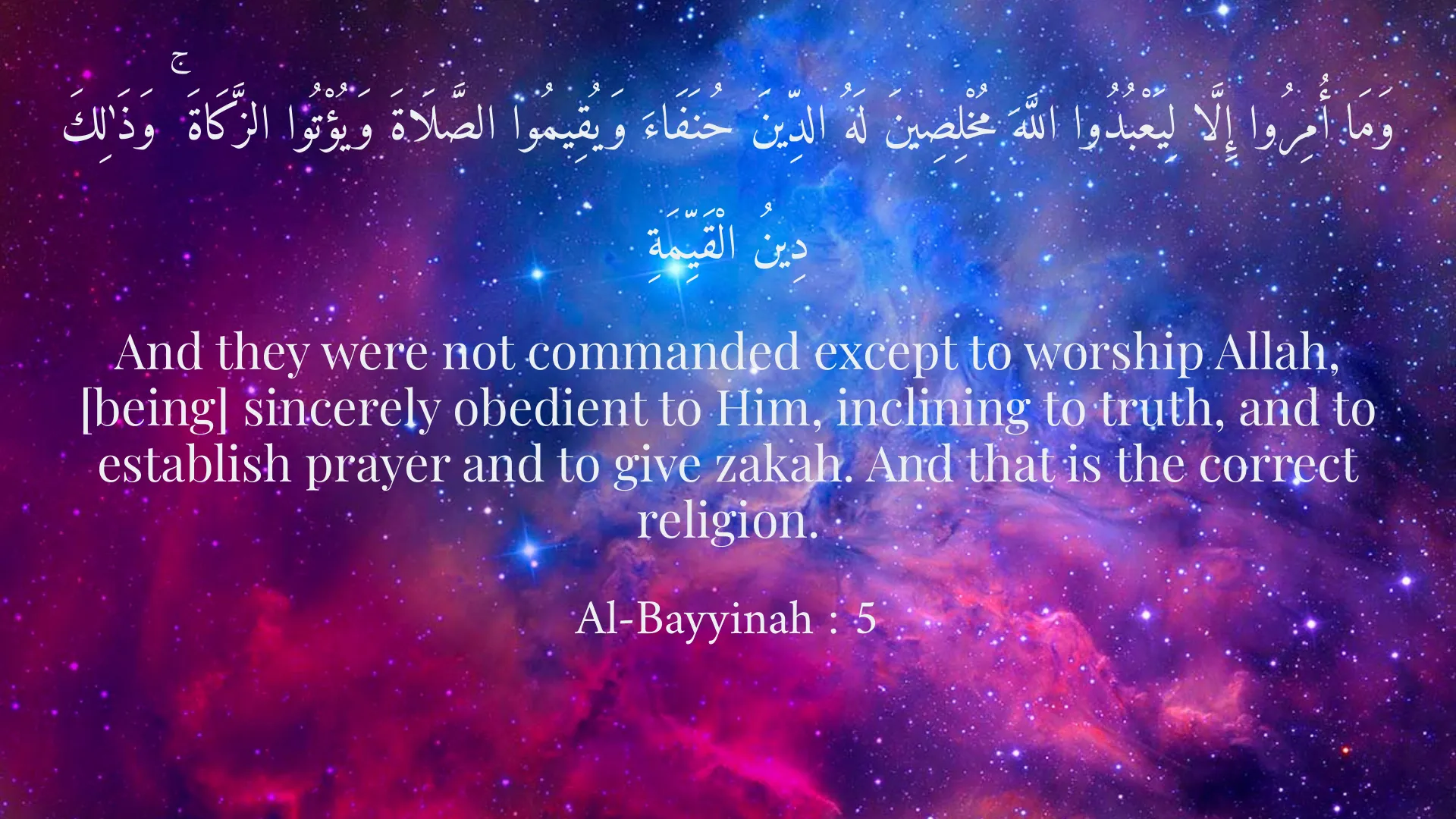
وَمَا أُمِرُوا إِلَّا لِيَعْبُدُوا اللَّهَ مُخْلِصِينَ لَهُ الدِّينَ حُنَفَاءَ وَيُقِيمُوا الصَّلَاةَ وَيُؤْتُوا الزَّكَاةَ ۚ وَذَٰلِكَ دِينُ الْقَيِّمَةِ
And they were not commanded except to worship Allah, [being] sincerely obedient to Him, inclining to truth, and to establish prayer and to give zakah. And that is the correct religion.
Al-Bayyinah : 5
إِنَّا أَنزَلْنَا إِلَيْكَ الْكِتَابَ بِالْحَقِّ فَاعْبُدِ اللَّهَ مُخْلِصًا لَّهُ الدِّينَ
Indeed, We sent down to you the Book for the people in truth. So worship Allah, [being] sincere to Him in religion.
Az-Zumar : 2
قُلْ إِنَّ صَلَاتِي وَنُسُكِي وَمَحْيَايَ وَمَمَاتِي لِلَّهِ رَبِّ الْعَالَمِينَ
Say, 'Indeed, my prayer, my rites of sacrifice, my living and my dying are for Allah, Lord of the worlds.'
Al-An'am : 162
Short Story
It is narrated that in ancient times, there lived a wealthy merchant in a city who possessed vast riches and constantly sought to leave a legacy. Whenever he performed a good deed, he would speak of it, desiring people to remember him kindly. One day, he endowed a large garden for the poor, and his deed was widely spoken of everywhere. In the same city lived an ascetic dervish who owned nothing but a worn prayer mat for worship and a few pieces of dry bread for sustenance. One day, with utmost sincerity and without anyone knowing, he donated his only prayer mat, which he greatly needed, to a mosque so that a passerby might pray upon it. A wise and pious Sheikh, who was aware of both situations, once told his students: "Do you know that the dervish's worn prayer mat, in the sight of Allah, is more valuable than the merchant's grand garden?" The students asked in astonishment, "Why, O Sheikh?" The Sheikh replied: "Because the merchant's intention was to gain people's admiration, while the dervish's intention was solely for the pleasure of the Lord. An action, no matter how great, if its intention is impure, is like a drawing on water that quickly vanishes. But if the intention is pure, even the smallest action shines like a jewel, gaining immense value in the sight of Allah and remaining eternal." This story teaches us that the measure of an action's worth is not its grandeur, but the sincerity of the intention behind it.